
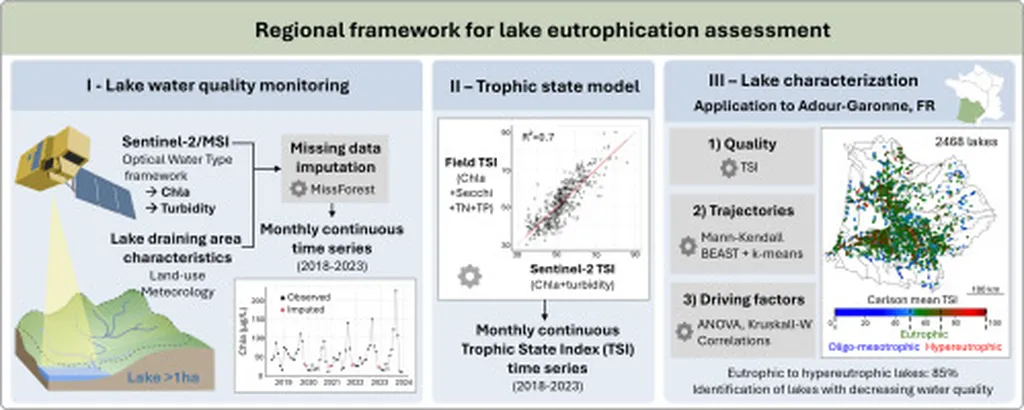
In the heart of Southwestern France, a groundbreaking study is transforming how we monitor and manage lake eutrophication, offering promising implications for agriculture and water resource management. Published in *Ecological Indicators*, the research led by Mathilde Joffre from the Centre de Recherche sur la Biodiversité et l’Environnement (CRBE) at the Université de Toulouse, introduces a novel framework that leverages Sentinel-2/MSI imagery to assess lake eutrophication at an unprecedented scale.
Eutrophication, the excessive growth of algae fueled by nutrient runoff, poses a significant threat to water quality and biodiversity. Traditional monitoring methods, which rely on field measurements, cover only a tiny fraction of lakes—just 1% in France. This gap leaves many lakes, particularly smaller ones, unmonitored and vulnerable. Joffre’s research addresses this critical gap by utilizing remote sensing technology to assess eutrophication in nearly 2,500 previously unmonitored lakes across the Adour-Garonne basin, an area spanning 118,000 square kilometers.
The study employs a sophisticated methodology that includes a missing data imputation scheme to fill gaps in monthly chlorophyll-a and turbidity time series using the MissForest method, which incorporates meteorological and land use predictors. This approach ensures continuous data collection, even for small and data-scarce lakes. The researchers then developed a satellite-derived trophic state linear model comparable to Carlson’s index, using exclusively satellite-derived chlorophyll-a and turbidity measurements.
“Our framework provides a comprehensive and scalable solution for assessing lake eutrophication,” said Joffre. “By integrating remote sensing with advanced data imputation techniques, we can now monitor lakes that were previously inaccessible, offering valuable insights for water management and agricultural practices.”
The findings reveal that over 85% of the lakes in the Adour-Garonne basin are eutrophic to hypereutrophic, with a mean Trophic State Index (TSI) of 58. The study also identified key drivers of eutrophication, including small lake size, low altitudes, and high proportions of agricultural land uses such as corn. These insights are crucial for the agriculture sector, as nutrient runoff from agricultural activities is a significant contributor to lake eutrophication.
“Understanding the spatial and temporal trends of eutrophication allows us to target specific areas for intervention,” explained Joffre. “This can help farmers adopt more sustainable practices, reducing nutrient runoff and improving water quality.”
The research not only provides continuous and categorical indicators to support the identification of priority lakes for targeted monitoring and management but also sets a precedent for future developments in the field. By demonstrating the effectiveness of remote sensing and machine learning in assessing lake health, the study paves the way for similar applications in other regions and ecosystems.
As climate change and water scarcity continue to pose challenges, innovative solutions like this are essential for preserving our natural resources. The study’s methodology, validated with high accuracy (r2 = 0.7, n = 487), offers a robust tool for environmental monitoring and management, with far-reaching implications for agriculture, water resource management, and biodiversity conservation.
For the agriculture sector, the research highlights the importance of sustainable practices and the need for targeted interventions to mitigate nutrient runoff. By adopting precision agriculture techniques and implementing best management practices, farmers can play a pivotal role in reducing eutrophication and protecting water quality.
As we look to the future, the integration of remote sensing and machine learning in environmental monitoring holds immense potential. This research, led by Mathilde Joffre and her team at the Centre de Recherche sur la Biodiversité et l’Environnement (CRBE) at the Université de Toulouse, marks a significant step forward in our ability to assess and manage lake eutrophication, offering hope for a more sustainable and resilient future.