
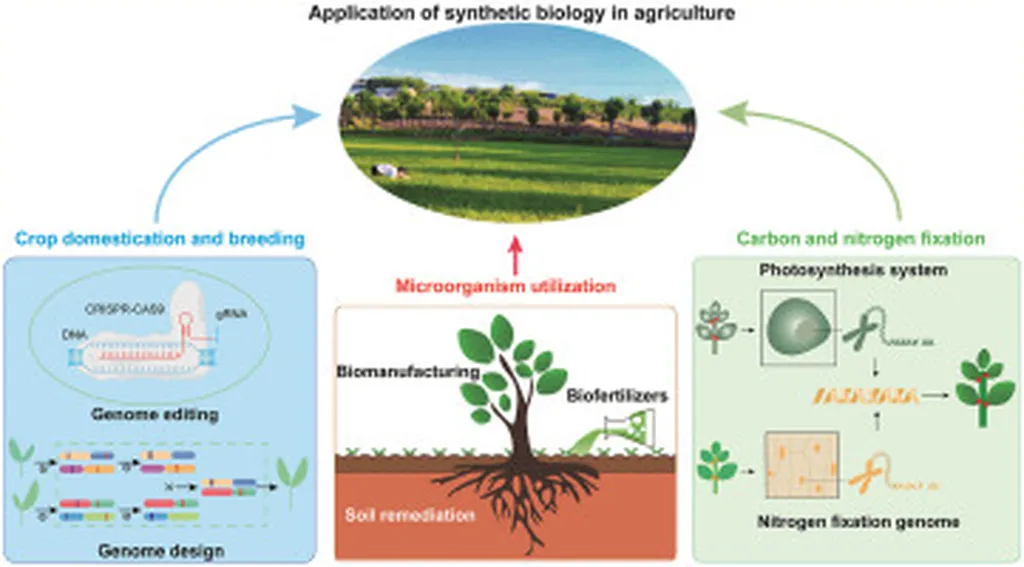
In the quest for sustainable agriculture, scientists are turning to synthetic biology to tackle one of the industry’s most persistent challenges: cellulose degradation. A recent study published in the *Journal of Animal Science and Biotechnology* sheds light on groundbreaking advancements that could revolutionize how we utilize fibrous feedstuffs, ultimately supporting a circular bioeconomy.
Cellulose, the most abundant organic polymer on Earth, is notoriously difficult to break down due to its tightly packed crystalline structure. This resistance poses significant obstacles in agriculture, where efficient cellulose digestion is crucial for sustainable livestock production. Traditional methods often fall short, hindered by low enzymatic activity and the presence of cellulase inhibitors.
Enter synthetic biology, a field that leverages molecular-level strategies to overcome these barriers. Researchers, led by Xingqi Liu from the College of Animal Science at South China Agricultural University, are engineering microbial systems with enhanced cellulose-degrading capabilities. By introducing engineered genes, synthetic regulators, and optimized enzymes, they are paving the way for more efficient biomass conversion.
“Synthetic biology offers innovative solutions to enhance cellulose degradation,” Liu explains. “Through targeted modifications at the nucleic acid and protein levels, we can develop high-performance microbial systems that significantly improve the secretion and catalytic efficiency of cellulases.”
The study highlights the use of CRISPR-Cas9 gene editing to knock out inhibitory genes and knock in activator genes, further boosting cellulase production. Additionally, the rational redesign of multi-enzyme complexes, such as cellulosomes, enhances the overall efficiency of cellulose breakdown.
The commercial implications for the agriculture sector are substantial. Improved cellulose degradation translates to better utilization of fibrous feedstuffs, reducing waste and lowering production costs. This aligns with the principles of a circular bioeconomy, where sustainable practices are paramount.
“Integrating artificial intelligence with synthetic biology allows for predictive screening and precision engineering of microbial strains,” Liu adds. “This synergy enables us to develop highly efficient cellulose-degrading systems tailored for specific agricultural applications.”
As the world grapples with the challenges of climate change and resource depletion, advancements in synthetic biology offer a beacon of hope. The research led by Liu and his team not only addresses immediate agricultural needs but also sets the stage for future developments in sustainable biomass conversion.
With the findings published in the *Journal of Animal Science and Biotechnology*, the scientific community is one step closer to unlocking the full potential of cellulose degradation, heralding a new era of efficiency and sustainability in agriculture.