
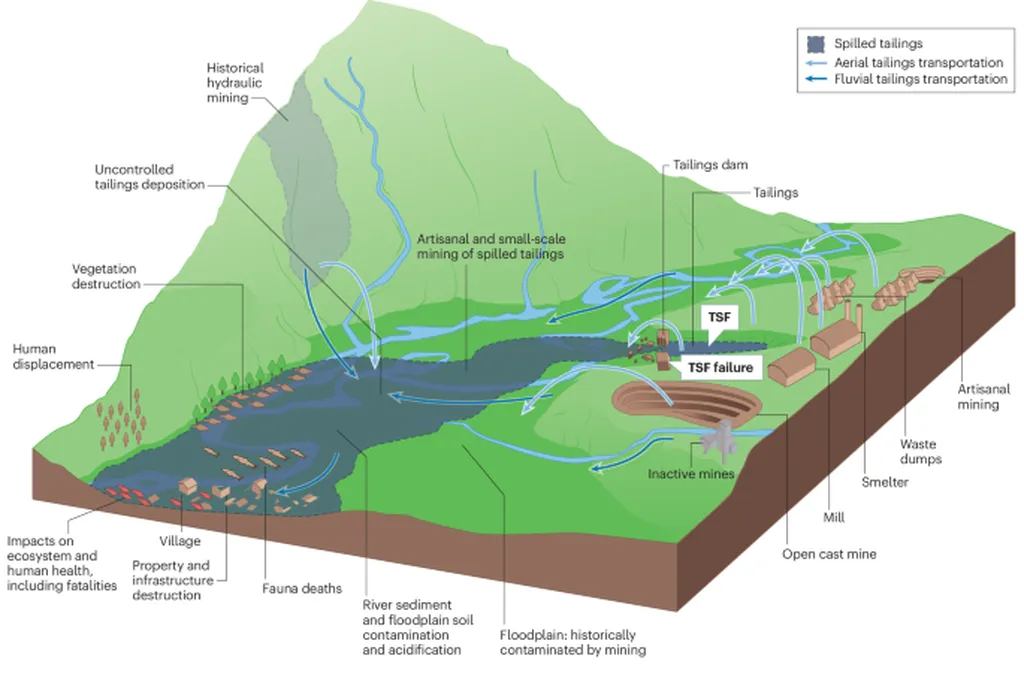
In the wake of environmental disasters, the long-term impacts on agriculture and human health often remain shrouded in uncertainty. A recent study published in *Ecological Indicators* sheds light on the enduring effects of tailings leakage and the efficacy of emergency response measures, offering valuable insights for the agritech sector. Led by Haijian Huang of the State Key Laboratory of Environmental Criteria and Risk Assessment and Liaoning University, the research employed advanced techniques to assess the spatiotemporal dynamics of pollution and health risks following a tailings spill.
The study focused on an area affected by a tailings leakage accident, collecting soil samples from agricultural and mining regions eight years post-accident. By utilizing partitioning-based Positive Matrix Factorization (PMF) coupled with Geographic Information Systems (GIS) mapping and health risk assessment models, the researchers systematically analyzed the changes in pollution levels and sources over time. “Our goal was to evaluate the long-term effectiveness of emergency measures and identify key factors for targeted remediation,” explained Huang.
The findings revealed a significant reduction in the content of harmful elements like antimony (Sb), mercury (Hg), and arsenic (As) in farmland compared to pre-spill levels. The sources of these potentially toxic elements (PTEs) shifted from being dominated by the tailings spill and agricultural activities to a more diversified mix, primarily influenced by natural background sources. This shift indicates that emergency measures implemented after the spill were effective in mitigating the spread of pollution.
One of the most striking findings was the reduction in health risks associated with the accident-affected area. The cancer risk, initially deemed unacceptable, dropped to an acceptable level over eight years, aligning with risks observed in mineral impact and normal agricultural areas. “The health risk assessment showed that ingestion was the main exposure pathway, and after eight years, the health risk from accidental spillage decreased to an acceptable level,” noted Huang.
The study also highlighted the ongoing role of agricultural activities as a significant source of arsenic, contributing substantially to health risks. This underscores the need for targeted control measures in agricultural practices to further reduce health risks. The research demonstrated that partitioning-based PMF provides more accurate source resolution results than large-scale PMF, offering a more precise tool for environmental assessment and remediation.
For the agritech sector, these findings are crucial. They emphasize the importance of effective emergency response measures and long-term monitoring to ensure the safety of agricultural lands and the health of communities. The study’s methodology and results can guide future developments in environmental risk assessment and remediation strategies, ultimately supporting more sustainable and resilient agricultural practices.
As the agritech industry continues to evolve, integrating advanced analytical techniques like partitioning-based PMF with GIS mapping can enhance our understanding of environmental impacts and inform better decision-making. This research not only provides a roadmap for addressing the aftermath of environmental accidents but also underscores the need for ongoing innovation in agricultural and environmental technologies.