
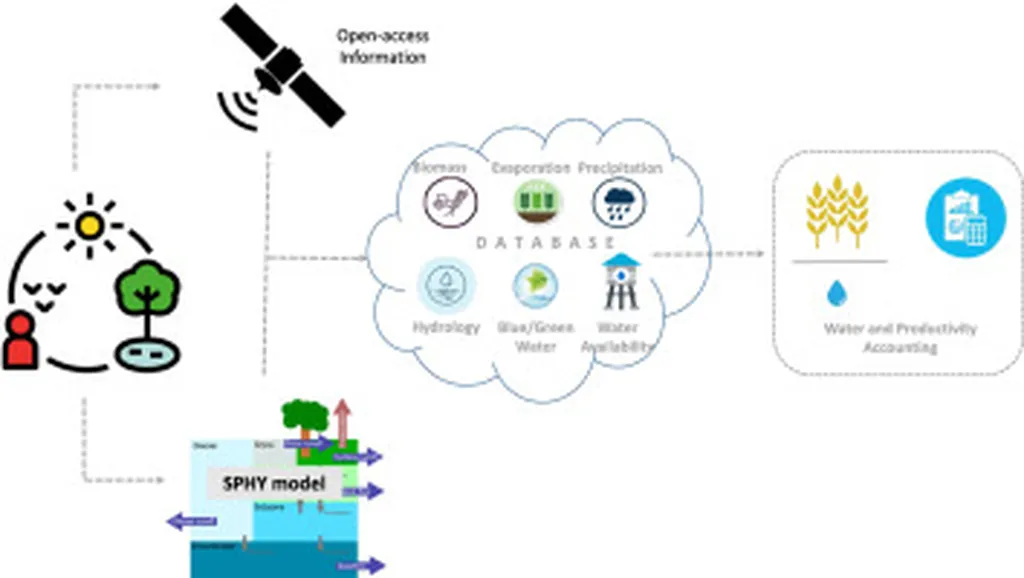
In the face of escalating water scarcity and climate variability, managing irrigation networks efficiently has become a critical challenge for sustainable agriculture. A recent study published in *Scientific Reports* offers a promising approach to this problem by applying the water accounting plus (WA+) framework to enhance irrigation management. Led by Mahkameh Sadat Naeini of the Department of Water Sciences and Engineering at Imam Khomeini International University, the research provides valuable insights into water fluxes, productivity, and spatial heterogeneity in the Qazvin Plain irrigation network.
The study analyzed data from 2009 to 2021, integrating meteorological and remote sensing data from the WaPOR database. The findings reveal that the total net inflow during this period was approximately 10,582 million cubic meters (MCM), with precipitation contributing about 20%, surface inflow around 27%, and storage changes making up the remaining 53%. This comprehensive analysis highlights the importance of understanding the various sources of water inflow to optimize irrigation practices.
One of the key findings of the study is the breakdown of evapotranspiration (ET), which is a critical component of water use in agriculture. The research shows that transpiration accounted for 80% of total ET, with 72% classified as beneficial (transpiration plus interception) and 28% as non-beneficial (soil evaporation and canopy interception). “This distinction is crucial for improving water productivity,” explains Naeini. “By focusing on beneficial transpiration, we can enhance the efficiency of water use in agriculture, which is essential for sustainable farming practices.”
The spatial analysis conducted as part of the study revealed significant variations in water availability across the irrigation network. The eastern part of the network was found to have higher water availability, while the western region experienced deficits. These findings underscore the potential for targeted interventions, such as soil moisture conservation and optimized irrigation scheduling, to improve water productivity and ensure equitable distribution of water resources.
The commercial implications of this research are substantial for the agriculture sector. By adopting the WA+ framework, farmers and irrigation managers can make data-driven decisions that enhance water use efficiency and productivity. This approach not only helps in mitigating the impacts of water scarcity but also supports sustainable agricultural practices that are resilient to climate variability.
As the agriculture sector continues to grapple with the challenges posed by climate change and water scarcity, the insights provided by this study offer a roadmap for enhancing irrigation management. The WA+ framework, with its integration of meteorological and remote sensing data, provides a powerful tool for optimizing water use and ensuring the long-term sustainability of agricultural practices. “This research demonstrates the potential of the WA+ framework to inform sustainable irrigation management in semi-arid regions,” says Naeini. “By leveraging advanced data analytics, we can make significant strides in improving water use efficiency and supporting the agriculture sector in the face of growing challenges.”
The study published in *Scientific Reports*, led by Mahkameh Sadat Naeini from the Department of Water Sciences and Engineering at Imam Khomeini International University, highlights the importance of adopting innovative approaches to irrigation management. As the agriculture sector seeks to enhance water use efficiency and productivity, the WA+ framework offers a valuable tool for achieving these goals. By integrating advanced data analytics and remote sensing technologies, farmers and irrigation managers can make informed decisions that support sustainable agricultural practices and ensure the long-term viability of the sector.