
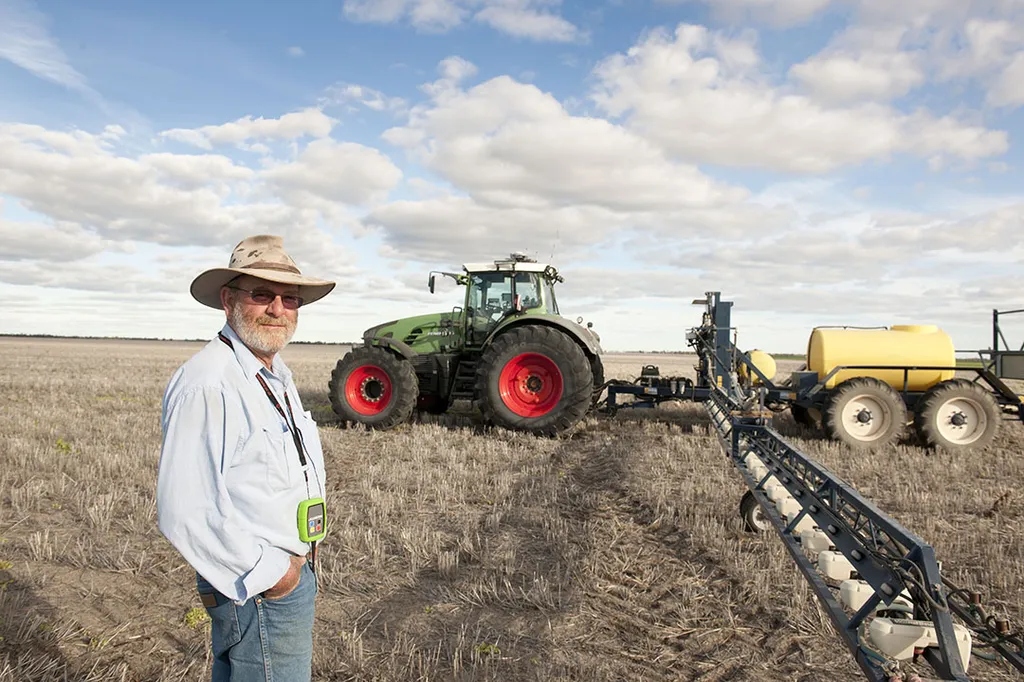
In the vast, sun-drenched landscapes north of Moree in New South Wales, Australia, Beefwood Farms has been pioneering the use of autonomous tractors for over a decade. Currently spanning more than 16,000 hectares, Beefwood Farms made history in 2015 as the first cropping farm in Australia—and likely the world—to integrate autonomous tractors into its daily operations. Gerrit Kurstjens, the visionary owner of Beefwood Farms, shares his insights and experiences navigating the challenges and triumphs of this groundbreaking technology.
The journey began with a clear objective: to minimize crop production costs. “Our main reason for using autonomous machinery is to minimize machinery costs by maximizing the output of our tractors, machines, and implements,” Kurstjens explains. “In a manned operation, we can maximize machinery utility up to some 100 hours per week. If we use autonomy, we can let our fleet operate 24/7 and thus up to 168 hours per week. That is almost 70 percent more.”
The initial foray into autonomy came with the installation of an autonomous retrofit kit from Dutch startup Probotiq on a Fendt 936 tractor. This kit, originally designed to convert fairway mowers to autonomous operation, proved to be a perfect fit for Beefwood Farms. “We had our ups and downs with the first Probotiq systems, but in hindsight, I must say the system was ideal for us and did a perfect job,” Kurstjens recalls. The success of the Fendt 936 led to the installation of similar systems on two John Deere R 8345 tractors, with plans to make the entire farm autonomous-ready.
However, the path was not without its obstacles. The technology attracted significant attention, drawing numerous tractor manufacturers to the farm. But then, the autonomy modes on the tractors suddenly stopped working. This coincided with the sale of Probotiq’s technology to John Deere in 2019, which led to the cessation of service and modifications. “John Deere confirmed they would supply us with an updated system later that year, but that did not happen,” Kurstjens laments. “We then got reimbursed for the cost under the condition that we returned all hard- and software to the supplier.”
Since then, Beefwood Farms has been on the lookout for an alternative autonomous retrofit kit that matches their needs. The search has led them back to their initial strategy of making existing tractors autonomous, this time with iQuus Autonomy from GPX Solutions. “These guys basically do the same as Probotiq used to do, but with a slight twist to prevent the technology from stopping to work once the tractor software has been updated,” Kurstjens explains.
Kurstjens emphasizes the numerous benefits of retrofitting existing machinery with autonomous technology. “Our drivers and operators know how to operate existing tractors and machinery, and they don’t have to get used to new machinery if we install an autonomous retrofit kit,” he notes. Additionally, the flexibility to switch between manned and unmanned operations is a significant advantage. “You can simply do this manually while driving and then have the tractor repeat this autonomously,” he adds.
The implications of this technology extend beyond mere efficiency. Kurstjens believes that the reluctance of major tractor manufacturers to offer autonomous solutions stems from concerns over profit margins and vendor lock-ins. “The technology is widely available and has become cheap. It can be found in drones, aviation, mining, and in the automotive industry,” he observes. “My take is that all major tractor manufacturers are able to sell autonomous tractors but don’t do so with legislation and liability as an excuse for losing margin and profit. They like to sell new tractors instead of making existing tractors autonomous.”
As Beefwood Farms revives its autonomous operations with iQuus Autonomy, the farm stands as a testament to the potential of autonomous technology in agriculture. The journey has been fraught with challenges, but the vision and determination of Gerrit Kurstjens continue to drive innovation forward, offering a glimpse into the future of farming.