
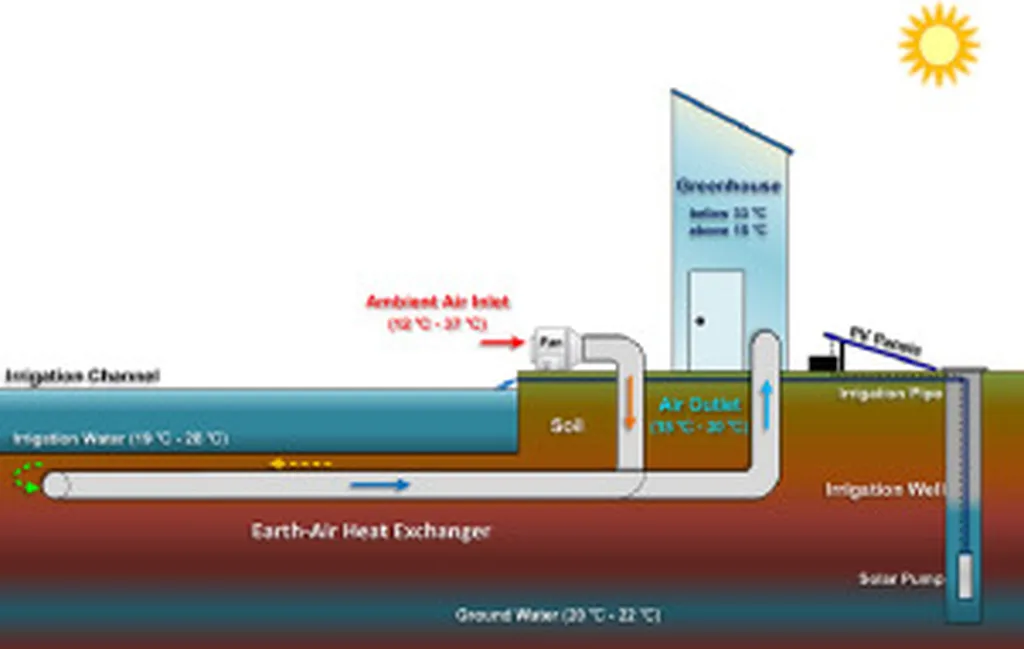
In the sweltering heart of Nigeria’s humid tropics, a groundbreaking study is offering new hope for greenhouse farmers battling excessive heat and humidity. Researchers at the University of Ibadan have turned to an age-old concept—earth-air heat exchange—to create a sustainable cooling solution for greenhouses, potentially revolutionizing agriculture in tropical regions.
The study, led by Mobolaji Omobowale and published in *Research in Agricultural Sciences*, explores the use of a ground-to-air heat exchanger (GAHE) system to cool greenhouses. This innovative approach taps into the stable temperatures found just below the Earth’s surface, providing a low-energy alternative to traditional cooling methods.
“In humid tropical climates like Ibadan, excessive heat and humidity can significantly reduce crop productivity,” Omobowale explains. “Our study demonstrates that by installing GAHE systems at a depth of 2 meters, we can achieve meaningful cooling, with average temperature reductions of nearly 3°C.”
The GAHE system consists of underground PVC pipes that draw in warm air from the greenhouse, cool it through the earth’s natural thermal mass, and then release it back into the greenhouse. The study found that pipes installed at a depth of 2 meters provided the most effective cooling, while those at 1 meter depth offered negligible benefits and sometimes even increased air temperature due to soil heat absorption.
This research is not just a scientific curiosity; it has significant commercial implications for the agriculture sector. In tropical regions, where greenhouse farming is often hampered by extreme heat, this low-energy cooling solution could boost crop yields and open up new opportunities for farmers. “This technology could be a game-changer for greenhouse agriculture in the tropics,” Omobowale says. “It’s sustainable, cost-effective, and has the potential to significantly improve crop productivity.”
The study’s findings align with previous research emphasizing the importance of depth in GAHE systems. By leveraging the stable subsurface temperatures, the system mitigates daytime thermal fluctuations and reduces the influence of solar radiation, providing a consistent cooling effect.
As the world grapples with climate change and the need for sustainable agricultural practices, this research offers a promising solution. It highlights the potential of earth-air heat exchangers to create more resilient and productive greenhouse environments, even in the most challenging climates.
The study’s results pave the way for further exploration and commercialization of GAHE systems in tropical regions. With continued research and development, this technology could become a cornerstone of sustainable agriculture, helping farmers adapt to a changing climate and secure food supplies for the future.
For now, the research led by Omobowale at the University of Ibadan serves as a beacon of hope for greenhouse farmers in the humid tropics, offering a practical and sustainable solution to the age-old problem of excessive heat and humidity.