
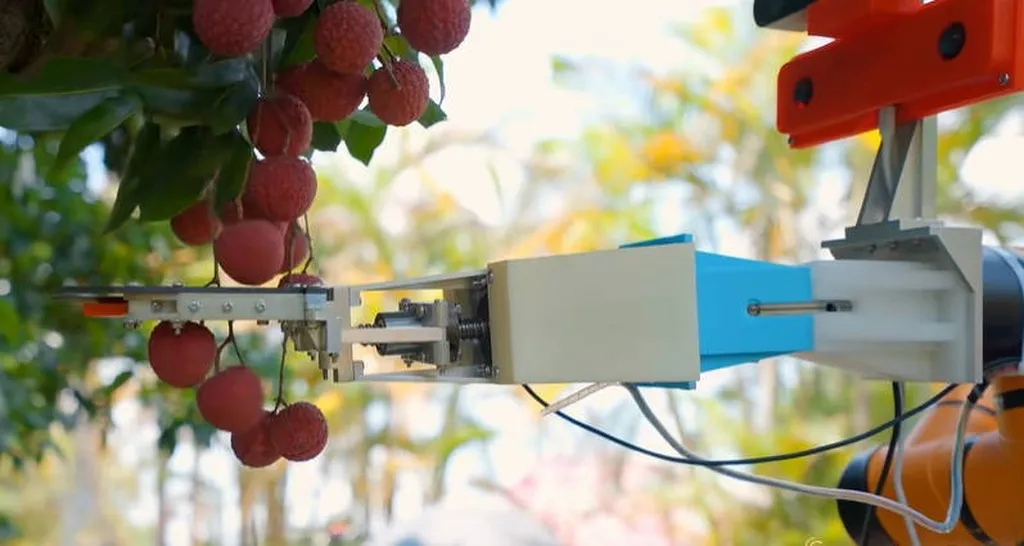
In the sprawling orchards of China, a technological revolution is brewing, one that could reshape the future of fruit picking and bolster the agriculture sector. Researchers have developed a sophisticated system that enhances the visual perception and decision-making capabilities of fruit-picking robots, addressing long-standing challenges in the industry.
The study, published in the journal ‘Machines’ and led by Yunhe Zhou from the School of Technology at Beijing Forestry University, focuses on litchi-picking robots. These robots often struggle with illumination variations, low recognition accuracy, complex maturity judgment, and occlusion, leading to inaccurate fruit localization. To tackle these issues, the researchers proposed an embodied perception mechanism based on “perception-reasoning-execution.”
At the heart of this innovation is a Y-LitchiC instance segmentation method, which achieves high-precision segmentation of litchi clusters. “This method significantly improves the mean average precision (mAP) by 1.6% compared with the YOLOv11s-seg model,” explains Zhou. This enhanced accuracy is a game-changer for the agriculture sector, where precision and efficiency are paramount.
But the breakthroughs don’t stop there. The researchers also introduced a generative artificial intelligence model to intelligently assess fruit maturity and occlusion, providing crucial support for automatic picking. This AI model offers higher-level reasoning and decision-making capabilities, enabling the robot to make dynamic harvesting decisions based on the orchard’s complex environment.
For unoccluded main fruit-bearing branches, the robot uses a skeleton thinning algorithm within the segmented region to extract the skeleton line. The midpoint of the skeleton is then used to perform the first type of localization and harvesting decision. For occluded branches, the robot employs threshold-based segmentation combined with maximum connected component extraction to obtain the target region, followed by skeleton thinning, completing the second type of dynamic picking decision.
The implications for the agriculture sector are profound. As the global population grows, so does the demand for efficient and sustainable food production. Automating the fruit-picking process not only increases productivity but also reduces labor costs and minimizes fruit damage. “This research provides a reliable theoretical basis and technical support for accurate fruit localization and precision picking,” says Zhou.
The study’s findings could pave the way for future developments in agricultural robotics. As generative AI models continue to evolve, we can expect even more sophisticated decision-making capabilities in robots, further enhancing their performance in complex environments. This could lead to a new era of smart farming, where robots work alongside humans to optimize crop yield and quality.
In the meantime, the litchi-picking robot developed by Zhou and his team stands as a testament to the power of innovation in agriculture. With its enhanced visual perception and decision-making capabilities, it is poised to revolutionize the way we pick fruit, one litchi at a time.