
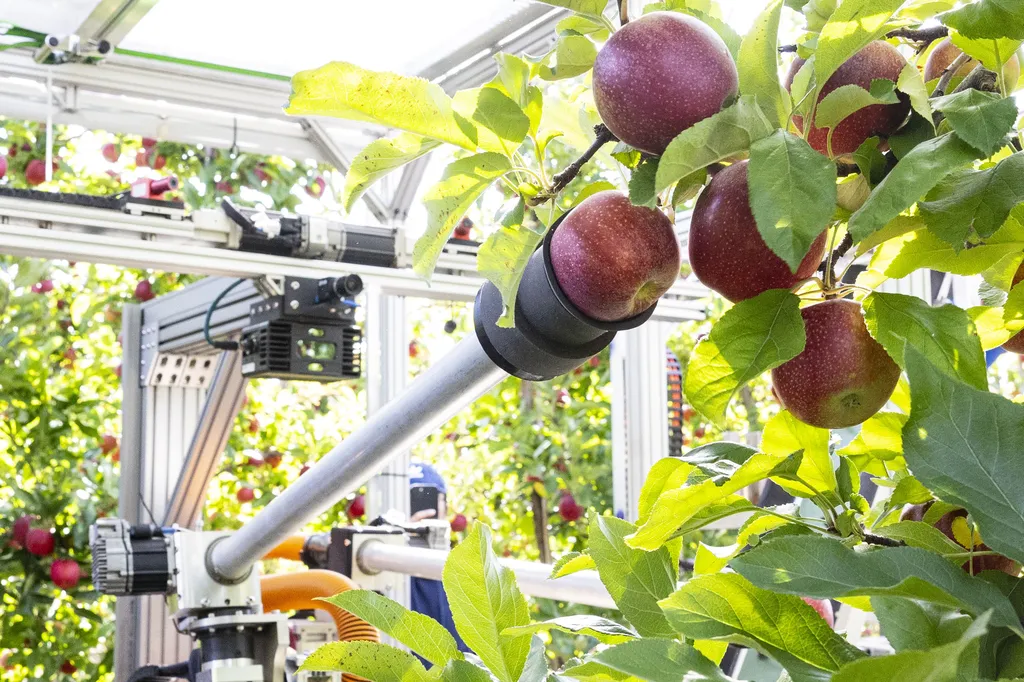
In the heart of China’s agricultural innovation, researchers have taken a significant stride towards automating one of the most labor-intensive tasks in orchard management: apple picking. A novel end-effector, designed by Zeyi Li and colleagues at Shihezi University, promises to revolutionize the way we approach robotic fruit harvesting, with implications that could resonate throughout the global agriculture sector.
The challenge of non-destructive apple harvesting has long perplexed engineers. Apples, with their delicate skin and varied sizes, require a gentle yet firm grip to avoid bruising or damage. Traditional robotic grippers often struggle with this balance, leading to significant post-harvest losses. Enter Li’s team, who have developed an underactuated rigid–flexible coupled end-effector that adapts to the size and shape of the fruit, ensuring a secure grasp without causing harm.
The key to their success lies in a sophisticated design that integrates an underactuated mechanism with a real-time force feedback control system. “Our end-effector mimics the human hand’s ability to adapt to different shapes and sizes,” explains Li. “By optimizing the geometric parameters and employing a rigid–flexible coupled dynamic simulation, we’ve created a gripper that distributes force evenly, minimizing the risk of damage.”
The team’s compression tests on ‘Red Fuji’ apples revealed a critical threshold: any force exceeding 24.33 N risked damaging the fruit. Through a series of simulations and real-world experiments, they demonstrated that their end-effector could maintain contact forces well below this threshold, regardless of the apple’s size. The results were impressive, with an average enveloping time of just 1.30 seconds and a mean absolute percentage error (MAPE) of less than 6% between simulations and actual performance.
The commercial implications of this research are substantial. As labor costs rise and workforce availability dwindles, automation offers a compelling solution for the agriculture sector. “This technology has the potential to transform apple harvesting,” says Li. “By reducing post-harvest losses and improving efficiency, it could significantly enhance the profitability of orchards worldwide.”
Beyond apples, the principles behind this end-effector could be applied to other delicate fruits and vegetables, opening up new avenues for innovation in agricultural robotics. The research, published in the journal ‘Agriculture’, represents a significant step forward in the quest for sustainable, efficient, and non-destructive harvesting methods.
As the agriculture sector continues to grapple with the challenges of a changing climate and evolving labor markets, innovations like Li’s end-effector offer a beacon of hope. By harnessing the power of advanced materials, smart design, and real-time feedback, we can create a future where technology and agriculture coexist harmoniously, benefiting producers, consumers, and the environment alike.