
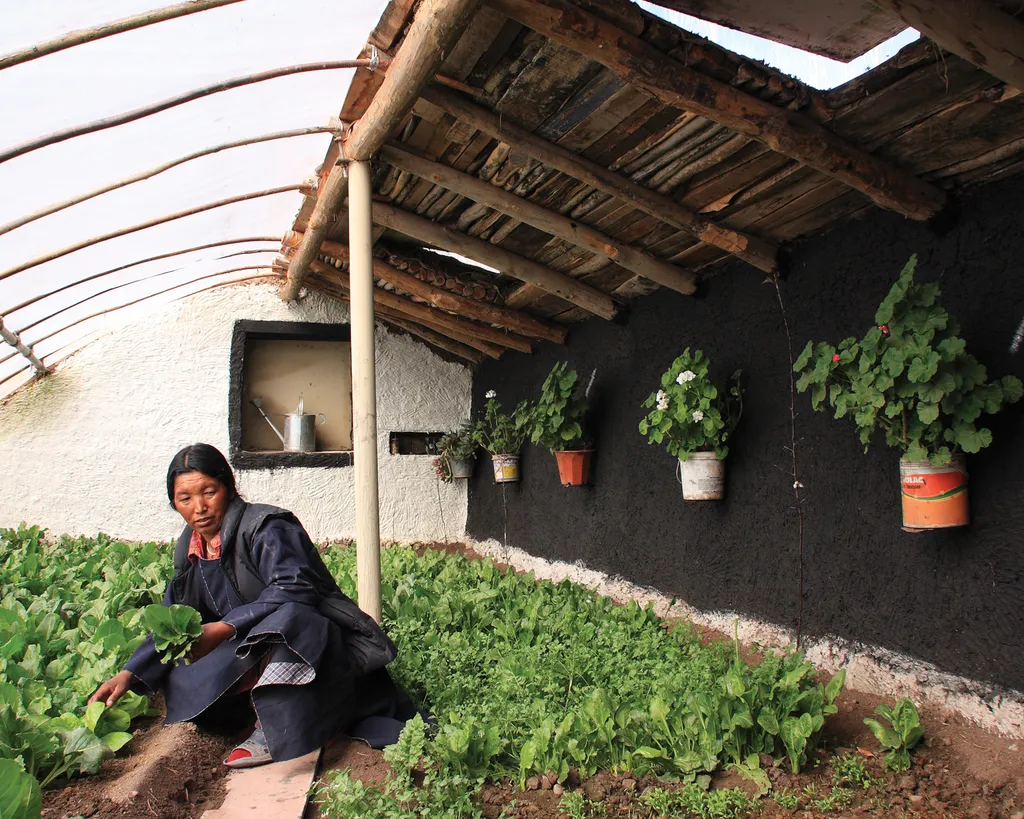
In the heart of winter, when frost paints the landscape white, solar greenhouses face a formidable challenge: maintaining the warmth necessary for crop growth. A recent study published in *Agriculture* offers a promising solution, combining computational fluid dynamics (CFD) and machine learning (ML) to optimize an auxiliary biomass heating system for solar greenhouses. This innovative approach could revolutionize cold-climate agriculture, enhancing efficiency and productivity.
The research, led by Zhanyang Xu from the College of Water Conservancy at Shenyang Agricultural University in China, focuses on the critical task of maintaining adequate root-zone temperatures during extreme cold. The study employs an integrated methodology that merges orthogonal experimental design, CFD simulation, and ML surrogate modeling to evaluate and optimize the heating performance of a biomass system.
“Our goal was to find the most effective layout for the heating system to ensure uniform and efficient warming of the root zone,” Xu explains. The team first developed a reliable CFD model, validated against experimental data, to generate high-fidelity temperature field data for nine different layout schemes. Parameter sensitivity analysis revealed that the burning cave diameter is the most influential factor, followed by burial depth, with inter-pool spacing having the least impact.
The study then compared six ML algorithms to find the best predictive surrogate model. Lasso Regression emerged as the top performer, with an impressive R² value of 0.934. The comprehensive optimization focused on maximizing the Suitable Area Ratio (Rs) in the critical 0.2 m depth root zone. The analysis identified the 2.5 m diameter group as optimal, achieving a maximum Rs of 90% and the lowest temperature standard deviation.
The final recommended design—a 2.5 m diameter, 0.7 m depth, and 10 m spacing—significantly improves heating uniformity and efficiency. This integrated CFD-ML approach not only provides a scientific basis for the design and structural optimization of similar underground thermal systems but also offers a rapid assessment tool for the agriculture sector.
The commercial implications of this research are substantial. By optimizing the biomass heating system, farmers can reduce energy costs and improve crop yields, even in the coldest months. The study’s findings could pave the way for more sustainable and efficient agricultural practices, particularly in regions where extreme cold poses a significant challenge.
“This research is a game-changer for cold-climate agriculture,” says Xu. “It provides a robust framework for optimizing heating systems, ensuring that crops can thrive even in the harshest winter conditions.”
As the agriculture sector continues to seek innovative solutions to enhance productivity and sustainability, this study offers a promising path forward. By leveraging advanced technologies like CFD and ML, farmers can achieve better control over their growing environments, ultimately leading to more resilient and profitable operations. The integration of these technologies not only optimizes resource use but also sets a new standard for precision agriculture in cold climates.
The research published in *Agriculture* and led by Zhanyang Xu from the College of Water Conservancy at Shenyang Agricultural University highlights the potential of combining cutting-edge technologies to address longstanding challenges in agriculture. As the sector continues to evolve, such interdisciplinary approaches will be crucial in driving innovation and ensuring food security in the face of a changing climate.