
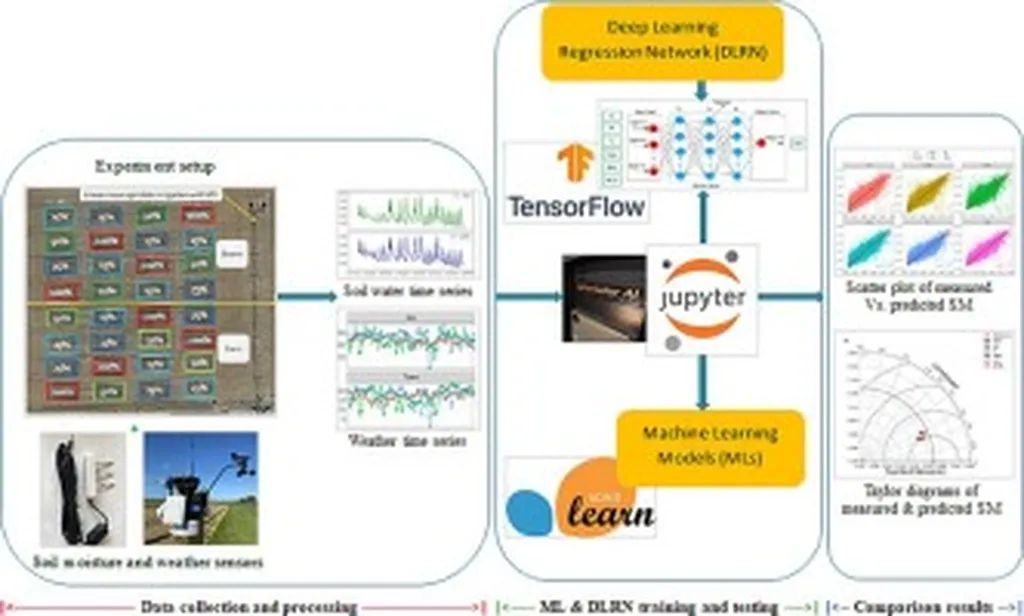
In the quest to optimize water resource management and bolster precision agriculture, a groundbreaking study published in *Barekeng* has introduced a novel approach to predicting soil moisture using advanced deep learning techniques. Led by Jemsri Stenli Batlajery from the School of Data Science at IPB University, Indonesia, the research leverages Long Short-Term Memory (LSTM) and Gated Recurrent Unit (GRU) algorithms to forecast daily soil moisture with remarkable accuracy. This innovation holds significant promise for the agriculture sector, where water efficiency and predictive insights can translate into substantial economic benefits.
Soil moisture is a critical factor in agricultural productivity, influencing everything from crop yields to irrigation strategies. By accurately predicting soil moisture levels, farmers can make informed decisions about water usage, potentially reducing waste and enhancing crop health. The study’s findings suggest that the multivariate GRU model, which incorporates multiple climate variables, offers the highest accuracy and stability for medium- to long-term forecasting. “The multivariate GRU model demonstrates superior performance, making it a reliable tool for farmers and water resource managers,” Batlajery noted. This model’s ability to integrate various climate data points could revolutionize how agriculturalists approach water management, particularly in regions prone to drought or erratic weather patterns.
The research also highlights the efficiency of the univariate LSTM model, which excels in training speed, making it ideal for daily predictions. This dual approach provides flexibility, allowing farmers to choose the model that best fits their specific needs. “The univariate LSTM model is particularly useful for daily predictions, offering a quick and efficient solution for immediate decision-making,” Batlajery explained. This efficiency could be a game-changer for small-scale farmers who need rapid insights to optimize their water usage and crop management practices.
The commercial implications of this research are vast. Precision agriculture, a rapidly growing field, relies heavily on data-driven insights to maximize productivity and minimize resource waste. By adopting these deep learning models, farmers can achieve more precise irrigation schedules, reduce water costs, and improve overall crop yields. This could lead to significant economic gains, particularly in regions where water scarcity is a pressing issue.
Looking ahead, the study suggests several avenues for future research. Testing the models in different regions and under extreme climate conditions could further validate their robustness and applicability. Additionally, applying transfer learning in data-scarce areas could expand the models’ reach, making them accessible to a broader range of agricultural contexts. “Future research should focus on testing these models in various environments and exploring transfer learning to enhance their applicability,” Batlajery said.
In conclusion, this research represents a significant step forward in the field of agritech, offering powerful tools for predicting soil moisture and optimizing water resource management. As the agriculture sector continues to evolve, the integration of deep learning models like LSTM and GRU could play a pivotal role in shaping a more sustainable and efficient future for farming. The study, published in *Barekeng* and led by Jemsri Stenli Batlajery from the School of Data Science at IPB University, Indonesia, underscores the transformative potential of these technologies and sets the stage for further innovation in the field.