
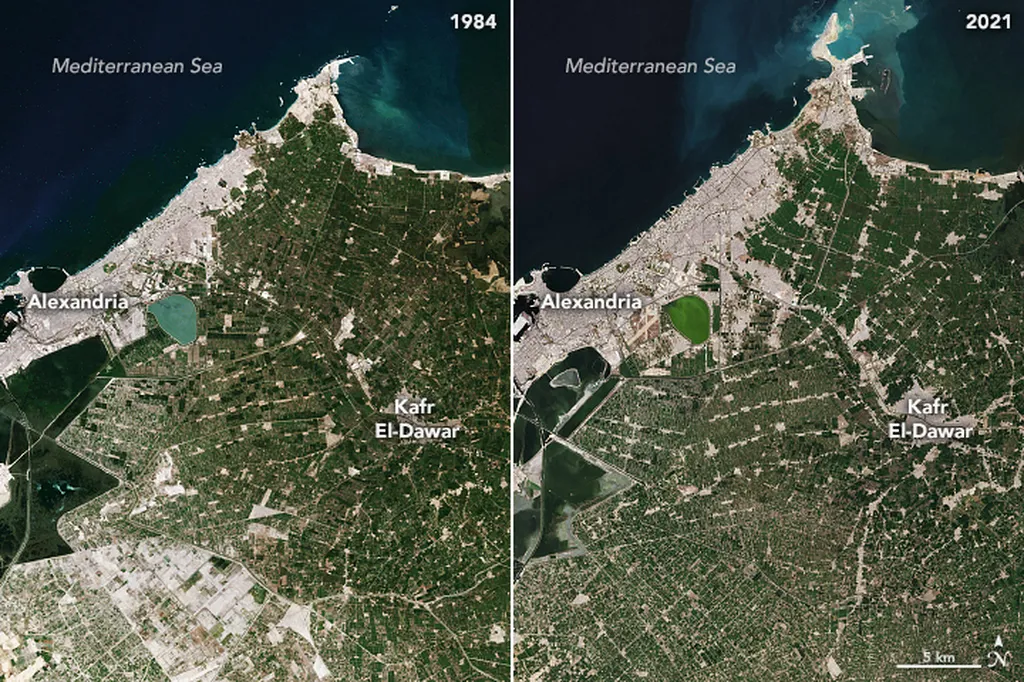
In the heart of Egypt’s Nile Delta, a silent transformation is underway, one that could reshape the agricultural landscape and economic future of the region. A recent study published in the *Arab Universities Journal of Agricultural Sciences* has uncovered significant changes in land use and land cover (LULC) in Kafr El-Sheikh Governorate, with profound implications for vegetation, land surface temperature, and, crucially, the agricultural sector.
Led by Abdelrahman Saleh from the Soil and Water Science Department at Ain Shams University, the research analyzed multi-temporal Landsat images to track environmental changes from 2000 to 2025. The findings are stark: a substantial decrease in vegetation cover and bare soil, accompanied by a notable expansion of urban areas. “We observed a significant reduction in vegetation cover by 254 km² and bare soil by 230 km², while urban areas increased by 409 km²,” Saleh explained. “This shift is primarily driven by the conversion of fertile farmland into urban spaces.”
The study employed remote sensing indices such as the normalized difference vegetation index (NDVI) and land surface temperature (LST) to measure these changes. The results revealed a consistent negative correlation between NDVI and LST, indicating that vegetation cover plays a pivotal role in regulating surface temperature. “The correlation coefficients ranged from -0.58 to -0.75, suggesting that as vegetation decreases, land surface temperatures rise,” Saleh noted.
The implications for the agricultural sector are significant. Urban expansion and the conversion of farmland threaten regional food security and the sustainable management of the Nile Delta ecosystem. To forecast future trends, the researchers employed Markov Chain modeling to simulate LULC changes up to 2050. The model predicts further urban expansion by 3% and an increase in fish farming by 2%, leading to a 5% reduction in agricultural land.
These projections highlight the urgent need for sustainable land management practices. “Our findings underscore the importance of balancing urban development with the preservation of agricultural land,” Saleh emphasized. “Without intervention, the continued loss of farmland could have severe economic and environmental consequences.”
The study’s insights are particularly relevant for policymakers, agricultural stakeholders, and urban planners. By understanding the dynamics of LULC changes, they can develop strategies to mitigate the negative impacts on the agricultural sector and ensure the long-term sustainability of the Nile Delta ecosystem.
As the region grapples with these challenges, the research by Saleh and his team serves as a critical wake-up call. It underscores the need for proactive measures to protect agricultural land and promote sustainable urban development. The future of the Nile Delta’s agricultural sector hangs in the balance, and the time to act is now.