
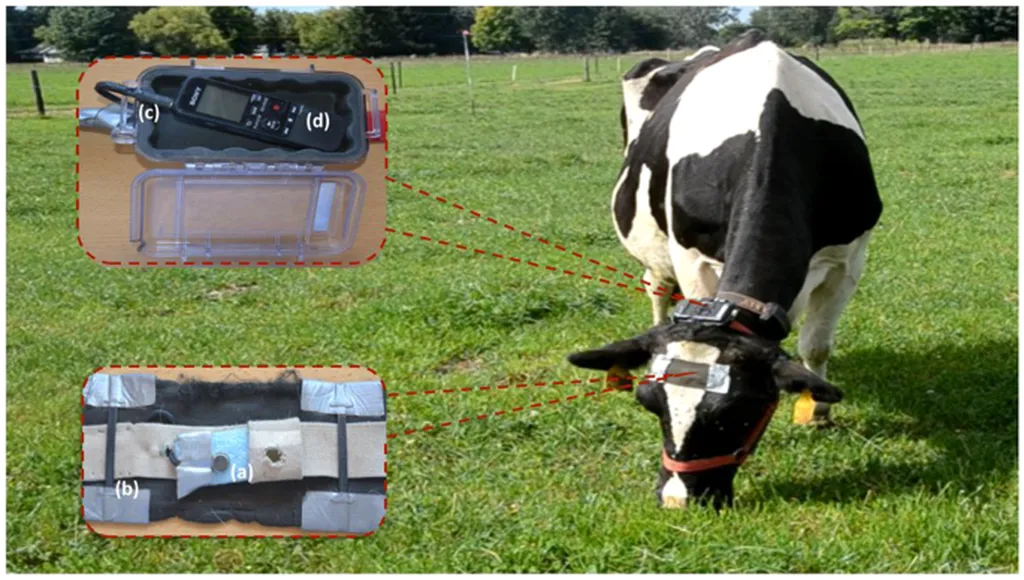
In the sprawling landscapes where goats browse, a silent revolution is underway, one that could transform how we understand and manage agricultural ecosystems. Researchers, led by Shilo Navon from the Department of Natural Resources at the Agricultural Research Organization (ARO) in Israel, have turned their attention to the symphony of sounds produced during grazing. Their findings, published in the journal ‘Sensors’, offer a promising new method for quantifying herbage intake in browsing goats, a challenge that has long perplexed the agricultural sector.
The study, titled “From Chew Counts to Intake Amounts: An Evaluation of Acoustic Sensing in Browsing Goats,” delves into the intricate process of herbage comminution—the breakdown of plant material in the mouth. By attaching acoustic sensors to the horns of six goats, the researchers were able to capture the sound bursts generated with each chew. This data was then analyzed to determine the relationship between chewing effort, bite mass, and satiety levels.
“Herbage intake is a fundamental aspect of agricultural ecosystems, but it’s notoriously difficult to quantify,” Navon explained. “Our study shows that acoustic monitoring can provide a reliable and non-invasive way to estimate intake amounts, which could have significant implications for the industry.”
The experiments involved presenting goats with hand-constructed patches of carob leaflets of predetermined mass. In the first experiment, the researchers varied the bite mass and total intake levels to determine the chewing effort and the sequence of bites and chews. They found that the global chewing coefficient was approximately 4 chews per gram of fresh mass ingested, or about 10 chews per gram of dry matter. Interestingly, while the chewing coefficient was fairly stable for individual animals, there was a large variation between different goats.
In the second experiment, the researchers controlled the feeding regime to achieve different levels of satiety. They discovered that the chewing coefficient remained stable for individual animals, although the chewing effort was slightly elevated at low satiety levels. When the data from both experiments were pooled and analyzed using inverse regression, the researchers found that the two-sided 95% confidence interval of the predicted intake of carob leaves was less than 10% of the predicted value. This level of precision is promising for the future potential of acoustic monitoring in estimating herbage intake.
The commercial impacts of this research could be substantial. Accurate estimation of herbage intake is crucial for optimizing feeding strategies, improving animal health, and enhancing overall productivity. By providing a non-invasive and reliable method for monitoring intake, acoustic sensing could revolutionize the way farmers and researchers approach grazing management.
“Usefully precise intake predictions should be attainable for the tested vegetation if chewing coefficients can be estimated locally,” Navon noted. “This could lead to more efficient use of resources and better outcomes for both animals and farmers.”
While the study highlights the potential of acoustic monitoring, it also acknowledges the significant challenges that remain. Further research is needed to refine the technology and adapt it for use in diverse agricultural settings. However, the findings represent a significant step forward in the quest to understand and manage grazing ecosystems more effectively.
As the agricultural sector continues to evolve, the integration of advanced technologies like acoustic sensing could play a pivotal role in shaping the future of farming. By harnessing the power of sound, researchers and farmers alike can gain deeper insights into the complex dynamics of grazing, paving the way for more sustainable and productive agricultural practices.