
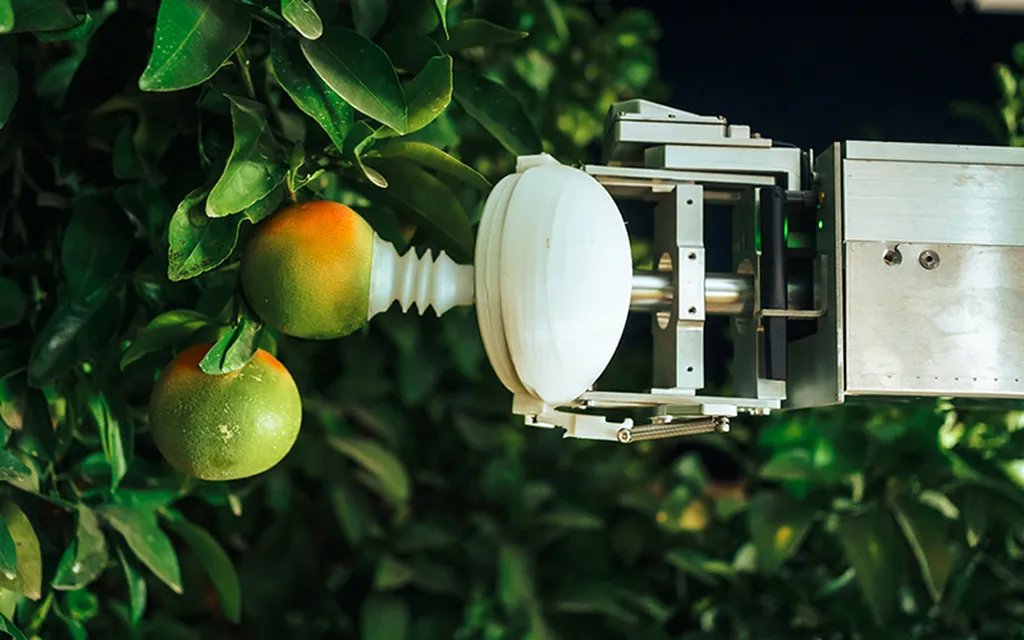
In the ever-evolving landscape of agricultural technology, a groundbreaking development has emerged from the College of Information and Intelligent Science and Technology at Hunan Agricultural University. Researchers, led by Zhiqin Wang, have introduced ACDNet, a novel deep learning framework designed to revolutionize citrus detection and robotic harvesting. This innovation, published in the journal *Agriculture*, promises to address the complex challenges of citrus detection in diverse orchard environments, potentially transforming the agricultural sector.
ACDNet stands out due to its three key innovations: the Citrus-Adaptive Feature Extraction (CAFE) module, the Dynamic Multi-Scale Sampling (DMS) operator, and the Fruit-Shape Aware IoU (FSA-IoU) loss function. These components work in tandem to enhance feature representation, suppress background interference, and improve localization accuracy. “The CAFE module combines fruit-aware partial convolution with illumination-adaptive attention mechanisms, significantly improving feature extraction efficiency,” explains Wang. This adaptability is crucial for navigating the varied conditions of orchards, from differing lighting conditions to varying levels of fruit occlusion.
The DMS operator further refines the process by adaptively focusing on fruit regions, while the FSA-IoU loss function incorporates citrus morphological priors and occlusion patterns to boost detection precision. The results are impressive: ACDNet achieves a mean average precision ([email protected]) of 97.5%, with a precision of 92.1% and recall of 92.8%, all while maintaining real-time inference at 55.6 FPS. Compared to the baseline YOLOv8n model, ACDNet shows marked improvements in [email protected], precision, and recall, while reducing model parameters by 11% and computational cost by 20%.
The implications for the agricultural sector are profound. Automated citrus harvesting has long been a goal for farmers seeking to increase efficiency and reduce labor costs. ACDNet’s ability to operate in real-time with high accuracy makes it a promising candidate for deployment in robotic harvesting systems. “This technology has the potential to significantly enhance the productivity and profitability of citrus orchards,” says Wang. By automating the harvesting process, farmers can reduce labor expenses and improve the consistency of their yields, ultimately leading to better market outcomes.
Beyond citrus, the research team envisions extending ACDNet to other spherical fruits, broadening its applicability across the agricultural spectrum. Future work will also focus on testing the model’s performance under extreme weather conditions, ensuring its robustness in real-world scenarios.
The development of ACDNet represents a significant step forward in the integration of deep learning and computer vision technologies into agricultural practices. As the agricultural sector continues to embrace technological advancements, innovations like ACDNet will play a pivotal role in shaping the future of farming. With its superior performance and adaptability, ACDNet is poised to become a cornerstone of modern agricultural robotics, driving efficiency and sustainability in the years to come.