
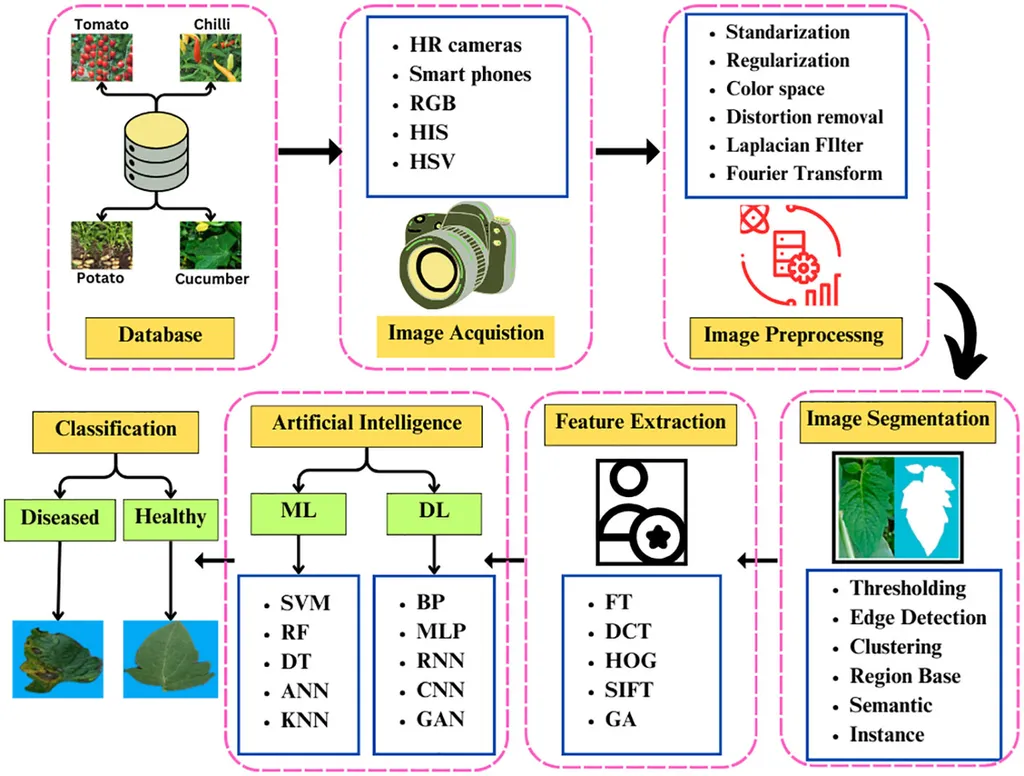
In the ever-evolving landscape of precision agriculture, a novel approach to plant disease detection is making waves, promising to revolutionize how farmers monitor and protect their crops. Researchers have developed a hybrid AI model that combines traditional machine learning with deep learning, significantly boosting computational efficiency and interpretability. This innovative solution, detailed in a study published in *PLoS ONE*, addresses the critical challenge of class imbalance in plant disease detection, where healthy leaves far outnumber diseased ones.
The study, led by Md Abdullah Al Kafi, introduces an iterative, two-stage process that first uses a lightweight classifier to quickly filter out healthy leaves. This preliminary step drastically reduces the number of leaves that need to be analyzed by more computationally intensive deep learning models, which then identify specific diseases. “By separating the healthy leaves early on, we minimize the computational load while maintaining high accuracy,” explains Al Kafi. This approach not only saves time and resources but also makes real-time disease detection feasible for farmers, even on entry-level hardware.
One of the standout features of this research is its use of Explainable AI (XAI) methods, particularly Gradient-weighted Class Activation Mapping (Grad-CAM). This technique generates heatmaps that highlight the areas of an image most influential in the model’s predictions. “These heatmaps provide transparency and help refine the feature extraction process, making the model more trustworthy and interpretable,” says Al Kafi. This transparency is crucial for gaining the trust of farmers and agronomists, who need to understand and rely on the technology’s recommendations.
The commercial implications of this research are substantial. Traditional deep learning models, while powerful, often require significant computational resources and time, making them less practical for real-time applications in the field. The hybrid model proposed by Al Kafi and his team offers up to 77.6% faster inference with only about 3% accuracy loss. In a large-scale test involving 1,227 images, the hybrid model reduced the total inference time from 4,548 seconds to just 1,010.13 seconds on an entry-level laptop, with minimal CPU load. This efficiency could translate into faster decision-making for farmers, allowing them to take timely action to prevent the spread of diseases and minimize crop losses.
The study’s findings suggest a promising future for AI in agriculture. As the technology becomes more efficient and interpretable, it could pave the way for widespread adoption in precision agriculture. Farmers could benefit from real-time, on-site disease detection, enabling them to apply targeted treatments and reduce the use of broad-spectrum pesticides. This not only improves crop yields but also promotes more sustainable farming practices.
Moreover, the integration of XAI methods could set a new standard for AI applications in agriculture. As farmers become more comfortable with AI-driven tools, the demand for transparent and interpretable models is likely to grow. This research could inspire further developments in explainable AI, leading to more trustworthy and effective agricultural technologies.
In conclusion, the hybrid AI model developed by Al Kafi and his team represents a significant step forward in plant disease detection. By addressing the challenges of class imbalance, optimizing computational efficiency, and incorporating explainable AI, this research offers a scalable, sustainable, and trustworthy solution for precision agriculture. As the technology continues to evolve, it has the potential to transform the way farmers monitor and protect their crops, contributing to a more efficient and sustainable agricultural future.