
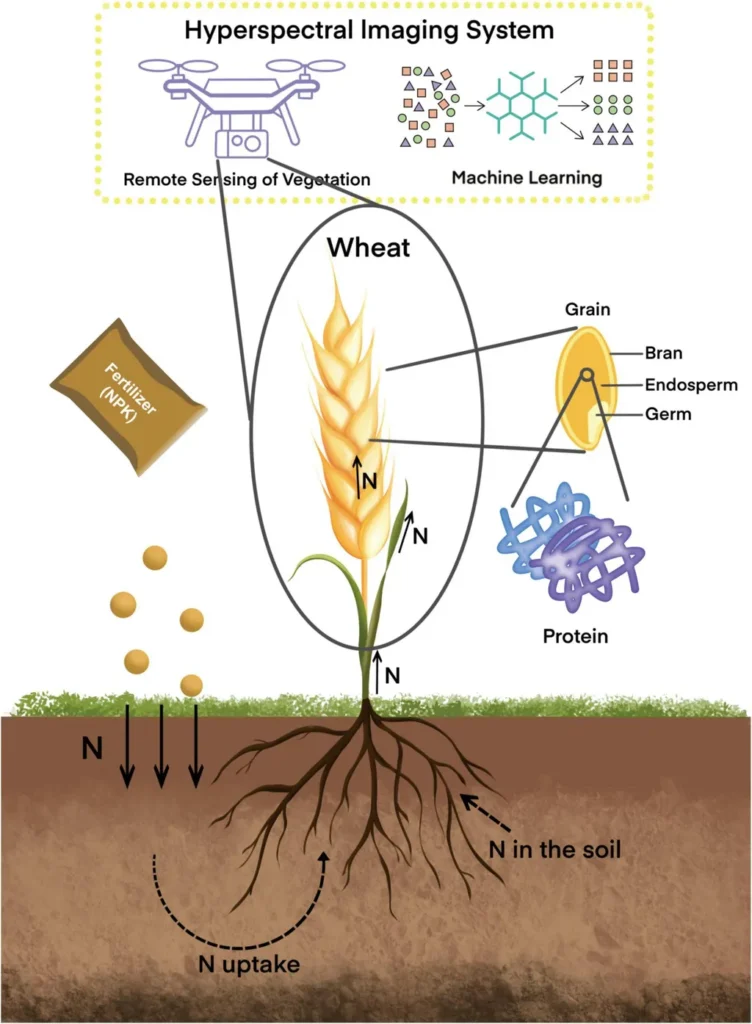
In the quest for precision agriculture, researchers have long sought ways to accurately estimate crop yields, a critical factor for food security and efficient farm management. A recent study published in *Agronomy* offers a promising approach by combining hyperspectral remote sensing and machine learning, potentially revolutionizing how farmers and agronomists predict winter wheat yields.
The study, led by Xuebing Wang from the College of Agriculture at Shanxi Agricultural University, leverages hyperspectral data collected during the critical growth stages of winter wheat. By calculating 18 vegetation indices (VIs) and analyzing their correlation with yield, the researchers identified key growth stages—flowering and grain-filling—where the highest correlations were observed. “The flowering and grain-filling stages are crucial for yield determination,” Wang explained. “Our findings show that these stages provide the most reliable data for accurate yield estimation.”
The research employed a continuous projection algorithm, Successive Projections Algorithm (SPA), to screen characteristic bands and Recursive Feature Elimination (RFE) to select optimal features from VIs and spectral bands. This multi-temporal fusion approach significantly improved the accuracy of yield estimation. Among the four machine learning models tested—Deep Forest (DF), Support Vector Regression (SVR), Random Forest (RF), and Gaussian Process Regression (GPR)—the DF model, when combined with features from the flowering and filling stages, performed best, achieving an R2 of 0.786, an RMSE of 641.470 kg·hm−2, and an rRMSE of 15.67%.
The implications for the agriculture sector are substantial. Accurate yield estimation allows farmers to make informed decisions about resource allocation, harvesting, and marketing, ultimately enhancing profitability and sustainability. “This method provides a robust tool for precision agriculture,” Wang noted. “By integrating data from different growth stages, we can offer farmers a more comprehensive and reliable yield prediction.”
The study’s findings suggest that combining hyperspectral data and VIs from various growth stages offers complementary information, paving the way for more accurate and timely yield estimates. This approach could be particularly beneficial for large-scale farms and agricultural cooperatives, where timely and precise data can drive operational efficiency and strategic planning.
As the agriculture industry continues to embrace technological advancements, research like this underscores the potential of integrating remote sensing and machine learning to address critical challenges. The study’s methodology and results provide a foundation for future developments in precision agriculture, offering a glimpse into a future where data-driven decisions are the norm.
For the agriculture sector, the commercial impacts are clear. Enhanced yield estimation can lead to better resource management, reduced waste, and increased profitability. As farmers and agronomists adopt these technologies, the potential for improving food security and sustainability becomes increasingly tangible. The research, published in *Agronomy* and led by Xuebing Wang from the College of Agriculture at Shanxi Agricultural University, represents a significant step forward in the quest for precision agriculture.