
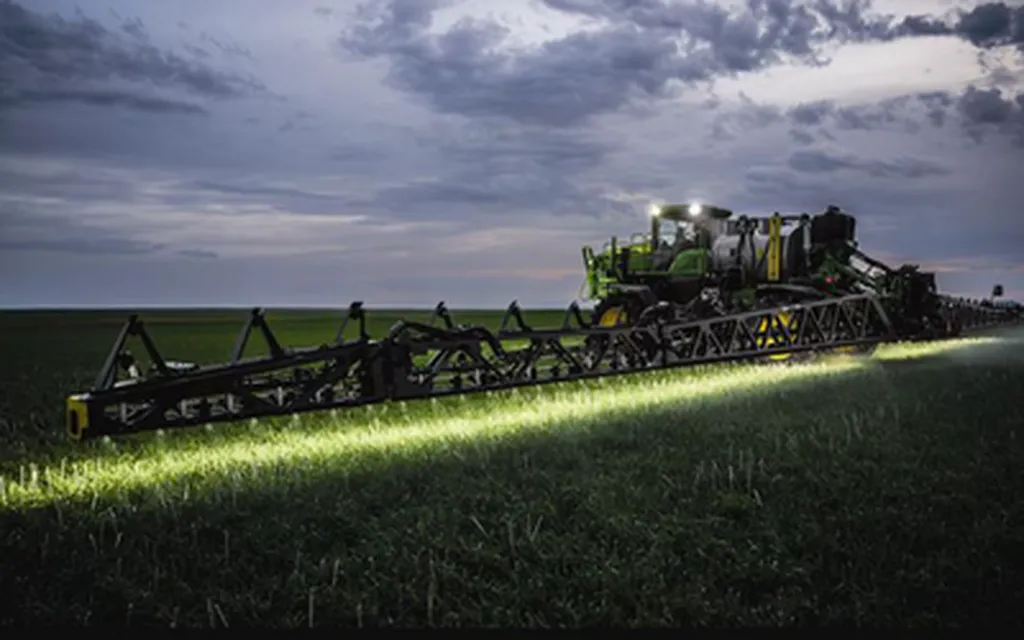
John Deere’s recent announcement of updates to its Model Year 2027 (MY27) application portfolio marks a significant stride in the realm of precision agriculture. The enhancements, which include improved maneuverability, visibility, and advanced precision agriculture tools, are poised to streamline logistics and data analysis for farmers, ultimately boosting their productivity and efficiency.
One of the most notable introductions is the next generation of John Deere’s See & Spray technology. This advanced system is designed to expand targeted application across a broader range of crops and operating conditions, allowing for more passes throughout the season. The updated See & Spray Gen 2 solution is particularly noteworthy as it supports operations of all sizes, helping farmers manage rising input costs, tighter application windows, and increasing weed pressure with greater confidence and flexibility.
Josh Ladd, marketing manager for application equipment at John Deere, underscored the company’s understanding of the increasing pressures farmers are facing. He stated, “That is why we have updated See & Spray to directly address those challenges by helping farmers apply exactly what’s needed, where it’s needed, and across more acres and more crops.”
The MY27 updates bring a simplified and unified See & Spray Gen 2 platform, eliminating the confusion between the previous system levels. This integration allows farmers and custom applicators to customize their machines to match their operations without feature compromise or compatibility challenges. They can choose between a single- or dual-tank configuration and add optional features, such as full boom lighting to maximize operating time by allowing nighttime operations and ExactApply or Individual Nozzle Control (INC) Pro nozzle systems.
John Deere’s expanded See & Spray technology now enables targeted application across a wider range of crops, including wheat, barley, and canola. With real-time weed detection and treatment, farmers gain the flexibility to adapt weed control strategies by crop and field conditions, maintaining effective weed control while optimizing input use and protecting profitability and supporting long-term agronomic outcomes.
In addition to crop expansion, customers will also benefit from the new Variable Rate capability, previously only available on See & Spray Select. This feature allows farmers to apply prescription-like applications without the need to build prescriptions. Using real-time living biomass detection from See & Spray cameras, the system automatically adjusts application rates at the nozzle level during fungicide, harvest aid/desiccation, and plant growth regulator passes. This expanded capability allows farmers to improve job quality, increase productivity, and extend the value of See & Spray into later-season applications.
The MY27 updates also include several See & Spray-specific enhancements, such as a new center-frame camera placement to reduce dust interference and enhance detection accuracy, higher operating speeds in targeted modes, and optional full boom lighting for nighttime operations. These capabilities will be available on MY27 John Deere 400 Series and 600 Series sprayers, as well as all Hagie sprayers.
Alongside the expanded See & Spray capabilities, John Deere is introducing several MY27 sprayer enhancements designed to improve overall productivity, operator awareness, and in-field efficiency. These updates include the ExactInject Direct Chemical Injection system, an enhanced G5Plus display experience, John Deere Operations Center integration, estimated time-to-empty and sprayer alerts, a SmartView camera system, and AutoTrac Vision 2.0-ready capability for Hagie machines.
John Deere’s commitment to helping farmers produce more with less—less time, less cost, and less complexity—is evident in these updates. The new MY27 sprayer updates and expanded See & Spray technology represent another step forward in delivering smarter, more productive application solutions across the production system. As the agricultural industry continues to evolve, these advancements are set to play a crucial role in shaping the future of farming.