
In the ever-evolving landscape of agricultural and biomedical technology, a groundbreaking development has emerged from the intersection of nanomaterials and sensing technology. Researchers have unveiled a novel class of sensors that combine metal-organic frameworks (MOFs) with surface-enhanced Raman scattering (SERS), promising unprecedented sensitivity and selectivity for detecting a wide range of contaminants and biomarkers. This innovation, detailed in a recent study published in the journal *Sensors*, could revolutionize how we monitor crop health, detect pesticides, and identify pathogens, ultimately enhancing food safety and agricultural productivity.
The study, led by Alemayehu Kidanemariam from the Department of Electronic Engineering at Gachon University in South Korea, explores the design and applications of MOF-based SERS sensors. These sensors leverage the unique properties of MOFs—highly porous, crystalline materials composed of metal ions and organic ligands—to create a platform that amplifies Raman signals, a spectroscopic technique used to identify molecular vibrations. By integrating plasmonic nanostructures with MOFs, the sensors achieve ultrahigh signal enhancement, enabling the detection of trace amounts of analytes.
“MOF-based SERS sensors offer a versatile and highly sensitive platform for detecting contaminants and biomarkers in agriculture and biomedicine,” Kidanemariam explained. “The combination of MOFs with SERS technology allows for the creation of sensors that are not only highly sensitive but also selective, making them ideal for real-world applications.”
One of the key advantages of these sensors is their ability to preconcentrate analytes and control the distribution of hotspots—regions where the electromagnetic field is significantly enhanced—leading to improved detection limits. The study highlights various strategies for designing these sensors, including metal-MOF composites, plasmon-free frameworks, ligand functionalization, and hierarchical or core-shell architectures. These design strategies enhance the sensors’ performance, making them suitable for a wide range of applications, from environmental monitoring to pathogen identification and biomarker analysis.
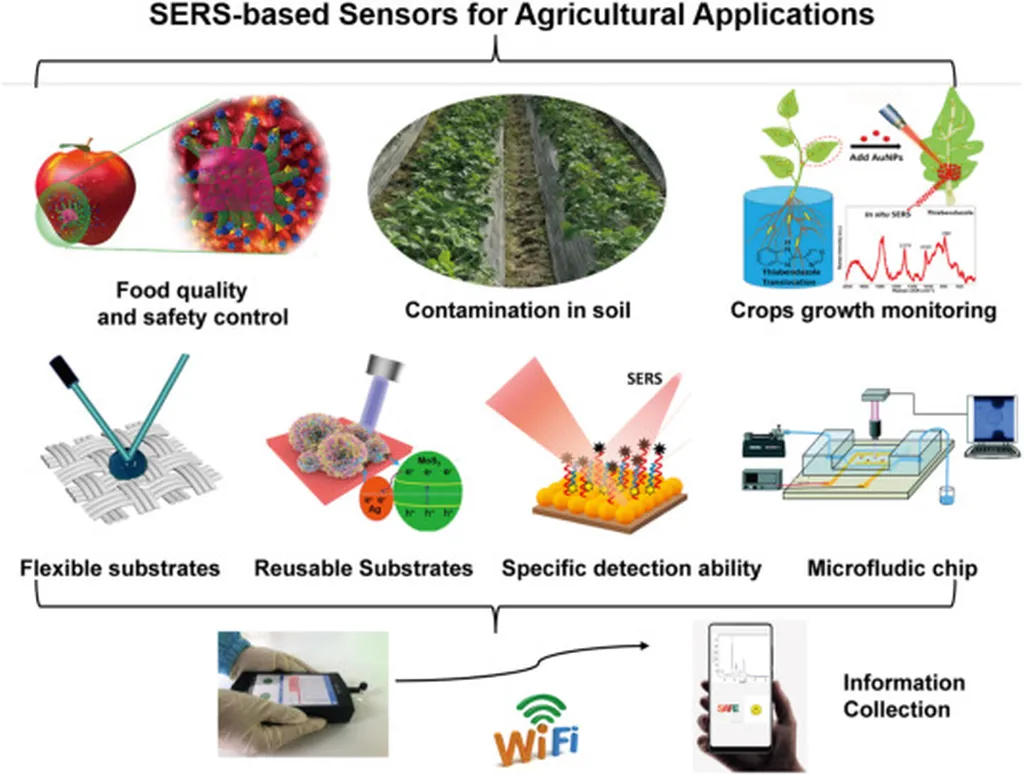
For the agriculture sector, the implications are profound. Farmers and agricultural scientists could benefit from portable, field-deployable sensors that can quickly and accurately detect pesticides, heavy metals, and other contaminants in soil and water. This capability would enable more precise and timely interventions, reducing the risk of crop damage and ensuring food safety. Additionally, the sensors could be used to monitor the health of crops by detecting biomarkers associated with diseases or nutrient deficiencies, allowing for early intervention and improved yield.
Beyond agriculture, the sensors hold promise for biomedical applications, such as the detection of biomarkers for early disease diagnosis and the monitoring of therapeutic agents. The study also emphasizes the potential for integrating these sensors with portable Raman devices and AI-assisted data analysis, further enhancing their utility in real-world settings.
Despite these advancements, challenges remain. The study acknowledges issues related to reproducibility, quantitative reliability, matrix interference, scalability, and biocompatibility. Addressing these challenges will be crucial for the widespread adoption of MOF-based SERS sensors.
Looking ahead, the future of MOF-based SERS sensors is bright. As researchers continue to refine the design and fabrication of these sensors, they are likely to become more robust, scalable, and cost-effective. The integration of intelligent spectral interpretation and multifunctional capabilities will further expand their applications, bridging the gap between laboratory innovation and practical, real-world use.
In the words of Kidanemariam, “The potential of MOF-based SERS sensors is vast, and we are just beginning to scratch the surface of what they can achieve. With continued research and development, these sensors could become indispensable tools in agriculture, biomedicine, and beyond.”
As the agricultural industry seeks to enhance sustainability and productivity, the advent of MOF-based SERS sensors represents a significant step forward. By providing a powerful tool for monitoring and detecting a wide range of analytes, these sensors could help farmers and researchers make more informed decisions, ultimately leading to a safer and more productive food supply.