
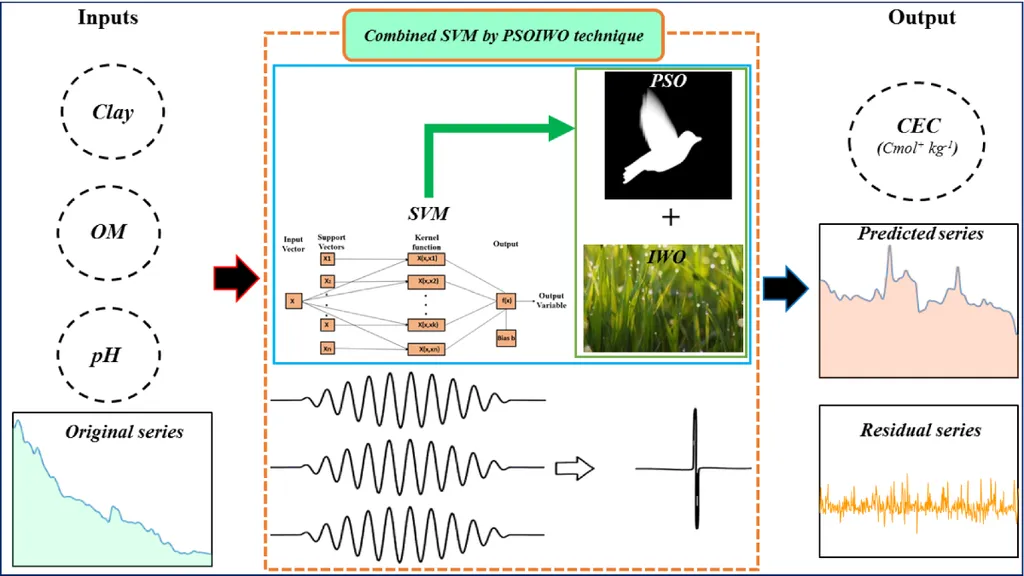
In the ever-evolving landscape of precision agriculture, the quest for more accurate and efficient decision-making tools is relentless. A recent study published in the journal *Algorithms* introduces a novel hybrid optimization framework that could significantly enhance the training of Support Vector Machines (SVMs), a popular tool in critical decision-making applications, including agriculture. The research, led by Khalid Nejjar from the IABL, FSTT, Abdelmalek Essaadi University in Morocco, combines Open Competency Optimization (OCO) and Particle Swarm Optimization (PSO) to address longstanding challenges in SVM training.
Support Vector Machines are favored for their robust theoretical foundations and ability to construct optimal separating hyperplanes in high-dimensional spaces. However, their effectiveness hinges on the efficiency of the optimization algorithm used to solve their underlying dual problem, which is often complex and constrained. Traditional solvers like Sequential Minimal Optimization (SMO) and Stochastic Gradient Descent (SGD) come with their own set of limitations. SMO, for instance, ensures numerical stability but lacks scalability and is sensitive to heuristics. On the other hand, SGD scales well but suffers from unstable convergence and limited suitability for nonlinear kernels.
The proposed OCO–PSO framework aims to bridge these gaps by leveraging the global exploration capability of PSO and the adaptive competency-based learning mechanism of OCO. This combination enables efficient exploration of the solution space, avoidance of local minima, and strict enforcement of dual constraints on the Lagrange multipliers. “Our approach not only enhances the accuracy and interpretability of SVMs but also ensures a sparser model, which is crucial for practical applications,” says Khalid Nejjar, the lead author of the study.
The study evaluated the OCO-PSO–SVM framework across multiple datasets, including medical, agricultural yield, signal processing, and imbalanced synthetic data. The results were impressive. On the Ionosphere dataset, OCO-PSO achieved an accuracy of 95.71%, an F1-score of 0.954, and a Matthews correlation coefficient (MCC) of 0.908. These metrics matched the performance of random forest classifiers while offering superior interpretability through its kernel-based structure. Notably, the proposed method yielded a sparser model with only 66 support vectors compared to 71 for standard SVC, a reduction of approximately 7%, while strictly satisfying the dual constraints with a near-zero violation.
The optimal hyperparameters identified by OCO-PSO also differed substantially from those obtained via Bayesian optimization for SVC, indicating that the proposed approach explores alternative yet equally effective regions of the hypothesis space. “This suggests that our method can uncover new and potentially more effective configurations for SVM training,” Nejjar adds.
The statistical significance and robustness of these improvements were confirmed through extensive validation using 1000 bootstrap replications, paired Student’s t-tests, Wilcoxon signed-rank tests, and Holm–Bonferroni correction. These results demonstrate that the proposed metaheuristic hybrid optimization framework constitutes a reliable, interpretable, and scalable alternative for training SVMs in complex and high-dimensional classification tasks.
For the agriculture sector, the implications are profound. Precision agriculture relies heavily on accurate data analysis to make critical decisions about crop management, yield prediction, and resource allocation. The enhanced performance and interpretability of SVMs trained using the OCO-PSO framework could lead to more precise and efficient agricultural practices. This could translate into higher yields, reduced resource waste, and ultimately, increased profitability for farmers.
Moreover, the sparser models produced by the OCO-PSO framework could make SVM-based solutions more accessible and cost-effective for smaller farms and agricultural cooperatives. As Khalid Nejjar explains, “The ability to achieve high accuracy with fewer support vectors means that our models can be deployed more efficiently, even on resource-constrained systems.”
The research also opens up new avenues for future developments in the field of machine learning and optimization. The successful integration of OCO and PSO in this study suggests that similar hybrid approaches could be explored for other machine learning algorithms, potentially unlocking new levels of performance and efficiency. As the field of precision agriculture continues to evolve, the demand for robust, interpretable, and scalable machine learning tools will only grow. The OCO-PSO framework represents a significant step forward in meeting these demands.
In conclusion, the study by Khalid Nejjar and his team offers a promising new direction for enhancing the training of Support Vector Machines. The proposed OCO–PSO framework not only addresses the limitations of traditional solvers but also opens up new possibilities for the application of SVMs in precision agriculture and beyond. As the agricultural sector continues to embrace data-driven decision-making, tools like the OCO-PSO–SVM framework will play an increasingly vital role in shaping the future of farming.