
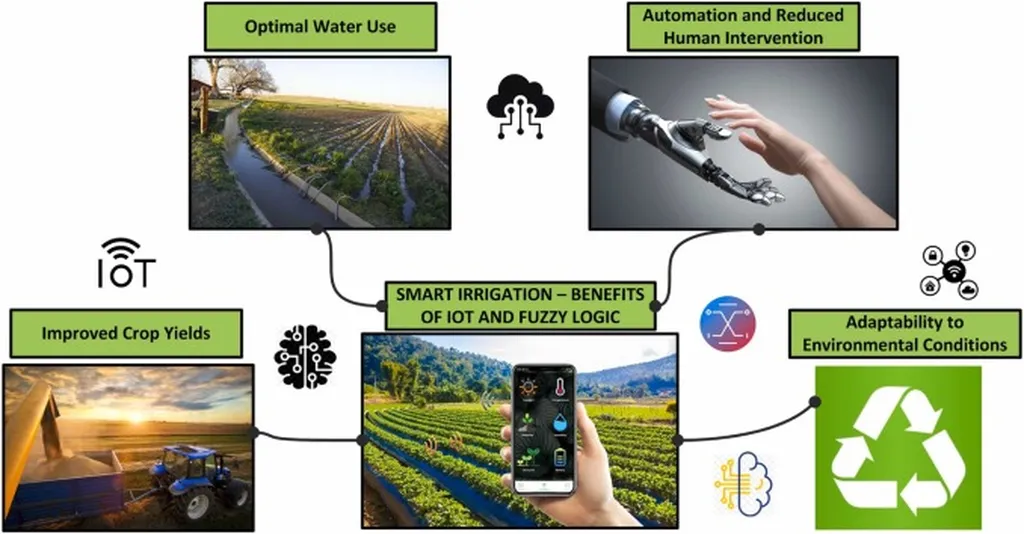
In the ever-evolving landscape of precision agriculture, a groundbreaking study has emerged that promises to revolutionize irrigation systems. Published in the journal *Mathematics*, the research introduces a mathematically grounded neuro-fuzzy control framework for IoT-enabled irrigation systems, potentially transforming how farmers manage water resources.
At the heart of this innovation is a sophisticated model that captures the intricate water dynamics within the crop root zone, driven by factors such as evapotranspiration, irrigation, and drainage. The study, led by Nikolay Hinov from the CoE “National Center of Mechatronics and Clean Technologies” in Sofia, Bulgaria, employs a Mamdani-type fuzzy controller to approximate the optimal irrigation strategy. This controller is then converted into a Takagi–Sugeno (TS) representation, allowing for a rigorous stability analysis based on Input-to-State Stability (ISS) theory and Linear Matrix Inequalities (LMIs).
One of the most compelling aspects of this research is its integration of artificial neural networks (ANNs) to enhance the accuracy and adaptability of the fuzzy controller. “By augmenting the fuzzy controller with lightweight ANN modules, we can significantly improve the prediction accuracy and long-term adaptability of the system,” Hinov explains. This integration is a first in the field, providing a mathematically certified neuro-fuzzy irrigation controller that ensures stability and efficiency.
The practical implications for the agriculture sector are substantial. Experimental validation in an operational IoT setup demonstrated accurate soil-moisture regulation, with a tracking error below 2%, and an impressive 28% reduction in water consumption compared to fixed-schedule irrigation. These results highlight the potential for significant water savings and improved crop yields, addressing critical challenges in sustainable agriculture.
The study’s findings are poised to shape future developments in the field. By providing a robust framework that combines the strengths of fuzzy logic, ANNs, and IoT technology, it offers a blueprint for developing intelligent irrigation systems that are both efficient and adaptable. As Hinov notes, “This work provides one of the first mathematically certified neuro-fuzzy irrigation controllers integrating ANN-based estimation with Input-to-State Stability (ISS) and LMI-based stability guarantees.”
In an era where water scarcity and climate change pose significant threats to agriculture, this research offers a beacon of hope. By leveraging advanced mathematical models and cutting-edge technology, it paves the way for more sustainable and efficient irrigation practices. The implications extend beyond immediate water savings, potentially influencing policy and practice in the broader agricultural sector.
As the world grapples with the challenges of feeding a growing population while conserving precious resources, innovations like this one are not just welcome—they are essential. The study’s integration of IoT, fuzzy logic, and ANNs represents a significant step forward, offering a glimpse into the future of precision agriculture. With continued research and development, the potential for even greater advancements in this field is immense, promising a more sustainable and productive future for agriculture.