
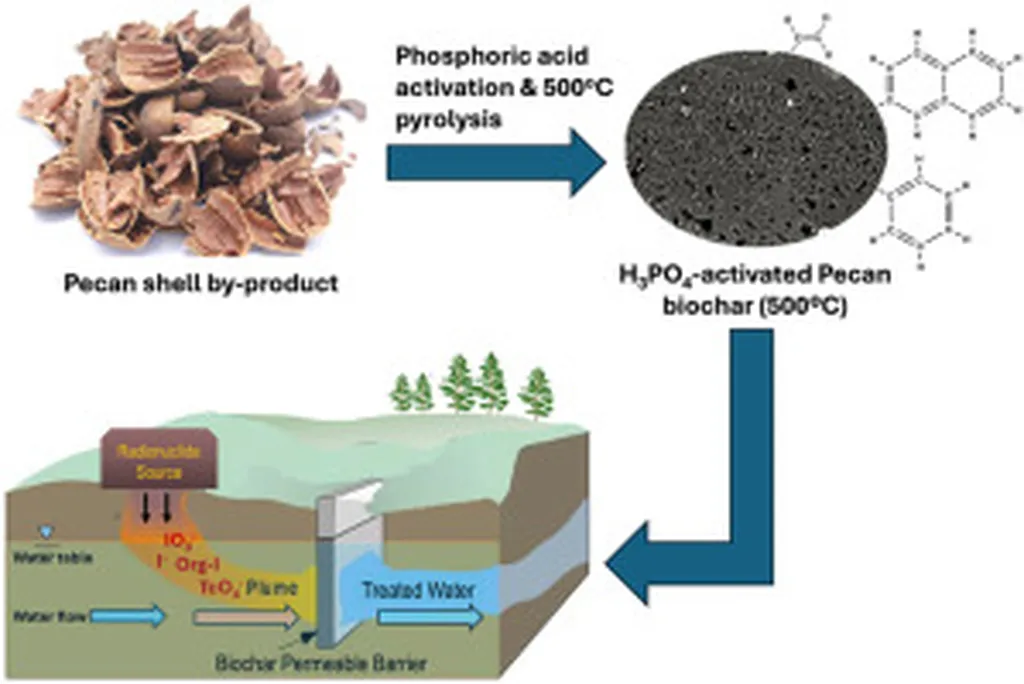
In a significant stride towards sustainable water remediation, researchers have developed an innovative method to transform agricultural waste into a high-performance adsorbent for arsenic removal. The study, published in *Technologies*, leverages a fuzzy decision network to optimize the synthesis of a magnetic biochar nanocomposite derived from pecan shells, offering a promising solution to global water contamination challenges.
Arsenic contamination poses a severe threat to public health and ecosystems, necessitating efficient and eco-friendly remediation technologies. The research, led by Sasirot Khamkure of the Irrigation and Drainage Department at the Universidad Autónoma Agraria Antonio Narro in Mexico, introduces a novel approach using a Multi-Input Fuzzy Rules Emulated Network (MiFREN) to systematically investigate and optimize the synthesis process of magnetic biochar nanocomposites.
The study identified key parameters influencing the material’s crystallinity and adsorption performance, with the precursor type (biochar), Fe:precursor ratio (1:1), and iron salt type emerging as the most significant factors. Particle size and N2 atmosphere, however, had minimal effects. The optimal material, designated FS7, achieved over 90% arsenic removal, significantly outperforming the least efficient sample by 50.61%.
“This research demonstrates the potential of integrating artificial intelligence with traditional materials science to create sustainable solutions for water remediation,” said Khamkure. “By optimizing the synthesis process, we can enhance the performance of adsorbents derived from agricultural waste, making them viable for large-scale applications.”
Kinetic analysis confirmed that the adsorption process involves chemisorption on a heterogeneous surface, with a maximum adsorption capacity (qe) of 12.74 mg/g. Regeneration studies using 0.1 M NaOH showed high stability, with FS7 retaining over 70% of its removal capacity over six cycles. Desorption occurs via ion exchange and electrostatic repulsion, and post-use analysis confirmed the material’s structural integrity and resistance to oxidation.
The study also demonstrated the effectiveness of FS7 in real-world applications by testing it on groundwater samples from the La Laguna region. Despite the presence of competing ions such as Na+, Cl–, and SO42-, FS7 maintained its selectivity and performance.
The commercial implications for the agriculture sector are substantial. Agricultural waste, such as pecan shells, is typically discarded or underutilized, representing a significant economic and environmental burden. By converting this waste into a high-value adsorbent, farmers and agribusinesses can generate additional revenue streams while contributing to environmental sustainability.
“This research not only addresses a critical environmental issue but also opens up new opportunities for the agricultural sector,” said Khamkure. “By transforming waste into a valuable resource, we can create a circular economy that benefits both the environment and the economy.”
The integration of AI-driven optimization with reusable and effective adsorbents sets a precedent for future developments in water remediation technologies. As global water contamination issues continue to escalate, innovative solutions like this magnetic biochar nanocomposite offer hope for achieving the United Nations’ Sustainable Development Goal of clean water and sanitation for all.
By leveraging advanced technologies and sustainable practices, the agriculture sector can play a pivotal role in addressing environmental challenges while enhancing economic prosperity. This research underscores the importance of interdisciplinary collaboration and the potential of agritech innovations to drive positive change.
The study, published in *Technologies*, highlights the transformative potential of integrating AI with traditional materials science to create sustainable solutions for water remediation. As the world grapples with increasing water contamination issues, innovative approaches like this offer a beacon of hope for achieving cleaner and safer water supplies.