
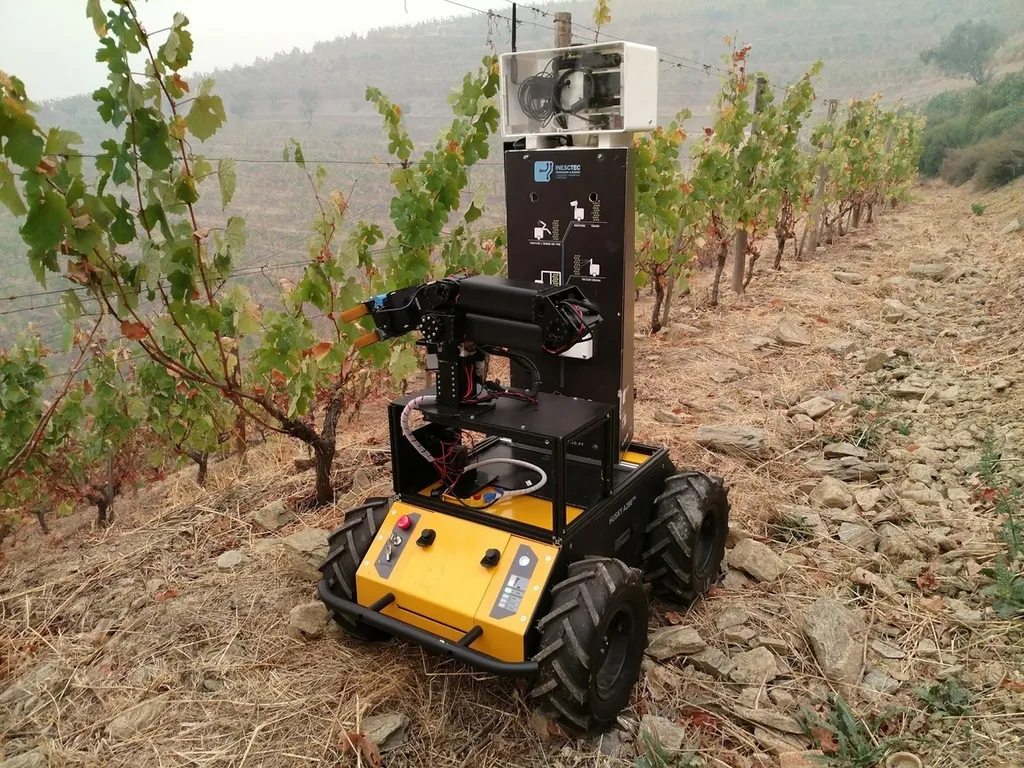
In the ever-evolving landscape of agricultural technology, a groundbreaking study has emerged that promises to revolutionize the way unmanned ground vehicles (UGVs) navigate complex farming environments. Published in the journal *Applied Sciences*, the research, led by Dimitris Katikaridis from the Institute for Bio-Economy and Agri-Technology (IBO) at the Centre of Research and Technology-Hellas (CERTH), introduces a proactive path planning system that leverages the coordination between UAVs and UGVs to enhance efficiency and safety in agricultural operations.
The study addresses a critical challenge faced by UGVs in agriculture: the presence of dynamic obstacles such as workers, animals, and equipment, which can cause mission delays, higher energy consumption, and potential safety risks. Traditional reactive local avoidance systems often fall short in handling these dynamic environments effectively. To tackle this issue, the researchers proposed a shift from reactive local avoidance to proactive global optimization.
The system integrates aerial imagery from an unmanned aerial vehicle (UAV) to identify dynamic obstacles using a low-latency YOLOv8 detection pipeline. These obstacles are then translated into georeferenced exclusion zones for the UGV, allowing it to plan its path proactively. The UGV follows the optimized path while relying on a LiDAR-based reactive protocol to autonomously detect and respond to any missed obstacles. A farm management information system serves as the central coordinator, ensuring seamless communication and coordination between the UAV and UGV.
The system was rigorously tested in 30 real-field trials in a walnut orchard, covering two distinct scenarios with varying worker and vehicle loads. The results were impressive, with the UGV completing all tasks safely. There were four partial successes caused by worker detection failures under afternoon shadows, highlighting the need for further refinement in certain conditions.
“Our system demonstrated high mission success rates, with the UGV completing all tasks safely and efficiently,” said Katikaridis. “The integration of UAV and UGV technologies has the potential to significantly enhance the productivity and safety of agricultural operations.”
The study also revealed that UAV energy consumption remained stable, while UGV energy and mission time increased during reactive maneuvers. Communication latency was low and consistent, enabling timely execution of both proactive and reactive navigation protocols.
The implications of this research for the agriculture sector are profound. By enabling more efficient and safe navigation of UGVs, farmers can expect reduced operational costs, increased productivity, and improved safety for workers. The system’s ability to handle dynamic environments makes it particularly valuable in orchards and other semi-structured agricultural settings.
“This research opens up new possibilities for the future of agricultural robotics,” said Katikaridis. “The proactive path planning system not only enhances the capabilities of UGVs but also paves the way for more advanced multi-robot collaboration in agriculture.”
As the agriculture sector continues to embrace technological advancements, the integration of UAVs and UGVs holds the promise of transforming traditional farming practices. The study published in *Applied Sciences* by Katikaridis and his team at the Institute for Bio-Economy and Agri-Technology (IBO) at the Centre of Research and Technology-Hellas (CERTH) represents a significant step forward in this direction, offering a glimpse into the future of smart, efficient, and safe agricultural operations.