
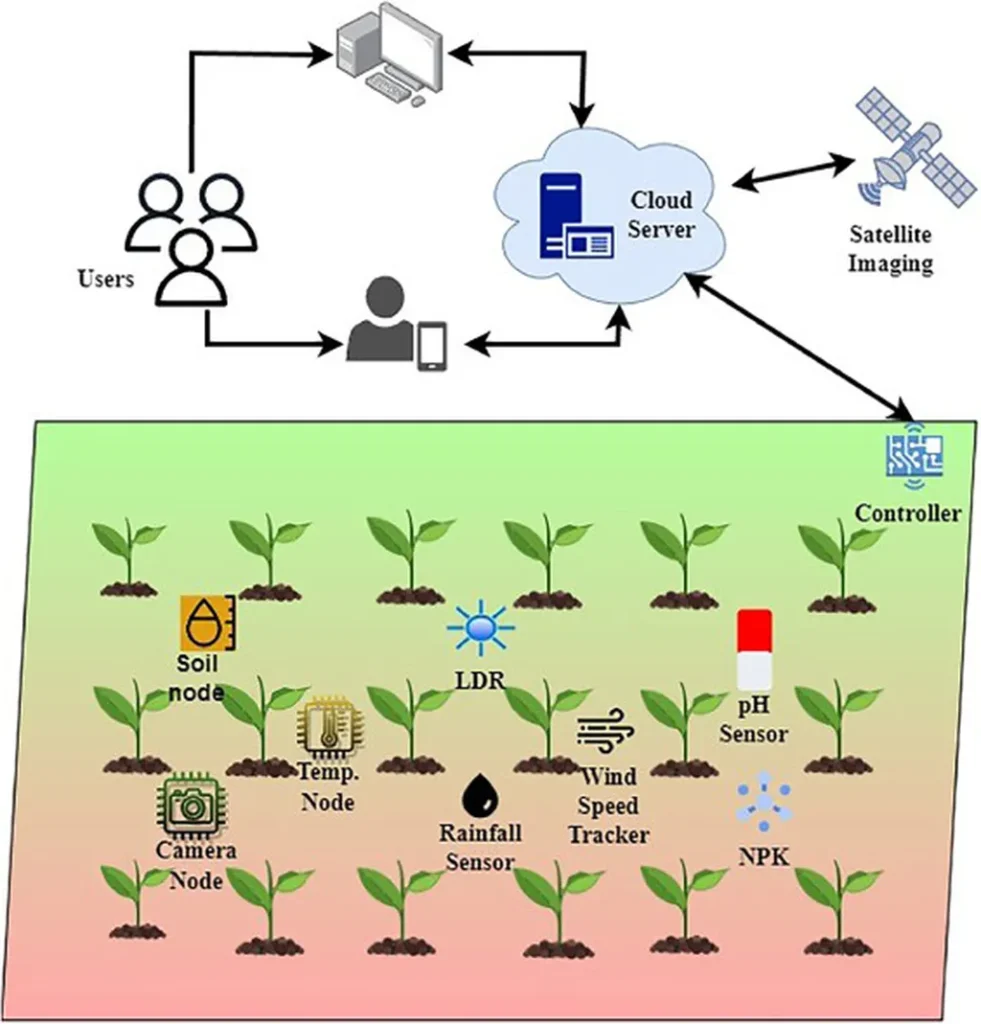
In the ever-evolving landscape of agriculture, technology is playing an increasingly pivotal role. A recent study published in the journal ‘Computers’ introduces a novel architecture designed to harness the power of IoT and robotics data, offering a promising solution for sustainable agricultural practices. The research, led by Mohamed El-Ouati from TSCF, INRAE, University Clermont Auvergne, France, presents a multi-layered framework that could revolutionize how farmers manage and utilize data.
Modern farms are generating vast amounts of data from a myriad of sources, including IoT devices, robots, and drones. This data deluge, while rich in potential, poses significant challenges in terms of management and processing. The proposed architecture aims to address these challenges head-on, providing a scalable and resilient framework for transforming raw data into actionable insights.
The architecture comprises five distinct layers, each serving a unique purpose. The Source Layer acts as the unified entry point, accommodating structured, spatial, and image data from various sources. “This layer is crucial as it sets the stage for the entire data processing pipeline,” explains El-Ouai. The Ingestion Layer follows, employing a hybrid fog/cloud architecture with Kafka for real-time streams and batch processing of historical data.
Data is then segregated for processing in the Batch Layer and the Speed Layer. The Batch Layer, deployed in the cloud, uses a Hadoop cluster, Spark, Hive, and Drill for large-scale historical analysis. Meanwhile, the Speed Layer utilizes Geoflink and PostGIS for low-latency, real-time geovisualization. The final layer, the Governance Layer, ensures data quality, lineage, and organization across all components using Open Metadata.
The commercial implications of this research are substantial. By enabling real-time, data-driven decision-making, farmers can optimize resource use, improve crop yields, and enhance overall farm management. This could lead to increased profitability and sustainability in the agriculture sector. Moreover, the architecture’s scalability and resilience make it adaptable to various farm sizes and types, from small-scale operations to large agribusinesses.
The research also opens up avenues for future developments in the field. As El-Ouai notes, “This architecture is not just a solution for today’s challenges, but a foundation for future innovations.” It could pave the way for advanced applications in anomaly detection, continuous queries, and edge processing, further enhancing the capabilities of smart farming systems.
In conclusion, this study represents a significant step forward in agricultural data management. By providing a robust framework for processing and analyzing IoT and robotics data, it offers a powerful tool for farmers seeking to leverage technology for sustainable and profitable farming practices. As the agriculture sector continues to evolve, such innovations will be crucial in meeting the challenges and opportunities of the future.