
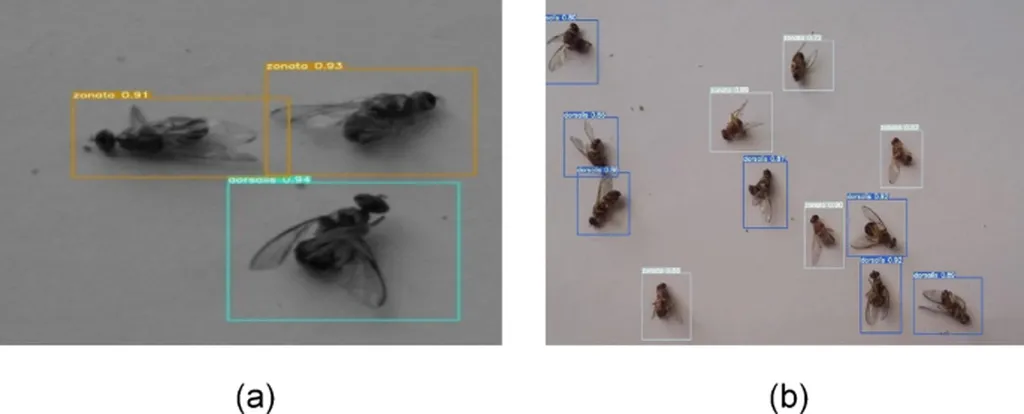
In the ever-evolving landscape of smart agriculture, the ability to detect and manage pests efficiently is a game-changer. A recent study published in *Applied Sciences* introduces a novel model, MSDS-YOLO, designed to enhance the detection of small-target pests, addressing a significant challenge in the field. The research, led by Junjie Li from the Xinjiang Space-Air-Ground Integrated Intelligent Computing Technology Laboratory, offers promising advancements that could reshape pest management strategies and bolster agricultural productivity.
Pest detection is a cornerstone of smart agriculture, but existing methods often fall short when dealing with small-target pests, particularly in complex backgrounds. Misidentification and missed detections can lead to significant crop losses and increased pesticide use, which has environmental and economic implications. The MSDS-YOLO model aims to mitigate these issues by improving the accuracy and robustness of pest detection.
The model introduces several innovative components. First, it incorporates a dynamic multi-scale feature extraction module (C3k2_DMSFE) that adapts to different input features, capturing a wide range of feature information. This adaptability is crucial for identifying pests of varying sizes and characteristics. “The dynamic adjustment of the module allows it to effectively capture multi-scale and diverse feature information, which is essential for accurate pest detection,” Li explains.
Additionally, the model employs a novel Dimensional Selective Feature Pyramid Network (DSFPN), which uses adaptive feature selection and multi-dimensional fusion mechanisms to enhance the saliency of small targets. This means that even the smallest pests, which might otherwise be overlooked, are more likely to be detected. The model also includes 160 × 160 detection heads, replacing the traditional 20 × 20 detection heads, and uses a combination of Normalized Gaussian Wasserstein Distance (NWD) and CIoU as a position loss function to measure prediction errors more accurately.
The practical implications of this research are substantial. Accurate pest detection can lead to more targeted and timely interventions, reducing the need for broad-spectrum pesticides and minimizing their environmental impact. This precision can also enhance crop yields and quality, directly benefiting farmers and the agricultural industry as a whole. “The improved detection accuracy can significantly reduce crop losses and optimize pesticide use, which is beneficial for both the environment and the agricultural sector,” Li notes.
The model’s performance was validated on a real small-target pest dataset, Cottonpest2, achieving a mean average precision (mAP50) of 86.7%, a 3.0% improvement over the baseline. Furthermore, MSDS-YOLO demonstrated better detection accuracy than other YOLO models on public datasets, showcasing its robustness and generalization ability.
As the agricultural sector continues to embrace smart technologies, the MSDS-YOLO model represents a significant step forward in pest management. Its ability to adapt to different conditions and enhance small-target detection could pave the way for more efficient and sustainable farming practices. The research not only addresses current challenges but also sets the stage for future developments in agricultural technology, promising a more resilient and productive future for the industry.