
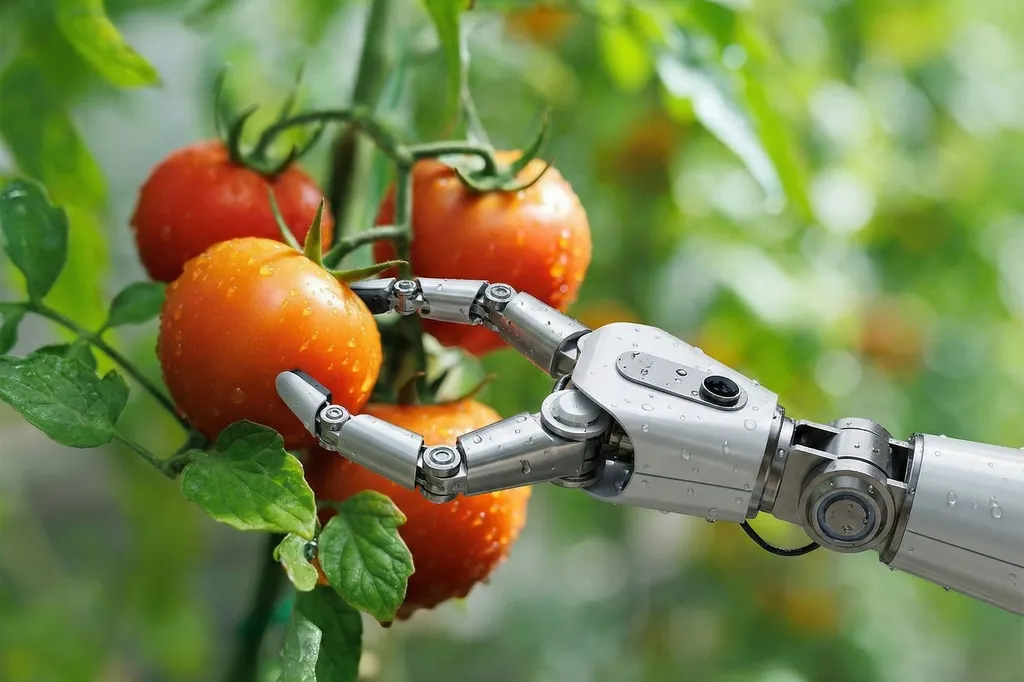
In the heart of Shanghai, a team of researchers led by Binhao Chen at Shanghai Jiaotong University is tackling one of agriculture’s most persistent challenges: the labor-intensive process of tomato harvesting. Their solution? A dual-arm tomato harvesting robot that could revolutionize the way we approach agricultural labor, reducing physical workload and boosting efficiency.
The team’s innovative approach, detailed in their recent paper published in *Agriculture*, addresses a critical gap in current robotic harvesting technology. Traditional single-arm robots often struggle with the complexities of agricultural environments, where collision avoidance and precise grasping orientations are paramount. Chen and his colleagues have developed a reinforcement learning-based cooperative control algorithm tailored specifically for dual-arm systems, enabling more efficient and effective harvesting.
The robot’s design is sophisticated yet practical. It employs a deep learning-based semantic segmentation network to accurately identify the spatial locations of tomatoes and branches from sensory data. This perception module is the foundation for a reinforcement learning-based cooperative path planning approach, which ensures that the robot’s arms avoid collisions and maintain the correct orientation during harvesting.
One of the most notable aspects of their work is the introduction of a task-driven policy network architecture. This architecture decouples the complex harvesting task into structured subproblems, making the learning process more efficient and improving overall performance. “By breaking down the task into smaller, more manageable subproblems, we can significantly enhance the robot’s ability to learn and adapt,” Chen explains.
The implications for the agriculture sector are substantial. Labor shortages and rising wages have long been challenges for farmers, particularly during peak harvesting seasons. A reliable, efficient harvesting robot could alleviate these pressures, reducing labor costs and ensuring a more consistent supply of produce. “This technology has the potential to transform the agricultural landscape, making it more sustainable and economically viable,” Chen adds.
The team’s simulations and experimental results are promising, demonstrating that the proposed method can generate collision-free harvesting trajectories that satisfy dual-arm orientation constraints. This translates to a significantly higher tomato harvesting success rate, a critical metric for any agricultural technology.
Looking ahead, this research could pave the way for further advancements in agricultural robotics. The principles underlying the dual-arm coordination and subtask decoupling could be applied to other crops and harvesting scenarios, broadening the impact of this technology. As the agriculture sector continues to evolve, innovations like these will be crucial in meeting the demands of a growing global population.
The work of Binhao Chen and his team at the School of Mechanical Engineering, Shanghai Jiaotong University, represents a significant step forward in the field of agricultural robotics. Their research not only addresses immediate challenges but also sets the stage for future developments, offering a glimpse into a future where technology and agriculture converge to create more efficient, sustainable, and productive farming practices.