
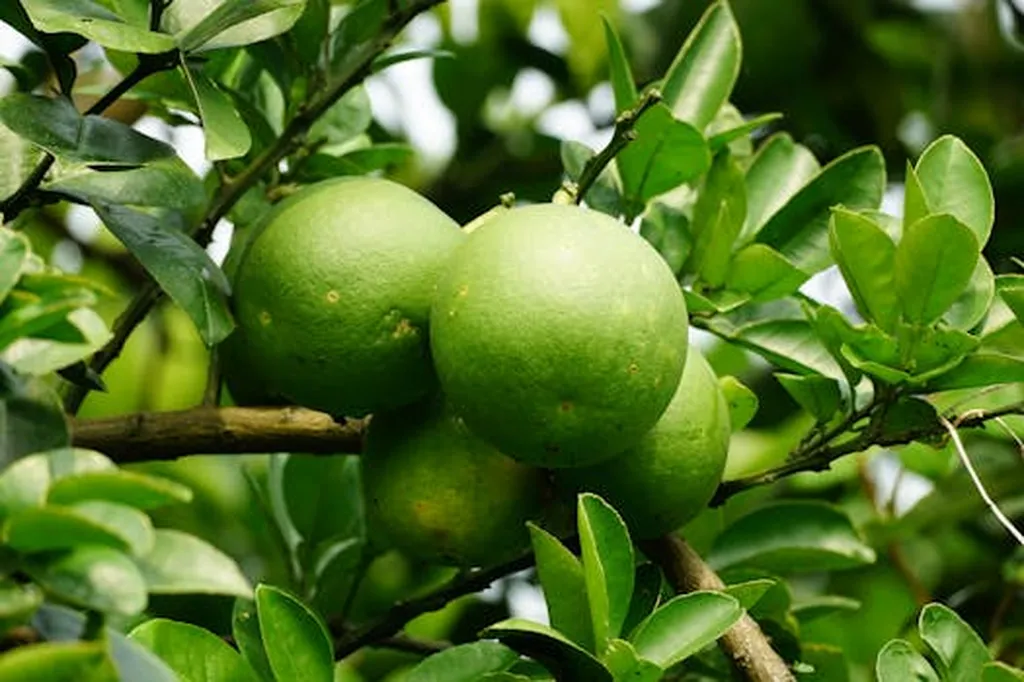
In the rapidly evolving world of agricultural robotics, precision and efficiency are paramount. A recent study published in the journal *Agriculture* introduces a novel approach to instance segmentation that could revolutionize the way harvesting robots identify and interact with fruit. Led by Zhen Li from the College of Artificial Intelligence and Low-Altitude Technology at South China Agricultural University, the research focuses on enhancing the YOLOv8n-seg model with a lightweight modification tailored specifically for pomelo fruit recognition.
The study addresses a critical need in the agriculture sector: the balance between real-time performance and accuracy in automated harvesting systems. Traditional methods often struggle to meet the demands of both speed and precision, which can hinder the widespread adoption of robotic solutions in farming. To tackle this challenge, Li and his team constructed a comprehensive pomelo dataset comprising 5076 samples, meticulously annotated and augmented to ensure robustness.
The researchers integrated the RepGhost module into the C2f module of the YOLOv8-seg backbone network. This modification enhances feature reuse capabilities while significantly reducing computational complexity. “The RepGhost architecture allows us to maintain high accuracy while drastically improving efficiency,” Li explained. “This is crucial for real-world applications where every millisecond counts.”
The results are impressive. The YOLOv8-seg-RepGhost model achieved a 16.5% reduction in parameter count, from 3.41 million to 2.84 million, and a 14.8% decrease in computational load, from 12.8 GFLOPs to 10.9 GFLOPs. Inference time was shortened by 6.3%, reaching a remarkable 15 milliseconds. Despite these improvements, the model maintained excellent detection performance, with a bounding box mAP50 of 97.75% and a mask mAP50 of 97.51%.
The implications for the agriculture sector are profound. Automated harvesting systems equipped with this enhanced segmentation method could significantly boost productivity and reduce labor costs. “This technology has the potential to transform the way we approach fruit harvesting,” Li noted. “By improving the efficiency and accuracy of robotic systems, we can make automated harvesting more viable and cost-effective for farmers.”
The study not only offers a practical solution for pomelo recognition but also sets a precedent for future developments in agricultural robotics. As the demand for sustainable and efficient farming practices grows, innovations like the YOLOv8-seg-RepGhost model will play a pivotal role in shaping the future of the industry. With its combination of high segmentation efficiency and detection accuracy, this research provides a robust foundation for the development of advanced visual systems in harvesting robots, paving the way for more intelligent and automated agricultural practices.