
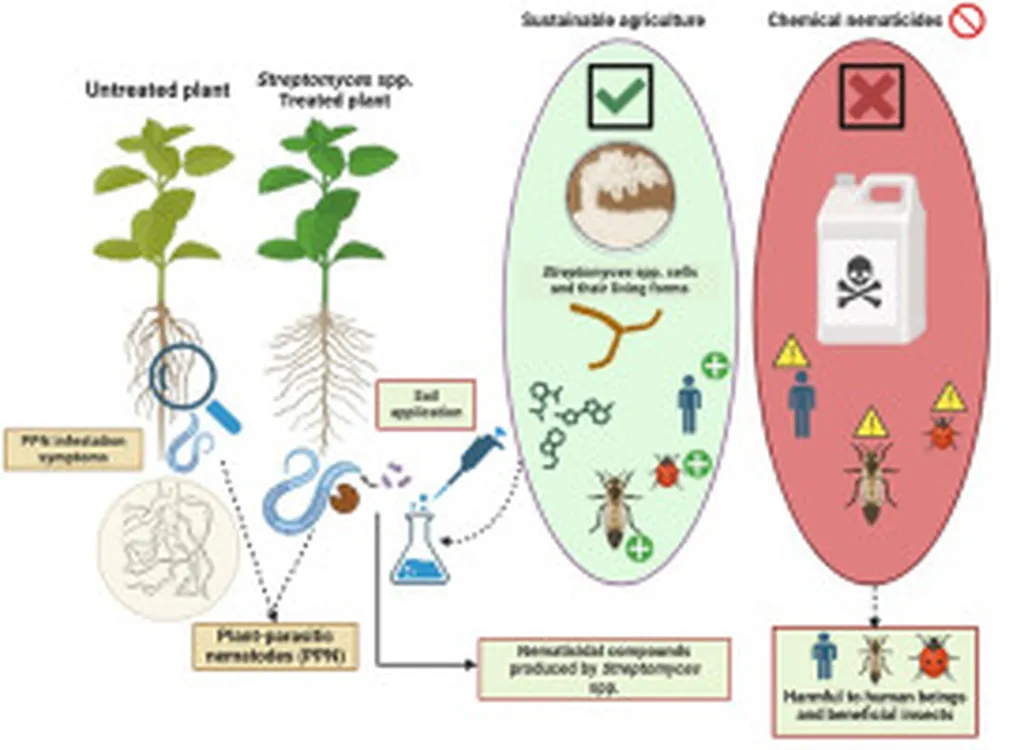
In the relentless battle against plant-parasitic nematodes, a tiny yet powerful ally has emerged from the soil: Streptomyces avermitilis. This bacterium, a natural producer of bioactive compounds, is gaining traction as a sustainable solution to a problem that costs the global agricultural industry billions annually. A recent review published in the *Arab Universities Journal of Agricultural Sciences* sheds light on the potential of Streptomyces avermitilis and its metabolites, particularly abamectin, to manage root-knot nematodes (RKNs) and other plant-parasitic nematodes (PPNs).
Root-knot nematodes, notorious for their ability to disrupt plant nutrient uptake and root growth, have long plagued farmers worldwide. Traditional chemical nematicides, while effective, come with a hefty environmental and health toll. “The need for sustainable alternatives has never been more urgent,” says Mona Zayed, lead author of the review and a researcher at the Microbiology Department of Ain Shams University in Cairo, Egypt. “Streptomyces avermitilis offers a promising avenue for biological control, reducing our reliance on harmful chemicals.”
The review highlights abamectin, a metabolite produced by Streptomyces avermitilis, as a standout nematicide. Abamectin’s mode of action involves disrupting the nematode’s nervous system, leading to paralysis and death. Crucially, abamectin is derived from a natural source, making it a more environmentally friendly option compared to synthetic chemicals. “Abamectin’s efficacy and low environmental impact make it an attractive component of integrated pest management (IPM) strategies,” Zayed explains.
The commercial implications of this research are substantial. With the global nematicide market projected to reach $1.5 billion by 2025, the shift towards biological control agents (BCAs) like Streptomyces avermitilis could reshape the industry. Farmers stand to benefit from reduced chemical inputs, lower environmental impact, and potentially higher yields. Moreover, the development of abamectin-based products could open new markets for agritech companies, fostering innovation in sustainable agriculture.
The review also delves into the biochemical mechanisms underlying abamectin’s effectiveness and its role in IPM strategies. By integrating Streptomyces avermitilis into existing pest management frameworks, farmers can achieve more holistic and sustainable control of nematode populations. This approach not only mitigates the risk of pesticide resistance but also promotes biodiversity and soil health.
Looking ahead, the research suggests that Streptomyces avermitilis and its metabolites could play a pivotal role in the future of nematode management. As the agricultural sector increasingly prioritizes sustainability, the adoption of BCAs like Streptomyces avermitilis is likely to gain momentum. “The potential is immense,” Zayed notes. “By harnessing the power of natural organisms, we can develop more effective and eco-friendly solutions to some of agriculture’s most pressing challenges.”
In conclusion, the review published in the *Arab Universities Journal of Agricultural Sciences* by Mona Zayed and her team underscores the importance of exploring biological control agents as a sustainable alternative to chemical nematicides. As the agricultural industry grapples with the dual challenges of food security and environmental stewardship, the insights from this research could pave the way for innovative and sustainable pest management strategies. The future of nematode control may well lie in the soil itself, with Streptomyces avermitilis leading the charge.