
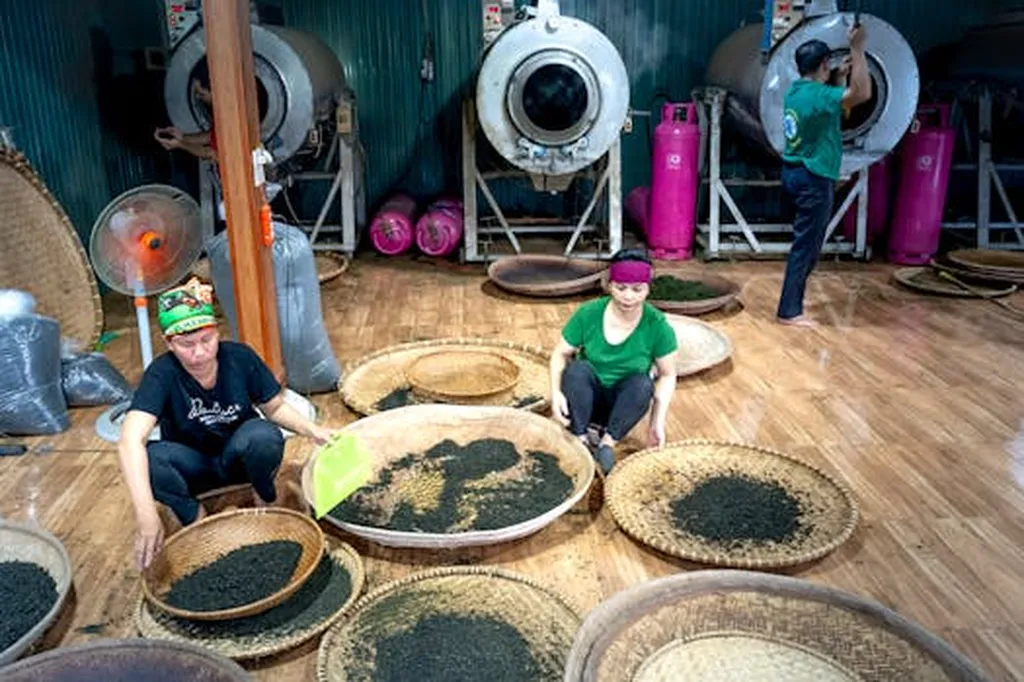
In the world of tea production, precision and timing are everything, especially when it comes to crafting the distinctive aroma and flavor of Tieguanyin tea. Traditionally, recognizing the optimal green-making stage—a critical phase in tea processing—has relied heavily on the sensory experience of skilled tea makers. However, this method is not only labor-intensive but also time-consuming. Enter a new lightweight automatic recognition model named T-GSR, developed by a team led by Yuyan Huang at the Institute of Digital Agriculture, Fujian Academy of Agricultural Sciences, which promises to revolutionize this process.
The T-GSR model leverages advanced image processing and machine learning techniques to accurately identify the green-making stages of Tieguanyin tea. The research, published in the journal ‘Sensors’, details how the model was trained using an extensive set of images captured at various stages of the green-making process. The team employed multi-color-space fusion and morphological filtering to enhance the representation of target tea features, ensuring that the model could capture the subtle nuances that define each stage.
One of the standout features of the T-GSR model is its improvements to the MobileNet V3 backbone network. “We introduced an adaptive residual branch to strengthen feature propagation, replaced the ReLU activation function with the Gaussian Error Linear Unit (GELU) to improve gradient propagation efficiency, and adopted an Improved Coordinate Attention (ICA) mechanism to replace the original Squeeze-and-Excitation (SE) module,” explained Huang. These enhancements enable the model to capture complex tea features more accurately, resulting in a recognition accuracy of 93.38% and an F1-score of 93.33%.
The implications of this research for the agriculture sector are significant. By automating the recognition of green-making stages, tea producers can achieve greater consistency and efficiency in their operations. This not only reduces the reliance on skilled labor but also ensures that the tea is processed at the optimal stage, enhancing the overall quality and market value of the final product. “Our model offers an effective solution for the intelligent recognition of Tieguanyin tea green-making stages, facilitating online monitoring and supporting automated tea production,” Huang added.
The commercial impact of this technology extends beyond Tieguanyin tea. The principles and techniques developed in this research can be adapted to other types of tea and even other agricultural products where precise stage recognition is crucial. This could lead to a broader adoption of intelligent monitoring systems in the agriculture sector, ultimately driving innovation and efficiency in food production.
As the agriculture industry continues to embrace digital transformation, research like this paves the way for smarter, more efficient, and more sustainable practices. The T-GSR model is a testament to the power of combining advanced image processing with machine learning to solve real-world problems in agriculture. With further development and refinement, this technology could become a cornerstone of modern tea production, setting new standards for quality and consistency.