
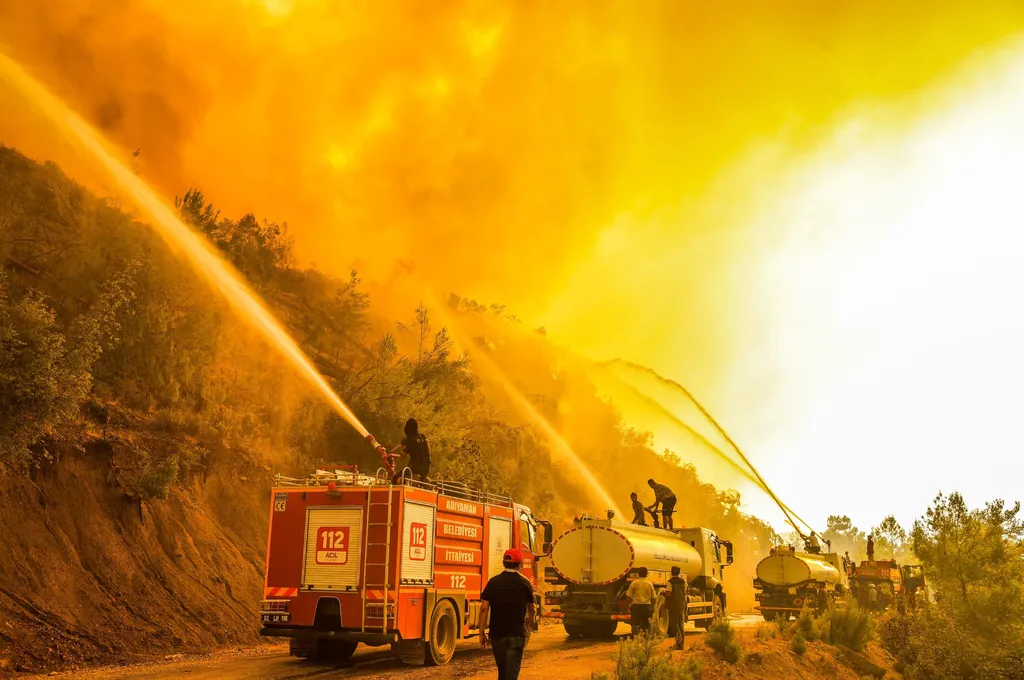
In the heart of Türkiye, a groundbreaking study is setting the stage for a revolution in wildfire detection, with profound implications for the agriculture sector. Researchers, led by İ. R. Karaş from the Department of Computer Engineering at Karabuk University, have developed a deep learning-driven system that promises to transform how we monitor and mitigate wildfires. Published in *The International Archives of the Photogrammetry, Remote Sensing and Spatial Information Sciences*, this research leverages Sentinel-2 satellite imagery and convolutional neural networks (CNNs) to detect wildfires with unprecedented accuracy.
Wildfires, exacerbated by climate change and human activity, pose a significant threat to ecosystems, infrastructure, and human life. Early detection is critical for effective prevention and mitigation, and this study offers a promising solution. The CNN-based system integrates advanced preprocessing techniques, including atmospheric correction, cloud masking, and spatial normalization, with a tailored CNN architecture optimized for spectral-spatial feature extraction. The model was trained on a curated dataset of wildfire events in Türkiye from 2016 to 2025, annotated at the pixel level to distinguish fire-affected and unaffected regions.
The results are impressive. The CNN model achieved an average precision, recall, and F1-score of 0.97, with an overall accuracy of 97%. Notably, the model’s high fire-class precision (1.00) minimized false alarms, while strong recall (0.93) ensured reliable detection. “The model’s lightweight design allows deployment on cloud platforms and edge devices, enabling real-time monitoring across forestry, agriculture, and urban planning applications,” Karaş explained. This capability is particularly crucial for the agriculture sector, where timely detection can prevent devastating losses.
The study also analyzed Turkish wildfire statistics from 1988 to 2023, revealing that over 90% of fires stem from human negligence or arson. This underscores the need for public education, stricter enforcement, and technology-driven surveillance. Long-term data further indicate a rising severity in fire events, strengthening the case for AI-enhanced early warning systems.
The commercial impacts for the agriculture sector are substantial. Real-time monitoring can help farmers and agricultural businesses implement preventive measures, such as controlled burns or targeted irrigation, to mitigate fire risks. Additionally, the system’s ability to integrate with existing cloud platforms and edge devices makes it a scalable and cost-effective solution. “By bridging remote sensing and deep learning, the proposed system supports both immediate disaster response and long-term policy planning for wildfire risk reduction,” Karaş noted.
This research demonstrates that CNNs applied to Sentinel-2 imagery offer a scalable, accurate, and cost-effective solution for wildfire detection. As the agriculture sector increasingly adopts technology-driven solutions, this system could become a cornerstone of modern wildfire management strategies. The study not only highlights the potential of AI in environmental monitoring but also paves the way for future developments in the field. With the rising severity of wildfires, the need for such innovative solutions has never been more urgent.