
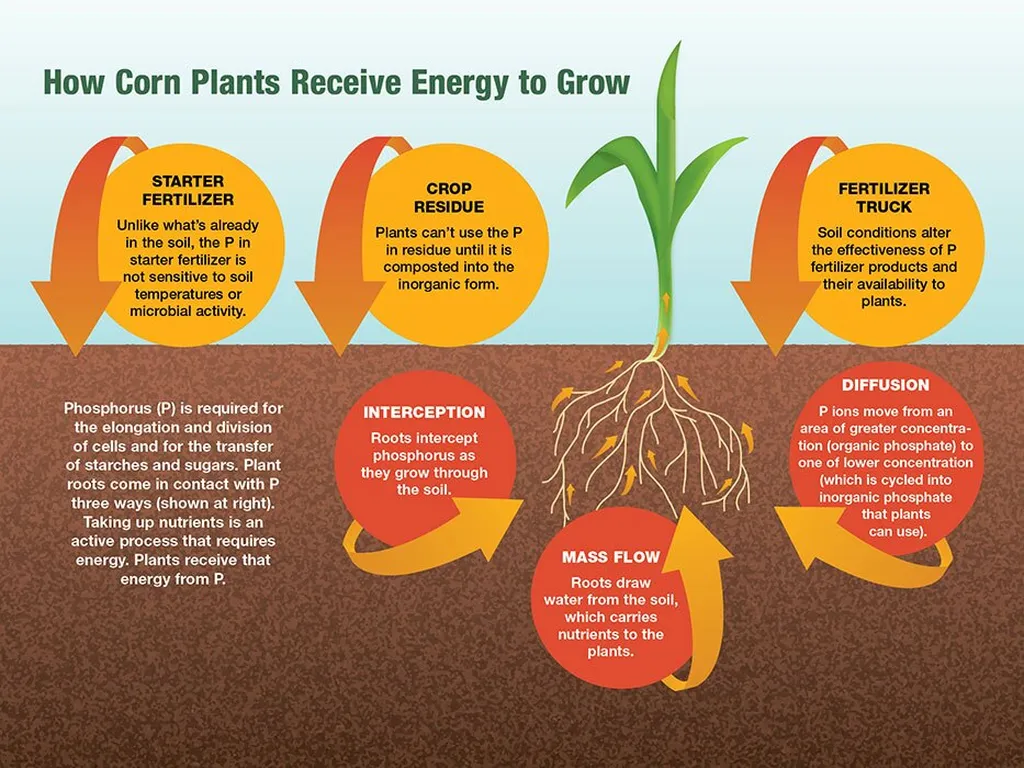
In the quest for sustainable agriculture, scientists are delving deep into the soil to understand how phosphorus (P) fertilizers and water supply interact to boost maize growth and phosphorus-use efficiency (PUE). A recent study published in *Frontiers in Plant Science* sheds light on this intricate relationship, offering promising insights for farmers and agronomists alike.
The research, led by Maoying Wang from the State Key Laboratory of Nutrient Use and Management at China Agricultural University, investigated how different types of phosphorus fertilizers and varying water conditions influence maize growth, root properties, and PUE in calcareous soil. The study focused on four types of P fertilizers: monoammonium phosphate (MAP), diammonium phosphate (DAP), ammonium polyphosphate (APP), and urea phosphate (UP), under well-watered and water-deficit conditions.
The findings reveal that the interaction between P fertilizers and water supply significantly enhances maize growth and P uptake by altering root morphological and physiological traits. For instance, MAP and APP showed a remarkable increase in total root length under well-watered conditions, up to 62% more than in dry treatments. This boost in root length translates to a more efficient root system for acquiring phosphorus, a critical nutrient for plant growth.
“Our results indicate that the optimal combination of P fertilizers and water supply can stimulate the root capacity to forage for nutrient and water resources,” Wang explained. “This is crucial for improving nutrient use efficiency and sustainable crop production.”
The study also found that the activity of acid phosphatase (APase) in the rhizosphere soil of MAP and DAP declined significantly under well-watered conditions, and the rhizosphere soil pH in the DAP treatment was lower compared to dry conditions. Additionally, APP improved soil P availability more than the other P fertilizers, regardless of water supply, with soil Olsen-P concentration being 17%-41% higher.
These findings have significant commercial implications for the agriculture sector. By understanding how different P fertilizers and water conditions interact, farmers can optimize their nutrient management strategies to enhance crop yields while reducing environmental impact. This is particularly relevant in regions with calcareous soils, where phosphorus availability is often a limiting factor for plant growth.
The research also highlights the potential for engineering root and rhizosphere processes to improve nutrient use efficiency. By manipulating the interactions of P fertilizer types and water supply, farmers can create more favorable conditions for root development and nutrient acquisition.
As the global demand for food continues to rise, the need for sustainable and efficient agricultural practices becomes ever more pressing. This study offers a promising avenue for achieving these goals, paving the way for more resilient and productive cropping systems.
In the words of Wang, “Engineering root/rhizosphere by manipulating the interactions of P fertilizer types and water supply can improve nutrient use-efficiency and sustainable crop production.” This insight could shape future developments in the field, guiding researchers and practitioners towards more innovative and effective nutrient management strategies.
With the findings published in *Frontiers in Plant Science* and led by Maoying Wang from the State Key Laboratory of Nutrient Use and Management at China Agricultural University, this research marks a significant step forward in our understanding of the complex interplay between phosphorus fertilizers, water supply, and root development. As we continue to explore these interactions, the potential for enhancing crop productivity and sustainability grows ever brighter.