
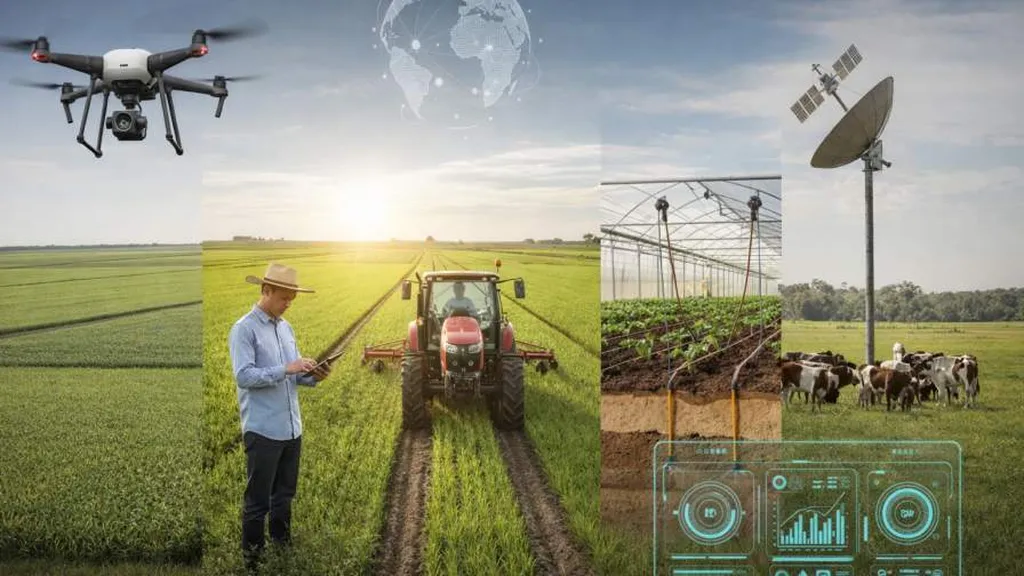
In the heart of India’s agricultural landscape, a quiet revolution is underway, one that promises to bridge the gap between cutting-edge technology and age-old farming practices. Researchers have developed an innovative artificial intelligence (AI) framework designed to empower farmers with expert agricultural advisory services, potentially transforming the way farming knowledge is disseminated and accessed.
The system, detailed in a recent study published in the *Journal of Agricultural Engineering*, leverages a technique known as retrieval-augmented generation (RAG) to provide context-aware guidance on critical farming practices. “This framework is not just about delivering information; it’s about making expert agricultural knowledge accessible to every farmer, regardless of their location or resources,” said Shreeram Sawant, lead author of the study and a researcher in Computer Engineering at Terna Engineering College, Navi Mumbai, Maharashtra.
At the core of this system is a sophisticated process that involves semantic chunking and embedding of package of practices (PoP) documents for five major crops: maize, ragi, sweet potato, cotton, and groundnut. These documents are processed using Amazon Titan via BedrockEmbeddings, and their vector representations are indexed in ChromaDB to enable efficient similarity search for query-relevant content retrieval. When a farmer poses a question, the system retrieves the most semantically similar document chunks and incorporates them into structured prompts.
The study evaluated four large language models (LLMs)—Llama3.1, Mistral, Phi3, and Qwen2.5—for their effectiveness in generating accurate agricultural recommendations. The performance of these models was assessed across multiple dimensions, including relevance, retrieval, lexical overlap, semantic quality, source attribution, and efficiency.
The results were promising. Mistral and Qwen2.5 emerged as the top performers, demonstrating superior relevance, semantic quality, and efficiency. “These models showed a remarkable ability to understand and respond to complex agricultural queries, providing farmers with accurate and contextually relevant advice,” Sawant explained.
The implications of this research are far-reaching. By democratizing agricultural expertise, the framework has the potential to significantly enhance farming practices, particularly in regions with limited access to traditional advisory services. This could lead to increased crop yields, improved pest and disease management, and more efficient use of resources, ultimately benefiting both farmers and the broader agricultural sector.
The study also highlights the potential of knowledge-grounded AI systems to revolutionize the way agricultural advice is delivered. As AI technologies continue to evolve, we can expect to see more sophisticated and tailored advisory systems that cater to the unique needs of farmers around the world.
In the words of Sawant, “This is just the beginning. The integration of AI in agriculture is poised to unlock new possibilities, making farming more sustainable, efficient, and profitable.” As we stand on the brink of this technological revolution, the future of agriculture looks brighter than ever.