
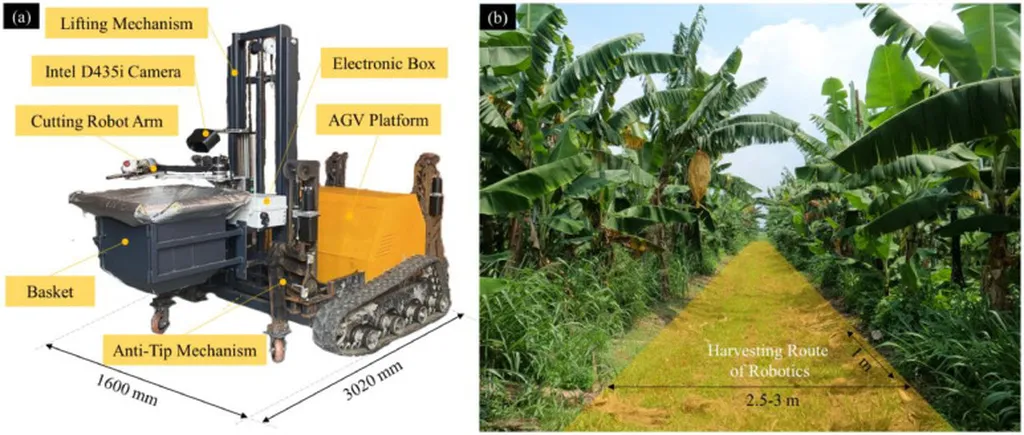
In the heart of the banana plantations, a quiet revolution is taking place, one that promises to reshape the way we approach harvesting. Researchers have developed a digital solution that combines real-time bunch detection with harvest-readiness classification, potentially transforming the speed and consistency of banana harvesting. This innovation, published in the *Journal of Agricultural Engineering*, is a testament to the power of integrating advanced technology into traditional agricultural practices.
At the core of this development is a You Only Look Once (YOLO) model, trained on a custom dataset collected under real plantation conditions. The model, a YOLOv12n detector, achieves an impressive 93% AP50-test with an inference latency of just 5.1 ms per image. This makes it perfectly suited for mobile deployment in the varied environments of banana plantations. “The consistency of performance across different environments is a significant breakthrough,” says Preety Baglat, lead author of the study and a researcher at the Faculty of Exact Sciences and Engineering, University of Madeira, and the Interactive Technologies Institute (ITI/LARSyS and ARDITI) in Funchal.
But the innovation doesn’t stop at detection. The researchers also developed a squeeze-and-excitation YOLO classifier for harvest-readiness prediction. This lightweight, task-specific classifier achieves 94% accuracy with an inference time of 2.8 ms per image. The classifier is designed to make a binary “cut” vs “keep” decision, providing a clear and actionable recommendation for harvesters.
The practical application of this technology is realized through a mobile decision support system built using Flutter and Dart. This system features intuitive interfaces for both field operators and administrators, along with integrated feedback mechanisms. These mechanisms allow for continuous model refinement based on user input, ensuring the system remains accurate and effective over time.
Field testing across diverse lighting and environmental conditions, as well as usability assessments with expert harvesters and administrative staff, have demonstrated the system’s reliable performance. The potential benefits are substantial, including faster decision-making and reduced manual labor. “This technology has the potential to significantly improve the efficiency of banana harvesting, benefiting both the workers and the industry as a whole,” Baglat explains.
The implications of this research extend beyond the banana industry. The integration of real-time detection and classification models into mobile decision support systems could revolutionize precision agriculture. As the technology matures, it could be adapted for use with other crops, further enhancing the efficiency and sustainability of agricultural practices.
In the broader context, this development highlights the growing role of technology in agriculture. As the global population continues to grow, the demand for food will increase, and innovations like this will be crucial in meeting that demand sustainably. The research published in the *Journal of Agricultural Engineering* by Baglat and her team is a step in that direction, offering a glimpse into the future of smart, efficient, and sustainable agriculture.