
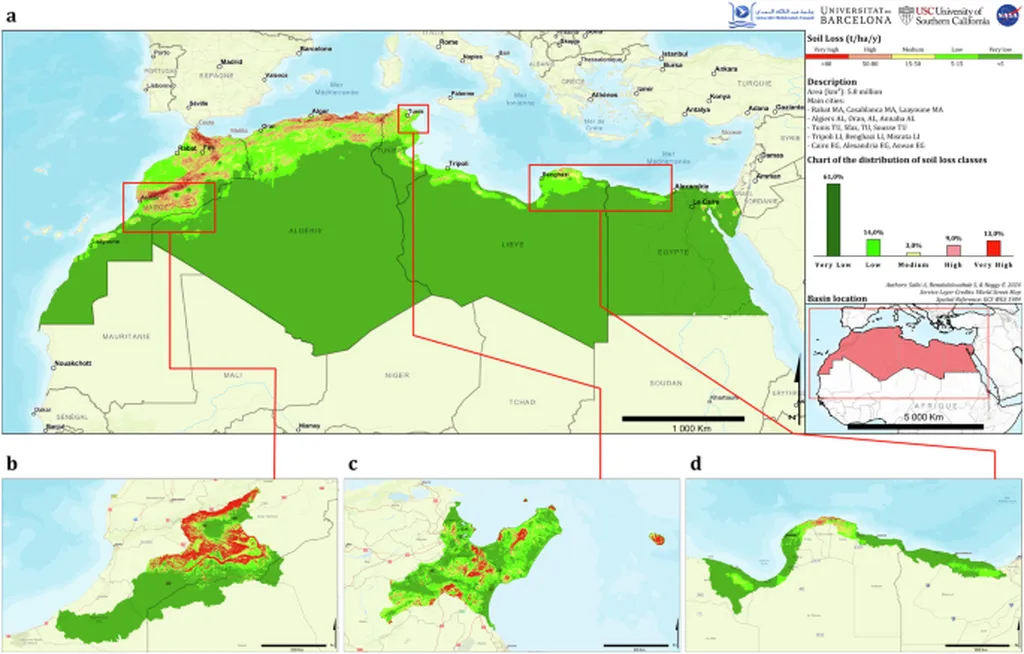
In the heart of the Middle East and North Africa (MENA), where the land is as strategic as it is fragile, a new study has shed light on the pressing issue of soil erosion. Published in *Frontiers in Earth Science*, the research, led by Ahmed Gueffaf of the Department of Earth Sciences at Echahid Cheikh Larbi Tebessi University in Algeria, focuses on the Upper-Bousselam Watershed, a critical region for cereal production. The study employs a GIS-based implementation of the Revised Universal Soil Loss Equation (RUSLE) to map and quantify water-induced soil erosion, offering a roadmap for sustainable land management.
Soil erosion is not just an environmental concern; it’s a economic one. In regions like the Upper-Bousselam Watershed, where agriculture is the lifeblood of the local economy, soil degradation directly impacts productivity and livelihoods. The study reveals a stark spatial heterogeneity in erosion intensity, with the highest soil-loss rates occurring in the northern mountainous areas and certain southern slopes. These areas, characterized by steep gradients, weak and easily erodible lithologies, and limited vegetation cover, are particularly vulnerable.
“Nearly two-thirds of the basin is characterized by low erosion levels, but about 9% of the area is subject to severe soil degradation,” Gueffaf explains. This stark contrast underscores the urgent need for targeted conservation measures. The study’s spatially explicit erosion assessment provides a scientific basis for identifying priority areas for intervention, supporting efforts to safeguard soil resources and ensure the long-term sustainability of agricultural production.
The commercial impacts of this research are significant. By pinpointing areas at risk, farmers and land managers can implement targeted conservation practices, reducing soil loss and maintaining productivity. This is not just about preserving the land; it’s about securing the economic future of the region’s agricultural sector.
Looking ahead, this research could shape future developments in the field by promoting the adoption of GIS-based models for erosion assessment. As Gueffaf notes, “The spatially explicit erosion assessment provides a sound scientific basis for identifying priority areas for conservation measures.” This approach could be replicated in other regions, offering a blueprint for sustainable land management in the face of climate change and increasing agricultural demands.
In the end, this study is a call to action. It highlights the urgent need for proactive land management strategies and offers a tool to achieve them. As the MENA region grapples with the challenges of soil degradation, this research provides a beacon of hope, guiding the way towards a more sustainable future.