
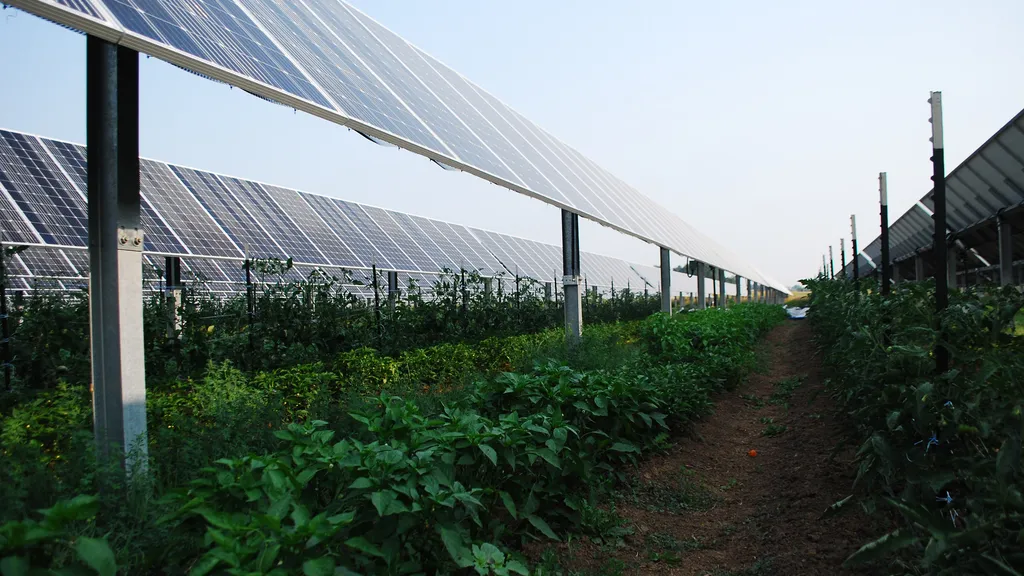
In the heart of Europe, a quiet revolution is taking place, one that promises to redefine the relationship between agriculture and renewable energy. Agrivoltaics, the innovative practice of co-locating solar panels with agricultural activities, is gaining traction as a sustainable solution to optimize land use and boost productivity. A recent study published in the Malaysian Journal of Sustainable Agriculture sheds light on the critical factors and key considerations in designing effective agrivoltaic systems, offering a glimpse into the future of farming.
The research, led by Rittick Maity from the Faculty of Electrical and Electronics Engineering Technology at Universiti Malaysia Pahang Al-Sultan Abdullah, explores the intricate balance between solar energy generation and agricultural productivity. “The design of agrivoltaic systems is a complex interplay of technical, economic, and environmental factors,” Maity explains. “Our goal is to maximize the synergies between solar energy and agriculture while minimizing potential conflicts.”
One of the key aspects highlighted in the study is the selection of suitable crops that can thrive under the varying levels of shade and microclimate changes induced by solar panels. This requires a deep understanding of both agronomy and photovoltaic technology. “We need to choose crops that not only tolerate but also benefit from the modified growing conditions under solar panels,” Maity notes. “This could open up new opportunities for farmers to diversify their crops and enhance their resilience to climate change.”
The study also emphasizes the importance of technological advancements in PV panels and mounting systems. Innovations in tracking systems, lightweight materials, and modular designs offer flexibility and adaptability to different agricultural landscapes and climatic conditions. “These advancements are crucial for enhancing the feasibility and efficiency of agrivoltaic installations,” Maity says. “They allow us to tailor the design to the specific needs of the crops and the local environment.”
Beyond the technical aspects, the research underscores the need for interdisciplinary collaboration. Agronomists, engineers, economists, and policymakers must work together to address challenges and optimize benefits. “Agrivoltaics is not just about technology; it’s about integrating technology with agricultural practices in a way that is economically viable and environmentally sustainable,” Maity explains.
The commercial impacts of agrivoltaics on the agriculture sector are substantial. By integrating solar energy production with farming, agrivoltaics can provide farmers with an additional revenue stream while reducing their carbon footprint. This can enhance the competitiveness of agricultural products in the market, as consumers increasingly demand sustainably produced food.
Moreover, agrivoltaics can contribute to food security by increasing the efficiency of land use. As the global population grows and arable land becomes scarcer, the need for innovative solutions to maximize food production becomes more pressing. Agrivoltaics offers a promising approach to meet this challenge.
The research by Maity and his team provides a comprehensive overview of the basic design, load structure, and different configurations of solar PV arrays used in agrivoltaics across Europe. This knowledge is invaluable for farmers, agritech companies, and policymakers looking to harness the potential of agrivoltaics.
As the world grapples with the dual challenges of climate change and food security, agrivoltaics emerges as a beacon of hope. By integrating solar energy with agriculture, we can create a more sustainable and resilient food system. The research published in the Malaysian Journal of Sustainable Agriculture offers a roadmap for this transformative journey, guiding us towards a future where farming and renewable energy coexist harmoniously.