
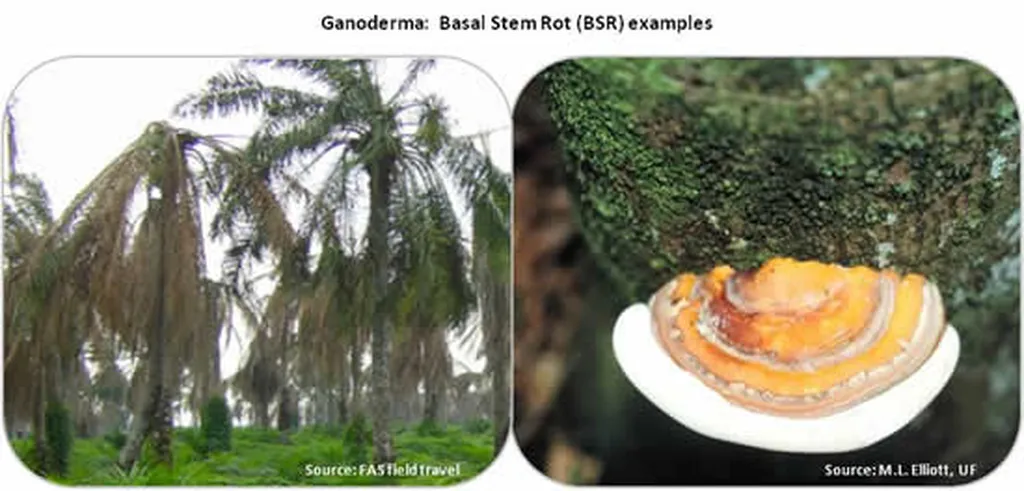
In the heart of Malaysia’s thriving oil palm industry, a silent enemy lurks beneath the soil, threatening the very roots of the sector’s prosperity. Ganoderma, a genus of fungi, is the culprit behind Basal Stem Rot (BSR) disease, a scourge that has long plagued oil palm plantations. Current management practices, relying heavily on sanitation measures and costly fungicides, have proven less than satisfactory. However, a beacon of hope emerges from the Crop Protection and Biosolutions Department of FGV R&D Sdn. Bhd., where researchers have uncovered a promising new ally in the fight against BSR: endophytic Trichoderma.
In a study published in the Malaysian Journal of Sustainable Agriculture, lead author Elya Masya Mohd Fishal and her team explored the potential of two specific strains of endophytic Trichoderma—Trichoderma asperellum M103 and T. harzianum M108—as biocontrol agents against BSR disease. The results, achieved through a simple yet effective seed coating technique, are nothing short of remarkable.
The study revealed that both Trichoderma isolates showed significant potential in suppressing BSR disease. “At the end of our study, both M108 and M103 demonstrated impressive results, reducing disease incidence to 67.78% and 71.11%, respectively, compared to the control at 87.78%,” Fishal explained. But the standout performer was M103, which not only delayed the onset of symptoms in inoculated oil palm seedlings to a staggering four months but also achieved the lowest epidemic rate and the smallest area under the disease progress curve.
The implications of these findings for the agriculture sector are profound. The use of endophytic Trichoderma as a biocontrol agent offers a sustainable and cost-effective alternative to traditional fungicides. “This research underscores the potential of endophytic Trichoderma as a viable biocontrol agent against BSR disease,” Fishal noted. “It opens up a promising avenue for sustainable disease management in oil palm cultivation.”
The commercial impact of this research could be substantial. By reducing the incidence and severity of BSR disease, oil palm plantations could see increased yields and improved profitability. Moreover, the use of biocontrol agents aligns with the growing global demand for sustainable and environmentally friendly agricultural practices.
Looking ahead, this research could pave the way for further exploration of endophytic Trichoderma and other biocontrol agents. As Fishal and her team continue to delve into the potential of these microbial allies, the future of oil palm cultivation looks increasingly bright. The fight against BSR disease is far from over, but with endophytic Trichoderma in their corner, farmers and researchers alike can take heart in the knowledge that nature itself may hold the key to sustainable and effective disease management.