
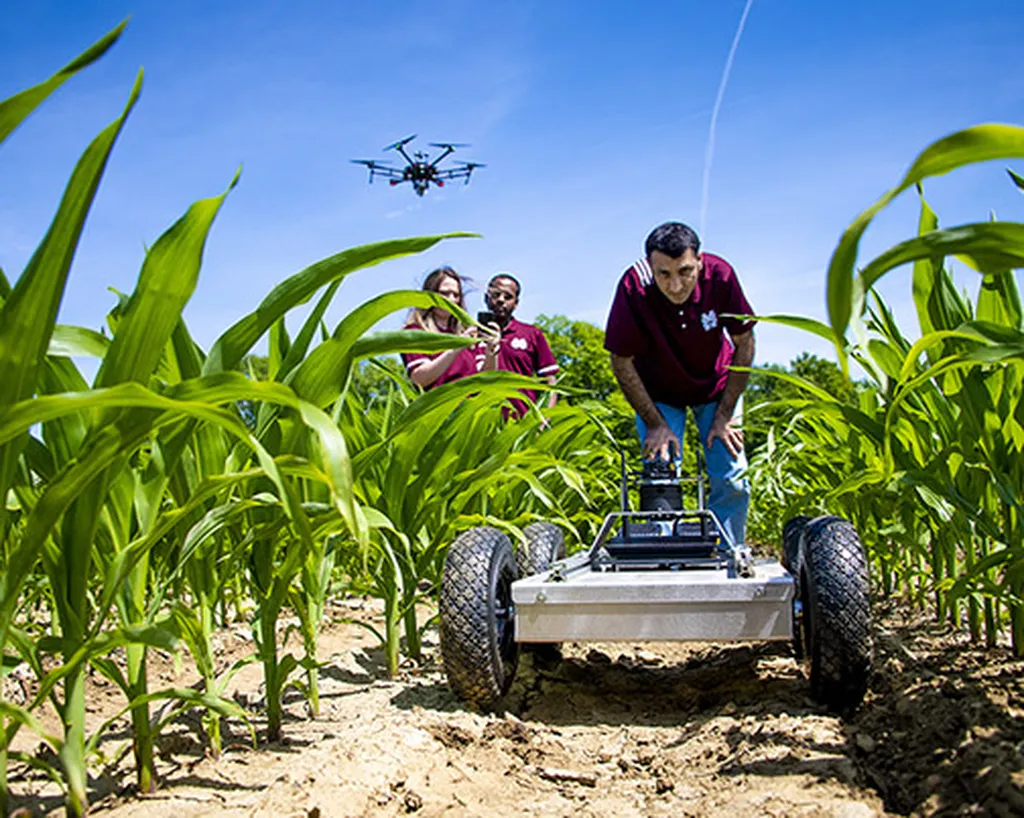
In the heart of Mississippi, where agriculture is the lifeblood of the economy, researchers at Mississippi State University (MSU) are pioneering a technological revolution aimed at transforming the way we farm. As global food demand escalates, the need for efficient, labor-reducing agricultural technologies has never been more pressing. MSU’s Department of Agricultural and Biological Engineering (ABE) and the newly established Agricultural Autonomy Institute are at the forefront of this green revolution, developing autonomous robots that not only perform field tasks but also collect valuable data to enhance crop yields and performance.
The stakes are high in Mississippi, where agriculture is the state’s largest industry, encompassing a vast 10.3 million acres. Among the crops that thrive in this fertile landscape, cotton stands out as one of the most valuable, with an estimated worth of $372 million in 2024. However, cotton harvesting presents a unique challenge due to the staggered ripening of bolls. Current harvesting systems are designed to pick all bolls in a single pass, leading to inefficiencies. Enter Hussein Gharakhani, an ABE assistant professor leading the charge in developing an autonomous cotton-harvesting robot. This innovative machine is designed to operate without a human driver, harvesting cotton with a precision that current equipment can’t match.
Gharakhani’s work is a testament to MSU’s commitment as a land-grant university to address high-priority agricultural issues. “That’s one of the main concepts as a land grant university. It’s one of our highest priorities,” Gharakhani said. “We make sure that we are solving high-priority issues related to agriculture in the state first, as well as the nation.”
The Agricultural Autonomy Institute, founded and directed by ABE Department Head Alex Thomasson, is another critical player in this technological leap. Thomasson emphasizes the necessity of autonomous equipment in combating labor shortages and meeting rising production demands. “We want to be a leader nationally and worldwide,” Thomasson said. “In fact, as far as I can tell, we’re the only university institute that’s completely focused on autonomous systems for agriculture.”
The implications of this research extend beyond the fields of Mississippi. Thomasson envisions significant economic development opportunities, attracting corporate partnerships and potentially establishing research, distribution, or manufacturing facilities in the state. “We want to do corporate engagement like we’re doing with John Deere and the Sugar Cane Growers Cooperative of Florida, to try to bring their business in the state,” Thomasson said.
A notable shift in the technology being developed is the move from large, single machines to fleets of smaller, autonomous ones. This transition allows for greater precision, reduced soil impact, and increased reliability. “If you’ve got, let’s say, five machines going through the field and one of them breaks down, you still have 80 percent of your operation functioning,” Thomasson explained. “If you have one large machine and that large machine breaks down, you have 0 percent of your operation moving forward.”
Gharakhani’s cotton harvester embodies this shift. By using machine vision and learning, the robot can identify and harvest individual cotton bolls selectively, a feat made increasingly possible by advances in artificial intelligence (AI). “Artificial intelligence is improving drastically, and it has been applied on different things, starting from perception systems or machine-vision systems,” Gharakhani noted.
The research doesn’t stop at harvesting. Moeen Ul Islam, a second-year Ph.D. student in ABE, is developing an autonomous ground vehicle designed to work in tandem with drones to collect high-quality agricultural data. “The thing about the new era of agriculture is people are trying to get as much data as possible,” Ul Islam said. This data can be analyzed to identify diseases and problems with crops, helping growers improve their yields. “So once you know a lot of information about your field, then you can effectively work to improve it,” Ul Islam explained.
AI is also crucial in training robots to navigate unpredictable agricultural environments. “I think nowadays it’s really hard to not use AI in like really advanced robots, because especially when in agriculture, everything is so unpredictable,” Ul Islam said. “So you need to have, like, some sort of training on the robot that you do prior to releasing it on the field for a mission so that it can handle unpredictable situations based on what it has learned from, like AI or machine learning models.”
Ul Islam plans to field test his robot this week, with a target completion date of April. The data gathered by these systems will be invaluable to local farmers and researchers globally, providing a solid backbone for agricultural research and innovation. “So that’s, I think, like a goal for us, so that we can develop a system that can provide, like a really solid backbone to research done by people all over the