
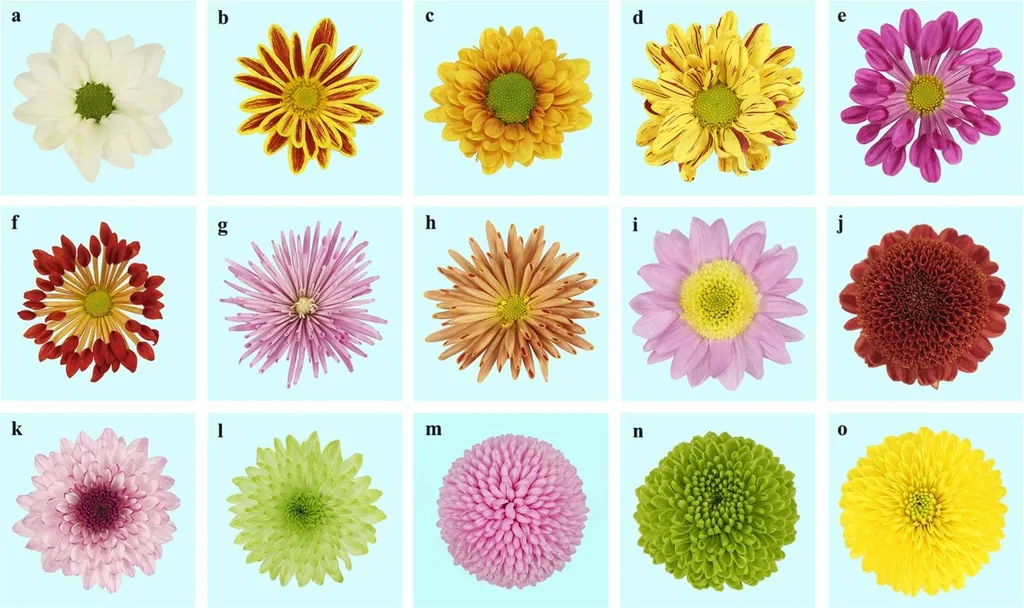
In the heart of New Delhi, a team of researchers led by Gunjeet Kumar from the Division of Floriculture and Landscaping at the Indian Agricultural Research Institute has been delving into the genetic diversity of Chrysanthemum morifolium, a flower renowned for its ornamental value and commercial significance. Their findings, recently published in the Malaysian Journal of Sustainable Agriculture, offer a promising glimpse into the future of chrysanthemum cultivation and breeding.
The study, which systematically characterized 50 genotypes of Chrysanthemum morifolium based on DUS (Distinctness, Uniformity, and Stability) descriptors, revealed significant variations in both quantitative and qualitative traits. This diversity is a goldmine for breeders looking to develop new cultivars with novel flower and plant architectures.
“Genetic diversity is the cornerstone of crop improvement,” Kumar explained. “By understanding and harnessing this diversity, we can develop new chrysanthemum varieties that are not only aesthetically pleasing but also resilient to environmental stresses.”
The researchers observed substantial variability in 14 quantitative traits, with the number of flowers per plant showing the highest genetic coefficient of variation (GCV) and phenotypic coefficient of variation (PVC). This suggests that breeders could make significant gains by selecting for this trait.
Principal Component Analysis (PCA) and cluster analysis further revealed that leaf characters and ray floret traits contribute significantly to the genetic variability in chrysanthemum germplasm. This insight could guide breeders in their selection and crossing strategies.
The study also highlighted the potential of certain genotypes, such as Gauri and Pusa Shwet, which stood out due to their unique traits. Gauri, for instance, was an outlier for plant height and number of flowers per plant, while Pusa Shwet had a unique combination of large-sized and semi-double type flower heads.
The commercial implications of this research are substantial. Chrysanthemums are a major player in the global floriculture market, with a market size of over $1.5 billion. By developing new cultivars with improved traits, breeders can cater to the evolving demands of consumers and the agriculture sector.
Moreover, the study’s findings could also aid in the conservation of chrysanthemum genetic resources. By identifying and preserving diverse genotypes, researchers can ensure the long-term sustainability of chrysanthemum cultivation.
As we look to the future, this research paves the way for more targeted and efficient breeding programs. By leveraging the power of genetic diversity, breeders can develop chrysanthemum varieties that are not only beautiful but also resilient, productive, and adaptable to changing climates.
In the words of Kumar, “This is just the beginning. The insights gained from this study will undoubtedly shape the future of chrysanthemum breeding and cultivation, benefiting both growers and consumers alike.”