
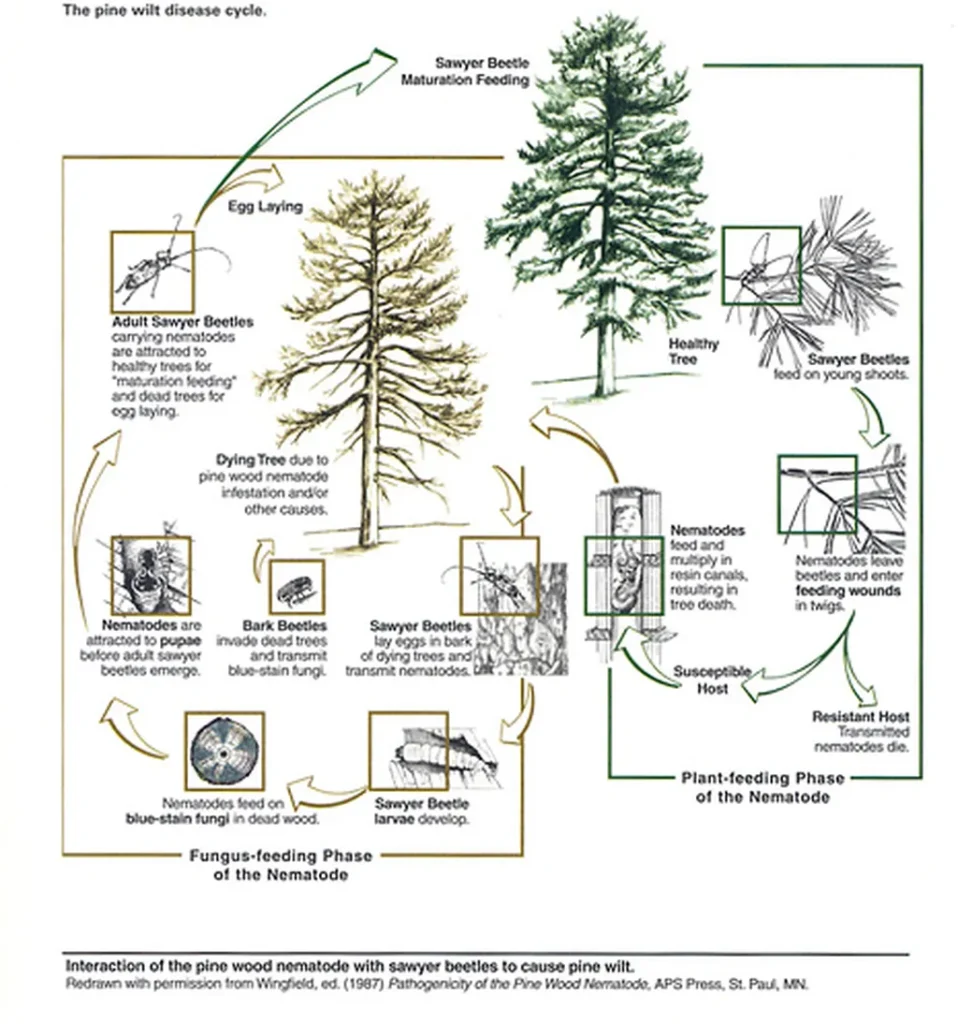
In the relentless battle against pine wilt disease, a formidable foe often dubbed the “cancer of pine trees,” researchers have unveiled a promising new weapon: PGCNet. This innovative semantic segmentation model, detailed in a study published in *Frontiers in Plant Science*, combines the strengths of Convolutional Neural Networks (CNNs) and Transformers to offer a robust solution for identifying this rapidly spreading and highly lethal disease.
Pine wilt disease poses a significant threat to forest ecosystems, with its rapid spread and high mortality rate. Traditional identification methods, while useful, often fall short due to limitations in their ability to capture both global context and local details. Existing fusion strategies, which combine different types of neural networks, have struggled with high computational overhead and inadequate integration of semantic and detailed information.
Enter PGCNet, developed by a team led by Jiying Liu from the School of Information Science and Technology at Yunnan Normal University in Kunming, China. PGCNet stands out by efficiently fusing CNN and Transformer representations, leveraging the CSWin Transformer as its backbone network to capture comprehensive global contextual information. “Our model employs a Progressive Guidance Fusion Module (PGFM) to achieve effective cross-layer fusion of semantic and detailed features through a spatial–channel collaborative attention mechanism,” Liu explains. This innovative approach ensures that the model can handle complex background interference and identify small-scale disease targets with remarkable accuracy.
One of the standout features of PGCNet is its lightweight Context-Aware Residual Atrous Spatial Pyramid Pooling module (CAR-ASPP), which enhances multi-scale feature representation while significantly reducing the number of parameters and computational complexity. This makes the model particularly suitable for edge computing environments, where real-time monitoring and deployment are crucial.
The commercial implications for the agriculture sector are substantial. Pine wilt disease not only devastates forest ecosystems but also has a significant economic impact on the timber industry. Early and accurate identification of the disease can lead to timely interventions, reducing the spread and mitigating financial losses. “Our model offers a practical solution for real-time monitoring and edge deployment of forestry disease detection,” Liu notes, highlighting the potential for extending this technology to other agricultural remote sensing disease identification tasks.
The study’s experimental results demonstrate that PGCNet outperforms mainstream semantic segmentation models across multiple evaluation metrics. Its high accuracy and computational efficiency make it a valuable tool for forestry and agricultural applications. As the agriculture sector continues to embrace technological advancements, models like PGCNet could play a pivotal role in disease management and ecosystem preservation.
In the broader context, this research underscores the importance of integrating advanced neural network architectures to address complex agricultural challenges. The fusion of CNN and Transformer representations in PGCNet not only enhances disease detection capabilities but also sets a precedent for future developments in the field. As researchers continue to refine these models, the potential for real-time, accurate, and efficient disease identification could revolutionize agricultural practices, ensuring the health and sustainability of our ecosystems.
With its innovative approach and promising results, PGCNet represents a significant step forward in the fight against pine wilt disease. As the agriculture sector increasingly turns to technology for solutions, this research offers a glimpse into the future of disease management and ecosystem preservation.