
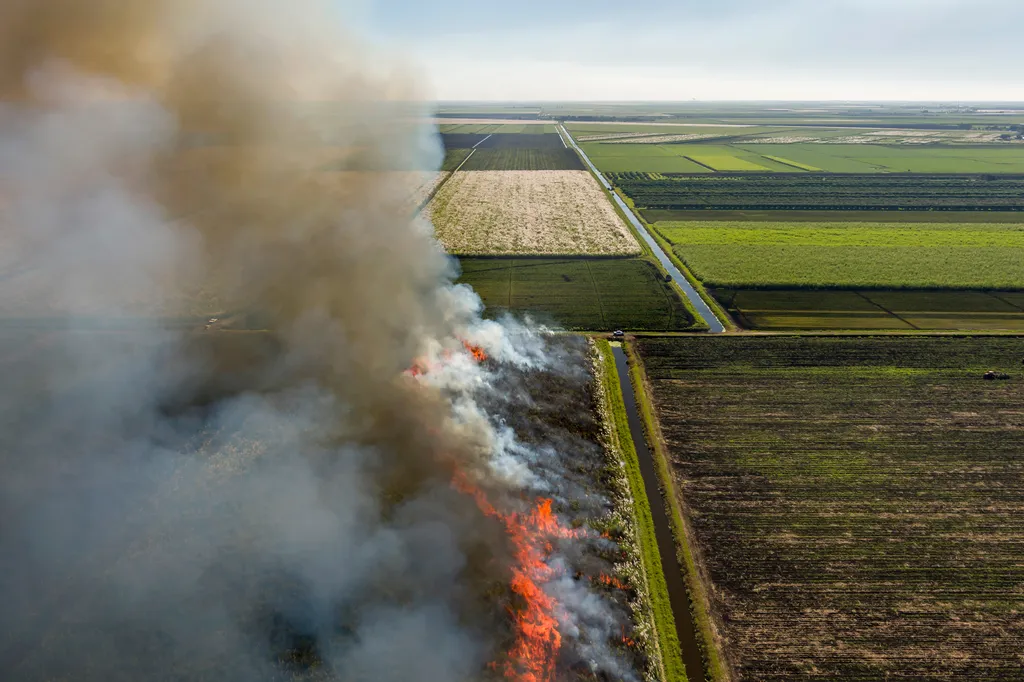
In the heart of South Florida, a silent battle is waged between the agricultural industry and the air quality it impacts. The burning of sugarcane fields, a practice aimed at simplifying the harvesting process, releases significant amounts of fine particulate matter (PM2.5) into the air. A recent study, published in *GeoHealth*, sheds light on the extent of this issue and its disproportionate impact on certain communities.
The study, led by Olivia Sablan from the Department of Atmospheric Science at Colorado State University, utilized a combination of low-cost PurpleAir sensors, regulatory monitors, and satellite imagery to quantify PM2.5 levels during the 2022–2023 sugarcane burning season. The findings reveal a stark reality: median 24-hour PM2.5 concentrations increased by 2.3–6.9 μg/m³ on smoke-impacted days compared to unimpacted days. Moreover, short-term PM2.5 increases of over 40 μg/m³ were observed during smoke events.
Sablan emphasizes the importance of surface measurements in capturing these increases. “Satellite imagery is of limited use for detecting smoke from agricultural fires in Florida due to the cloud cover, overnight smoke, and the fires being small and short-lived,” she explains. “For these reasons, surface measurements are critical for capturing increases in PM2.5 from smoke.”
The study also highlights a significant disparity in smoke exposure between different regions. The inland area near the Everglades Agricultural Area (EAA), home to large populations of low-income and minoritized groups, experienced more smoke-impacted days and higher study-average smoke PM2.5 concentrations compared to the more affluent coastal region. This finding underscores the need for increased air quality monitoring near the EAA.
For the agricultural sector, these findings present a complex challenge. While burning sugarcane fields may facilitate harvesting, it also poses significant health risks to nearby communities and potential regulatory scrutiny. As Sablan notes, “These findings highlight the need to increase air quality monitoring near the EAA.”
Looking ahead, this research could shape future developments in air quality monitoring and regulation. The use of low-cost sensors, as demonstrated in this study, could become a more common tool for tracking PM2.5 levels in agricultural regions. Additionally, the findings may prompt policymakers to reconsider current practices and explore alternative harvesting methods that minimize smoke emissions.
In the meantime, the study serves as a stark reminder of the delicate balance between agricultural productivity and environmental health. As the world grapples with the impacts of climate change and air pollution, the need for sustainable and equitable agricultural practices has never been more pressing.