
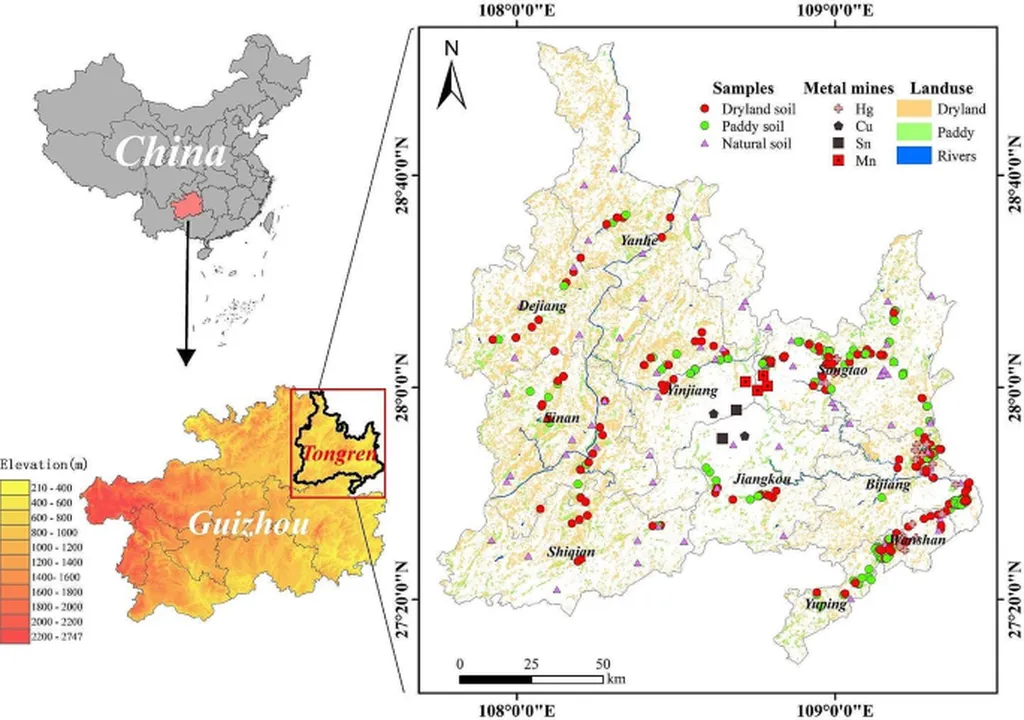
In the heart of Southwest China, where mining activities have left a complex geochemical footprint, a groundbreaking study is reshaping our understanding of heavy metal risks in agricultural soils. Published in *Ecotoxicology and Environmental Safety*, the research led by Dapeng Zong from the Key Laboratory for Conservation and Utilization of In-forest Resource at Southwest Forestry University, challenges conventional risk assessment models and underscores the urgent need for refined regulatory frameworks.
The study focuses on the bioaccessibility and cellular toxicity of heavy metals—Cu, Cd, Pb, Cr, and Ni—in contaminated soils. Traditional risk assessments often rely solely on total metal concentrations, but this approach may be misleading. “Our findings reveal critical limitations in current models,” Zong explains. “While cadmium (Cd) has long been recognized as a dominant ecological risk, our research highlights that chromium (Cr) poses a significant carcinogenic threat that has been severely underestimated.”
The integrated risk assessment framework developed by Zong and his team combines physiologically based extraction tests (PBET) with human intestinal cell (Caco-2) assays. This innovative approach provides a more accurate picture of the bioaccessible fractions of these metals and their potential toxicity. The results are striking: Cr emerged as the primary carcinogenic threat, with a lifetime cancer risk exceeding regulatory thresholds despite its relatively lower total concentration.
The bioaccessible fractions of these metals induced significant dose-dependent cytotoxicity and oxidative stress in human intestinal cells. Notably, Cr exposure caused substantial DNA damage, confirming its underestimated genotoxic potential. “This study demonstrates that conventional risk assessments can overestimate risks from metals like Cd and Cu while dangerously underestimating the carcinogenicity of Cr,” Zong adds.
The implications for the agriculture sector are profound. Accurate risk stratification is crucial for developing targeted remediation strategies and science-based policies in mining-affected regions. By incorporating both bioaccessible fractions and cellular toxicity endpoints, this integrated approach offers a scientifically robust methodology that can support sustainable agriculture and food security.
As the world grapples with the challenges of heavy metal contamination, this research provides a critical tool for refining existing regulatory frameworks. It underscores the need for a more nuanced understanding of metal bioaccessibility and biological effects, ultimately shaping future developments in soil remediation and agricultural practices.
In an era where food safety and sustainable land management are paramount, this study offers a beacon of hope. By addressing the overlooked hazards of Cr and other heavy metals, it paves the way for more accurate risk assessments and targeted interventions, ensuring a safer and more sustainable future for agriculture.