
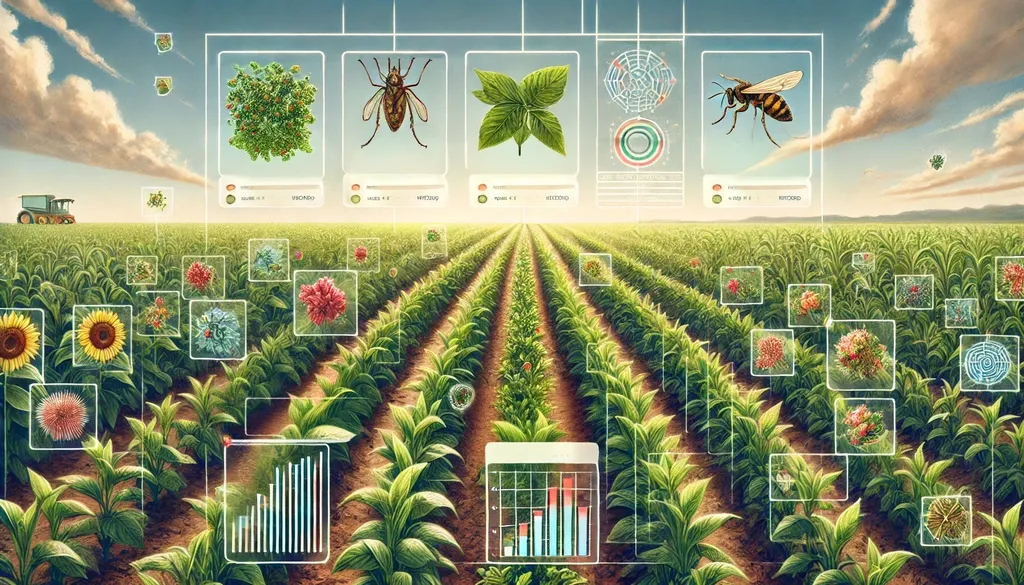
In the ever-evolving landscape of precision agriculture, a groundbreaking development has emerged that promises to revolutionize how we detect and manage plant diseases. Researchers have introduced STAR-Net, a novel deep learning model designed to tackle the complex challenges of plant disease segmentation in real-world agricultural environments. Published in *Frontiers in Plant Science*, this study, led by Yulong Fan, presents a robust solution that could significantly enhance disease detection accuracy and efficiency, ultimately benefiting farmers and the broader agricultural sector.
Plant disease segmentation is fraught with technical hurdles, including intricate backgrounds, varied lesion morphologies, and extreme class imbalances. These challenges have historically limited the effectiveness of traditional detection methods. STAR-Net addresses these issues head-on with an innovative architecture and a dynamic training strategy. The model features a Heterogeneous Branch Attention Aggregation (HBAA) module, which excels at capturing multi-scale and multi-morphology features, ensuring precise disease identification even in complex scenarios.
One of the standout achievements of STAR-Net is its performance on the NLB dataset, where it achieved a state-of-the-art average mIoU (mean Intersection over Union) of 93.36%. This metric underscores the model’s ability to accurately segment diseases with specific elongated morphologies, a critical capability for early and precise disease detection. Additionally, the model demonstrated remarkable robustness on the highly challenging PlantSeg dataset, achieving an average mIoU of 41.13%. This performance highlights its potential to thrive in real-world, ‘in-the-wild’ conditions, where variability and complexity are the norm.
The implications of this research are profound for the agriculture sector. Accurate and efficient disease segmentation can lead to timely interventions, reducing crop losses and improving yield. “Our work presents a powerful, well-validated, and synergistic solution for plant disease segmentation,” said lead author Yulong Fan. “It paves the way for practical applications in precision agriculture, where early detection and targeted treatment can make a significant difference in crop health and productivity.”
The commercial impact of STAR-Net extends beyond individual farms. By integrating this technology into existing agricultural systems, companies can offer advanced disease management solutions, enhancing their competitive edge. Farmers can benefit from reduced reliance on manual inspections and more effective use of resources, ultimately leading to sustainable and profitable farming practices.
Looking ahead, the success of STAR-Net sets a new benchmark for plant disease segmentation. Its innovative approach could inspire further advancements in deep learning and computer vision, driving the development of even more sophisticated agricultural technologies. As precision agriculture continues to evolve, models like STAR-Net will play a pivotal role in shaping the future of sustainable and efficient farming practices.
This research, led by Yulong Fan and published in *Frontiers in Plant Science*, represents a significant step forward in the fight against plant diseases. By leveraging cutting-edge technology, it offers a glimpse into a future where agriculture is not only more precise but also more resilient.