
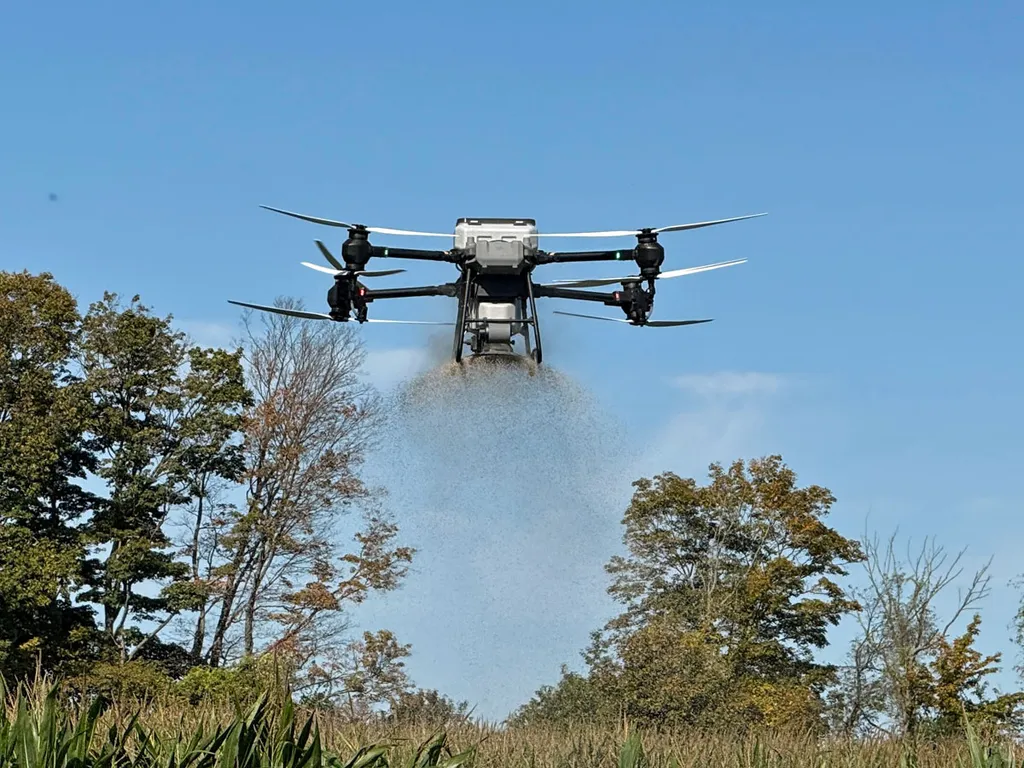
In the heart of Connecticut, a team of researchers led by Tong Wang at the University of Connecticut is revolutionizing the way we understand and interact with plants. Their work, recently published in *Frontiers in Plant Science*, is bridging the gap between artificial intelligence and plant science, promising to reshape the future of agriculture.
Imagine a world where drones and satellites work in tandem to monitor crop health, where AI algorithms predict yields with unprecedented accuracy, and where farmers can make data-driven decisions to optimize their harvests. This world is not a distant dream; it’s a reality that’s unfolding right now, thanks to advancements in AI and remote sensing technologies.
The research team, led by Wang, is harnessing the power of AI to transition plant research from manual measurements to automated data collection. High-throughput image-based phenotyping is at the forefront of this revolution. This technology enables the precise and automated acquisition of plant traits across various spatial and temporal scales, from controlled laboratory settings to complex field environments.
“AI is a game-changer,” says Wang. “It allows us to combine satellite observations, UAV imaging, soil and climate data, and spatiotemporal information to enhance the precision of trait monitoring and yield prediction.” This integration of AI methodologies with plant phenotyping and yield forecasting is paving the way for accurate and sustainable modern agriculture.
The commercial impacts of this research are profound. Precision agriculture, driven by AI, can significantly reduce costs and increase efficiency for farmers. By predicting yields and traits with greater accuracy, farmers can make informed decisions about resource allocation, planting strategies, and harvest timing. This not only boosts productivity but also promotes sustainable farming practices.
Moreover, the ability to monitor crop health in real-time can help in early detection of diseases and pests, preventing potential losses. “This technology is not just about increasing yields; it’s about ensuring food security and sustainability,” Wang emphasizes.
The research also opens up new avenues for crop improvement. By understanding how different traits respond to environmental conditions, breeders can develop crops that are more resilient to climate change. This is crucial in a world where the effects of climate change are becoming increasingly evident.
Looking ahead, the integration of AI in plant science is set to grow. The research team’s work is just the beginning. As AI algorithms become more sophisticated and data collection methods more advanced, the potential applications in agriculture are limitless.
In the words of Wang, “We are at the dawn of a new era in agriculture. The fusion of AI and plant science is not just a trend; it’s the future.” This future promises a more efficient, sustainable, and resilient agricultural sector, benefiting farmers, consumers, and the environment alike.
As we stand on the brink of this agricultural revolution, one thing is clear: the seeds of change have been sown, and the harvest is within sight. The research led by Tong Wang at the University of Connecticut’s Department of Plant Science and Landscape Architecture is a testament to the transformative power of AI in plant science, heralding a new era of precision and sustainability in agriculture.