
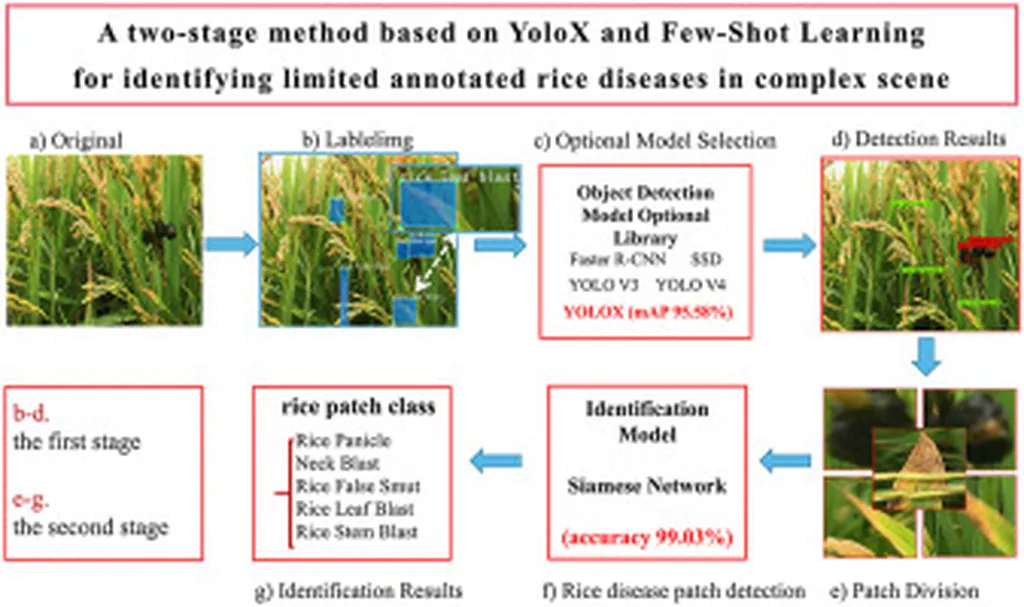
In the quest to bolster food security and streamline agricultural management, researchers have developed a novel approach to rice disease recognition that could revolutionize precision agriculture. The challenge has long been balancing accuracy with computational efficiency, especially when deploying models on resource-constrained devices commonly used in farming. A recent study published in *Frontiers in Plant Science* introduces LightWaveNet, a lightweight wavelet-enhanced network designed to address these very issues.
LightWaveNet stands out by employing a parallel structure of wavelet convolution and max pooling, enabling it to capture both high-frequency (fine-grained textures) and low-frequency (overall structural patterns) information simultaneously. This dual approach allows for a more comprehensive understanding of diseased areas in rice plants. “Most existing methods rely solely on spatial domain representations, which makes it difficult to capture both types of features effectively,” explains lead author Weiqiang Pi from the College of Intelligent Manufacturing and Elevator at Huzhou Vocational and Technical College. “Our model bridges this gap by leveraging wavelet transformations to enhance feature extraction.”
The model’s efficiency is equally impressive. With only 0.28 million parameters and 0.02 G FLOPs, LightWaveNet achieves a recognition accuracy of 95.90%. To put this into perspective, it outperforms the lightweight Mobilenetv2 model, which has 2.24 million parameters and 0.30 G FLOPs, while maintaining lower computational complexity. This efficiency is crucial for deployment in agricultural settings where resources are often limited.
The commercial implications for the agriculture sector are substantial. Accurate and rapid disease identification can lead to timely interventions, reducing crop losses and improving yields. Farmers can make data-driven decisions, optimizing the use of pesticides and other resources, ultimately leading to more sustainable and profitable farming practices. “This technology has the potential to transform how we approach disease management in agriculture,” says Pi. “By making high-accuracy models accessible on low-resource devices, we can empower farmers with the tools they need to protect their crops effectively.”
The introduction of LightWaveNet also opens up new avenues for research in lightweight recognition networks. Its innovative use of wavelet transformations and multi-stage supervision mechanisms could inspire further advancements in model design, particularly in fields where computational efficiency is paramount. As the agriculture sector continues to embrace digital transformation, such technologies will play a pivotal role in shaping the future of smart farming.
In summary, LightWaveNet represents a significant step forward in the field of precision agriculture. By combining high accuracy with computational efficiency, it offers a practical solution for rice disease recognition that can be readily deployed in real-world agricultural settings. As researchers continue to refine and expand upon this technology, its impact on the agriculture sector is poised to grow, heralding a new era of intelligent and sustainable farming practices.