
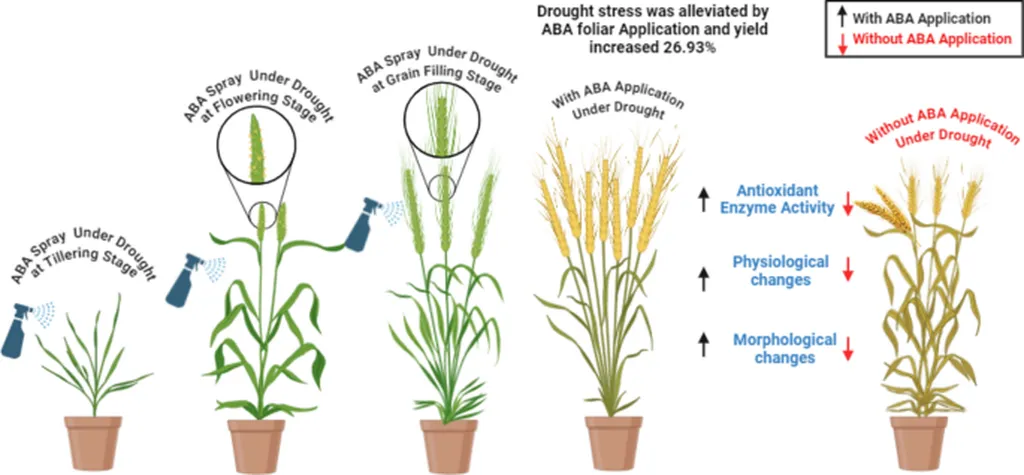
In the face of global climate change, rice farmers are grappling with the dual challenge of maintaining yield and quality while combating environmental stress. A recent study published in *Crop and Environment* sheds light on a critical plant hormone, abscisic acid (ABA), and its role in balancing rice growth and stress response. The research, led by Jiaying Zhai from the Hunan Provincial Key Laboratory of Stress Biology at Hunan Agricultural University, offers insights that could revolutionize rice cultivation strategies and variety improvement.
Plants, much like humans, must navigate a complex web of signals to respond to their environment. When faced with abiotic stress—such as drought, salinity, or extreme temperatures—they generate, perceive, and transmit signals that enhance their resistance. ABA acts as a key player in this process, coordinating growth and stress adaptation. “ABA is like a master regulator,” explains Zhai. “It helps rice plants make critical decisions about how to allocate resources between growth and defense.”
The study delves into the regulatory mechanisms of ABA in rice, analyzing signaling pathways, gene expression regulation, and functional characteristics under varying environmental conditions. One of the most compelling findings is how ABA mediates the trade-off between growth and stress defense. In simpler terms, ABA helps rice plants strike a balance between investing energy in growth or in defending against environmental stressors.
This research is not just academic; it has significant commercial implications for the agriculture sector. As climate change intensifies, understanding how to optimize rice cultivation becomes increasingly important. By leveraging the insights from this study, breeders and agronomists can develop rice varieties that are more resilient to environmental stress while maintaining high yields. “Our findings provide a theoretical basis for improving rice varieties and formulating efficient cultivation strategies,” says Zhai.
The study also highlights the potential for epigenetic regulation, which could open new avenues for crop improvement. Epigenetics involves changes in gene expression that do not alter the DNA sequence but can be inherited. This could lead to more targeted and sustainable approaches to enhancing rice resilience.
Looking ahead, this research could shape future developments in the field of agritech. By understanding the intricate balance mediated by ABA, scientists can develop more precise interventions to enhance crop resilience. This could include the use of biostimulants, genetic modification, or even AI-driven precision agriculture techniques to optimize ABA levels in crops.
In the broader context, this study underscores the importance of interdisciplinary research. By combining insights from plant biology, epigenetics, and agronomy, scientists can address some of the most pressing challenges in agriculture. As Zhai notes, “This is just the beginning. There’s so much more to explore in how plants adapt to their environment.”
For the agriculture sector, the implications are profound. As climate change continues to impact crop yields, the ability to develop stress-resistant varieties could mean the difference between scarcity and abundance. This research not only provides a roadmap for improving rice cultivation but also offers a glimpse into the future of sustainable agriculture.
Published in *Crop and Environment* and led by Jiaying Zhai from the Hunan Provincial Key Laboratory of Stress Biology at Hunan Agricultural University, this study is a testament to the power of scientific inquiry in addressing real-world challenges. As we move forward, the insights gained from this research could pave the way for a more resilient and sustainable agricultural future.