
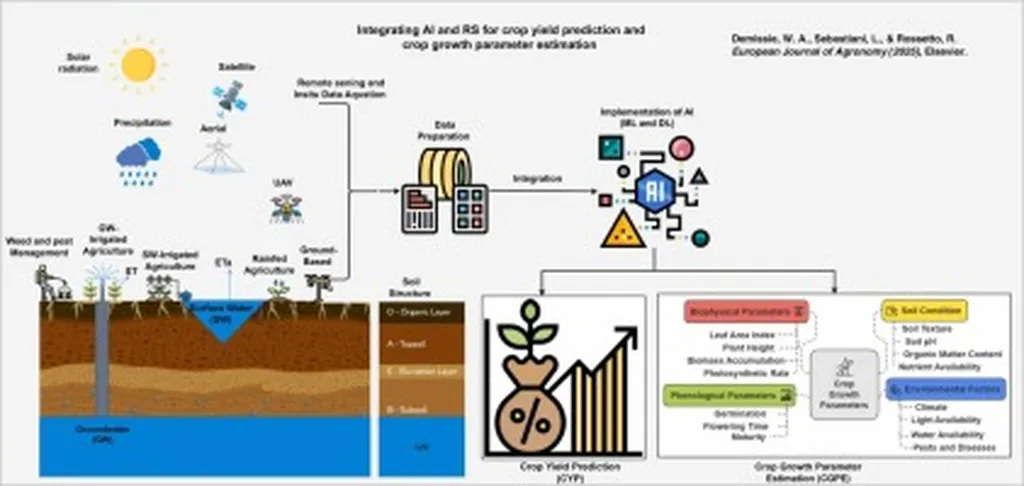
In the face of climate change and the pressing need for food security, accurate crop yield forecasting has become more critical than ever. Traditional methods, while useful, often fall short in capturing the intricate, nonlinear relationships between crops, soil, and climate. However, a recent study published in the *ITM Web of Conferences* offers a promising solution by leveraging the power of artificial intelligence (AI) and remote sensing technologies.
The research, led by Sunil Alwin Dany from the Division of Artificial Intelligence and Machine Learning at Karunya Institute of Technology and Sciences, explores how machine learning (ML) and deep learning (DL) models can be combined with remote sensing data to revolutionize crop yield forecasting. The study highlights the limitations of conventional methods like regression and ARIMA models, which struggle to fully represent the complex dynamics of crop growth.
By integrating data from multiple sources, including remote sensing indices, soil properties, and weather variables, the researchers were able to create a more comprehensive and accurate forecasting system. “The hybrid DL networks, such as CNN-LSTM, and algorithms like Random Forest (RF), Support Vector Machine (SVM), and Gradient Boosting, have shown remarkable capabilities in capturing both temporal and spatial aspects of crop growth dynamics,” Dany explained.
The results of the study are compelling. Hybrid DL models outperformed traditional and standalone ML models in terms of accuracy and scalability. This advancement not only enhances our ability to predict crop yields but also paves the way for more sustainable and data-driven agricultural decision-making.
The commercial implications for the agriculture sector are significant. Accurate crop yield forecasting can lead to better resource management, reduced waste, and improved food security. Farmers and agribusinesses can make more informed decisions about planting, harvesting, and marketing, ultimately leading to increased profitability and sustainability.
As the agriculture industry continues to evolve, the integration of AI and remote sensing technologies is likely to play a pivotal role. This research underscores the potential of these technologies to transform the way we approach crop yield forecasting and agricultural sustainability. By harnessing the power of data and advanced algorithms, we can create a more resilient and efficient agricultural system that meets the challenges of a changing climate and growing global population.
In the words of Dany, “The presented system provides a path to data-driven, renewable agricultural decision-making and underlines the possibility of joining data from multiple sources and using detailed information for effective crop yield forecasting.” This innovative approach not only enhances our ability to predict crop yields but also paves the way for a more sustainable and secure future for agriculture.