
In the ever-evolving landscape of precision agriculture, a groundbreaking study published in *Frontiers in Plant Science* is set to revolutionize how farmers detect and manage pumpkin leaf diseases. The research, led by Ruchika Bhuria from the Chitkara University Institute of Engineering and Technology in India, introduces an advanced deep-learning framework that promises to enhance disease diagnosis, ultimately safeguarding crop yields and boosting agricultural productivity.
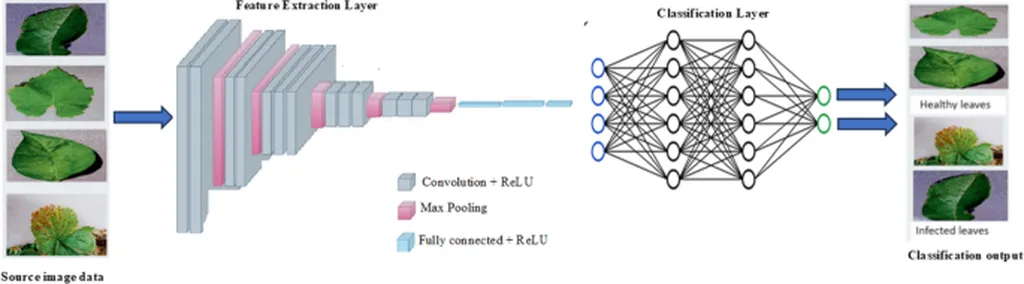
The study addresses a critical challenge in modern farming: the slow, subjective, and labor-intensive process of manually inspecting pumpkin leaves for diseases. Traditional methods often fall short in real-field environments, where timely and accurate detection is paramount. To overcome these limitations, Bhuria and her team developed a novel deep-learning architecture called DualFusion-CBAM-Stochastic. This hybrid model combines two powerful convolutional neural networks—DenseNet121 and EfficientNetB3—to extract fine-grained textures and multi-scale contextual features from leaf images.
“Our model leverages the strengths of both DenseNet121 and EfficientNetB3, integrating them through a dual-backbone fusion approach,” Bhuria explained. “This synergy allows for more robust feature extraction, significantly improving the accuracy of disease classification.”
The DualFusion-CBAM-Stochastic framework also incorporates a Convolutional Block Attention Module (CBAM) to refine features through sequential channel and spatial attention. Additionally, stochastic-depth regularization is employed to enhance model generalization by randomly bypassing deep layers during training. These innovations collectively contribute to a classification accuracy of 96%, outperforming existing CNN-based approaches.
The implications for the agriculture sector are profound. Early and accurate detection of pumpkin leaf diseases can lead to timely interventions, reducing crop losses and improving yield quality. “Precision agriculture is all about making data-driven decisions,” Bhuria noted. “Our model provides farmers with a reliable tool to monitor and manage diseases effectively, ultimately contributing to sustainable and profitable farming practices.”
The study’s findings not only advance automated disease diagnosis but also lay a strong methodological foundation for future research in agricultural image analysis. As the agricultural industry continues to embrace technological advancements, the DualFusion-CBAM-Stochastic framework could pave the way for similar applications in other crops, further enhancing precision agriculture’s potential.
In a field where every percentage point in yield improvement translates to significant economic gains, this research offers a promising solution. By integrating cutting-edge deep-learning techniques with practical agricultural needs, Bhuria and her team have made a significant stride towards a more efficient and sustainable future for farming.
The study, published in *Frontiers in Plant Science*, underscores the transformative power of AI in agriculture, highlighting the potential for similar innovations to address other pressing challenges in the sector. As the world grapples with the need for sustainable food production, such advancements are crucial in ensuring food security and economic stability for farmers worldwide.