
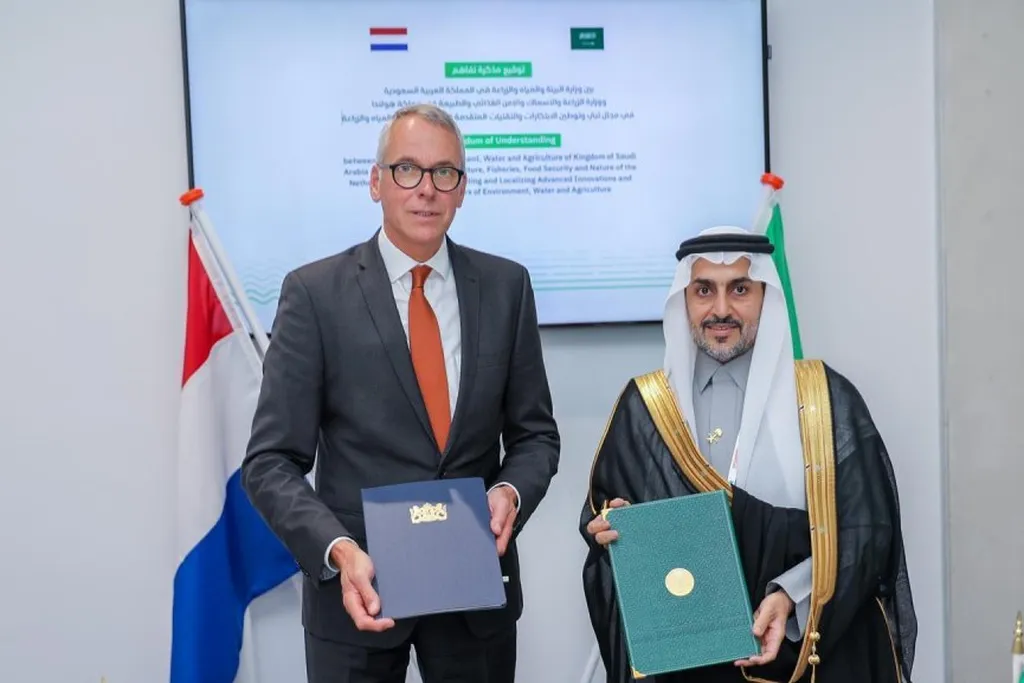
In a significant move to bolster international cooperation in agriculture, water management, and environmental innovation, Saudi Arabia and the Netherlands have signed 27 agreements and memoranda of understanding (MoUs). The agreements, totaling over SAR428 million (approximately USD 114 million), were inked during a visit by Saudi Vice Minister Eng. Mansour Al-Mushaiti to the Netherlands from June 10 to 12, 2025.
The agreements, involving both public and private sector participants, focus on the development and localization of technologies crucial for the future of agriculture and environmental sustainability. This initiative aligns with Saudi Vision 2030, which aims to diversify the economy, enhance technological capabilities, and promote sustainable development.
Key collaborations include biotechnology, greenhouse technologies, crop protection, and potato processing. These areas are critical for Saudi Arabia’s long-term agricultural strategy, which seeks to improve food security and reduce dependency on imports.
One of the notable agreements is between Saudi Arabia’s National Program for Livestock and Fisheries and the Dutch company VigGuard. This MoU aims to develop localized livestock disease control technologies, a crucial step in enhancing the Kingdom’s livestock sector.
In the realm of greenhouse and biotech development, collaborations were formed between the Saudi National Center for Sustainable Agriculture and several Dutch partners, including the Dutch Greenhouse Delta, Hoogendoorn, Hudson River Biotechnology, and Wageningen University. These partnerships focus on capacity building in sustainable agriculture and biotechnology, areas where the Netherlands has a proven track record.
Another significant agreement involves the Al-Yasin Agricultural Company and the Cobret Experimental Center. This partnership, valued at up to EUR 1 million (approximately USD 1.07 million), aims to support crop protection innovation, a critical component in ensuring food security.
The potato processing and production sector also saw notable developments with a MoU between the Lehaa Group, the Dutch Royal HZPC Group, and Gal Sahara Potato Production Company. This agreement involves investments exceeding SAR76 million (approximately USD 20.3 million) to enhance local potato output and build a French fries processing facility, a move that could significantly boost the local agricultural industry.
Dafa Agricultural Company signed six MoUs with companies specializing in vegetables, fertilizers, greenhouse systems, and agricultural software, totaling SAR292 million (approximately USD 77.9 million). These agreements are expected to bring advanced technologies and expertise to Saudi Arabia, furthering the country’s agricultural capabilities.
Additional partnerships were signed between the Makkah Region Development Authority and Dutch firms Van der Hoeven and Horizon 11 to facilitate biotechnology transfer. The Saudi Greenhouse Management and Agricultural Marketing Company also partnered with Plantae and Certhon to localize agtech innovations, a move that could revolutionize the agricultural sector in the Kingdom.
These agreements are part of Saudi Arabia’s broader efforts to promote innovation in the agrifood sector and build sustainable production systems. By partnering with Dutch institutions and companies, the Saudi Ministry of Environment, Water and Agriculture aims to advance greenhouse farming, biotechnology, and food security initiatives. The partnerships align with the Kingdom’s Vision 2030 plan to diversify its economy, modernize agricultural systems, and expand global trade relationships.
The implications of these agreements are far-reaching. They not only strengthen the bilateral relationship between Saudi Arabia and the Netherlands but also pave the way for technological advancements and sustainable practices in agriculture. As Saudi Arabia continues to invest in its agricultural sector, these collaborations could serve as a model for other countries looking to enhance their food security and agricultural capabilities.