
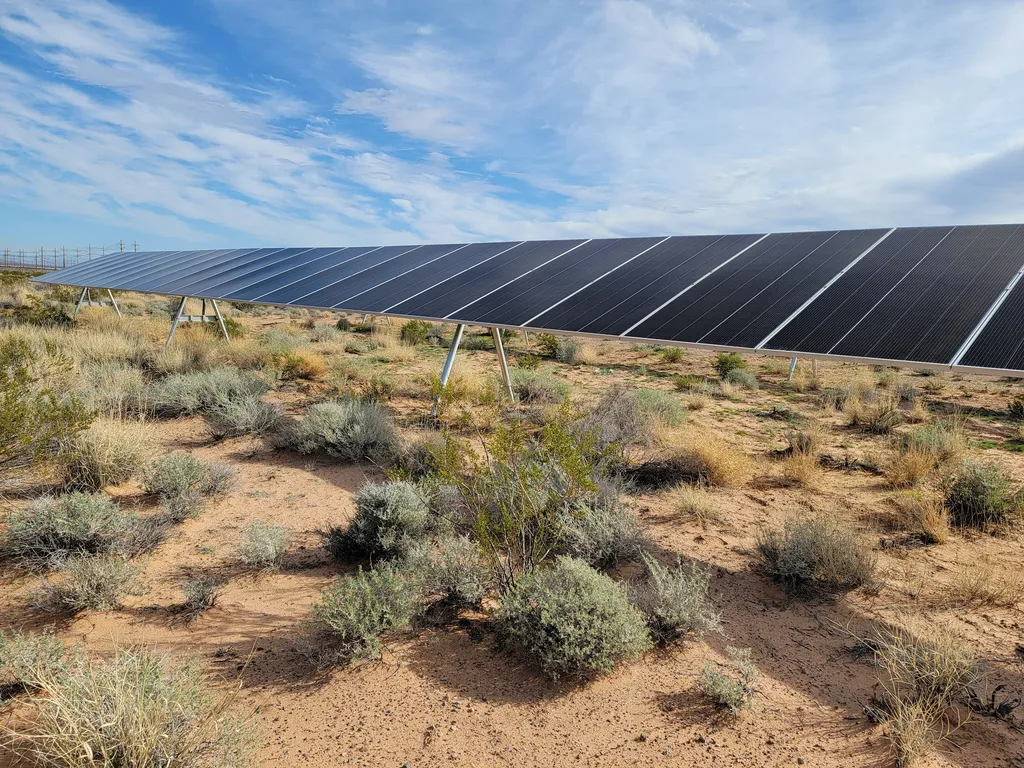
The Gemini Solar Project, located near Las Vegas, has become an unexpected haven for a rare desert plant, the threecorner milkvetch. This discovery, detailed in a new study, highlights the potential for solar farms to coexist with and even promote biodiversity in delicate ecosystems.
Traditionally, solar farm construction involves “blade and grade” methods, which clear vegetation and level the soil, disrupting the natural seed banks. However, the Gemini Solar Project adopted a more eco-friendly approach, aiming to preserve the existing ecosystem. The results were promising: before construction, scientists identified 12 threecorner milkvetch plants on the site. Post-construction, in 2024, this number surged to 93, indicating that the seeds had survived the construction process. Moreover, the plants at Gemini grew larger, produced more flowers and fruits, and thrived better than those on a nearby plot of land. This success can be attributed to the shade provided by the solar panels, which slows down soil evaporation and makes more water available for plant growth.
“This just shows the potential for a lot more plants,” said Tiffany Pereira, an ecologist at the Desert Research Institute and the lead author of the study, published late last year. “There are seedlings of so many other species coming up as well. The fact that the seed bank survived is phenomenal.”
This approach, known as ecovoltaics, focuses on constructing solar farms with native species in mind. For instance, seeding the soil with native grasses and flowers can give the ecosystem a boost, attracting pollinators, birds, and other wildlife. Lee Walston, an ecologist at Argonne National Laboratory, noted that some of these seed mixes do well at solar facilities, creating a habitat that attracts a variety of species.
In Minnesota, Walston led a study of two solar sites on converted cropland, observing a significant increase in biodiversity over five years. The number of unique flowering plant species increased sevenfold, and the abundance of insect pollinators tripled. Native bees alone increased by 20 times. A follow-on study across a dozen solar sites showed that grassland birds were also attracted to these areas, likely due to the abundance of insects. Birds could also nest among the panels, hiding from predators.
However, the success of ecovoltaics depends on various factors, including the type of plant species and the height of the solar panels. Certain plant species may need more or less shade, and taller panels can accommodate bigger plant species but come with higher costs. Additionally, conservation grazing using livestock like sheep and goats can help clear out invasive weeds, reducing the fire risk of dead plants.
“We’re trying to work with developers to say, ‘OK, well, if all you can do is 2 feet, what might be the best mix of seed mixes and management styles that could really optimize the habitat?'” Walston said.
Ecovoltaics can also return former agricultural fields to a more natural state, benefiting biodiversity, especially in prairie ecosystems that have evolved to require repeated disturbance. On the other hand, the traditional blade-and-grade approach not only disrupts the habitat but also leads to soil erosion and the invasion of opportunistic, fast-growing species that can outcompete native plants.
Beyond promoting biodiversity, solar farms can also support agriculture through a technique known as agrivoltaics. Researchers have found that crops like cucumbers grow exceptionally well on rooftops, benefiting from the unique microclimate created by the solar panels. This microclimate helps regulate temperatures and uses about one-third of the water compared to growing in full sun. Scientists are now exploring which crops, particularly high-value ones, will thrive best under solar panels, both on rooftops and on the ground.
“If you’re going to grow something, you want to grow something that a potential farmer could sell for a decent profit,” said Jennifer Bousselot, a horticulturist studying rooftop agrivoltaics at Colorado State University.
In conclusion, ecovoltaics and agrivoltaics offer a promising avenue for bolstering biodiversity and the food supply while generating clean electricity. As Pereira noted, “Rather than a moonscape of invasive species and dust blowing into cities, why not strive for something better? It’s a wild and beautiful place that we live in, and it’s our job to look out for these species as well.”
For the agriculture sector, these findings suggest new opportunities for sustainable farming practices that can coexist with renewable energy projects. Investors, too, may find value in supporting and funding such initiatives, which not only contribute to environmental conservation but also offer economic benefits through enhanced crop yields and biodiversity.