
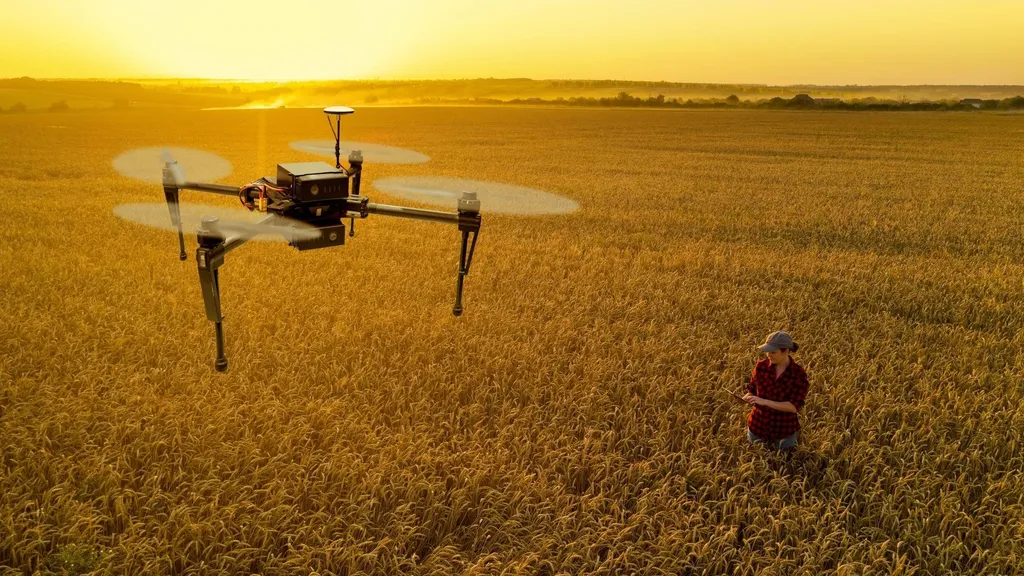
The agricultural sector is on the cusp of a technological revolution, with drones poised to play a pivotal role in transforming modern farming practices. As the global population continues to grow, the demand for improved productivity, efficient resource use, and climate resilience is driving the adoption of precision farming technologies. Among these, agricultural drones are emerging as a game-changer, offering farmers a suite of capabilities that enhance efficiency and sustainability.
Velma Wekesa, a Steward Officer under the Product Stewardship Department at AAK GROW, recently shared insights on how drone technology is revolutionizing agriculture. Drones are increasingly becoming integral to precision agriculture, which leverages various technologies to help farmers maximize yields while maintaining environmental sustainability. “Drone technology enables farmers to accurately identify pests and diseases, detect nutritional deficiencies in crops, and apply the right amounts of pest control products and fertilizers effectively and efficiently,” Wekesa explained.
One of the key advantages of drones is their ability to map fields with precision. This capability allows farmers to target specific areas that require treatment, rather than applying pesticides or fertilizers across entire fields. Traditional scouting methods often lead to blanket applications, which can be wasteful and environmentally harmful. “Through the mapping capabilities of drones, farmers do not need to spray entire sections of their farms,” Wekesa noted, highlighting the technology’s role in promoting sustainable farming practices.
Beyond pesticide spraying, drones offer a range of agricultural services. They can monitor crop health, assess nutritional needs, and scout for pests and diseases. These capabilities make drones a versatile tool for modern farmers, helping them to manage their fields more effectively and respond quickly to emerging issues.
The adoption of drone technology in agriculture is gaining momentum, particularly among large- and medium-scale farmers. In Kenya, the Sustainable Pest Management Framework (SPMF) project, supported by CropLife International, has been conducting awareness programs to highlight the benefits of drone technology, especially for smallholder farmers. “Through the support of the SPMF project, we have been conducting extensive awareness programs highlighting the advantages of drone technology, particularly targeting smallholder farmers,” Wekesa said. “Gradually, these farmers are embracing the innovation, with projections showing further scale-up in the next three to five years to come.”
One of the significant advantages of drone technology is the reduction of exposure risks for farmers. When farmers hire drone services, they are not directly involved in mixing or applying pest control products. Instead, licensed drone operators handle the entire process, ensuring that farmers do not come into direct contact with pesticides. This aspect of drone technology is particularly important for promoting safety and health in agricultural practices.
The global drone market is experiencing rapid growth, driven by expanding applications across various commercial sectors, including agriculture. According to Wekesa, the global adoption rate of drones has been steadily increasing, with projections indicating that this trend will continue. “Two to three years ago, the global adoption rate stood at 38 per cent, and by this year, this figure is expected to be much higher, reshaping farming practices worldwide,” she noted. In countries like China, drones are already being used for over 30 per cent of crop protection spraying, supported by government subsidies and favourable regulations.
For farmers interested in adopting drone technology, several steps are required. The Kenya Civil Aviation Authority (KCAA) oversees drone operations in the country, enforcing regulations that govern drone registration, licensing, flight permissions, and airspace management. Farmers must undergo a complex and lengthy process, including vetting by KCAA, approved training on drone operation, and purchasing the drone from a KCAA-approved reseller. However, Wekesa advises farmers to seek services from licensed and certified drone service providers, as this approach is easier and more cost-effective unless the farmer intends to venture into drone service provision.
AAK GROW, in partnership with key stakeholders, is conducting awareness programs to reach farmers interested in drone technology. These initiatives include field days and collaborations with Egerton University, the Pest Control Products Board (PCPB), the Ministry of Agriculture and Livestock Development, and Fahari Aviation, a licensed drone service provider. One key milestone achieved with Egerton University is the training of drone pilots. “We sponsored two individuals who were previously offering conventional spraying services. They underwent a drone piloting programme conducted in November last year,” Wekesa shared.
The “Stewardship Mashinani” initiative is another significant program aimed at promoting responsible agricultural practices by incorporating young learners. In partnership with Egerton University and selected schools through 4K Clubs, the program integrates innovation into agriculture and helps learners understand how the sector continues to evolve. This year, through a Memorandum of Understanding (MOU) with Fahari Aviation, AAK GROW plans to introduce drone technology as part of agricultural learning. In the long term, the initiative aims to influence curriculum development to integrate drone technology into agriculture as a subject.
Despite the numerous benefits of drone