
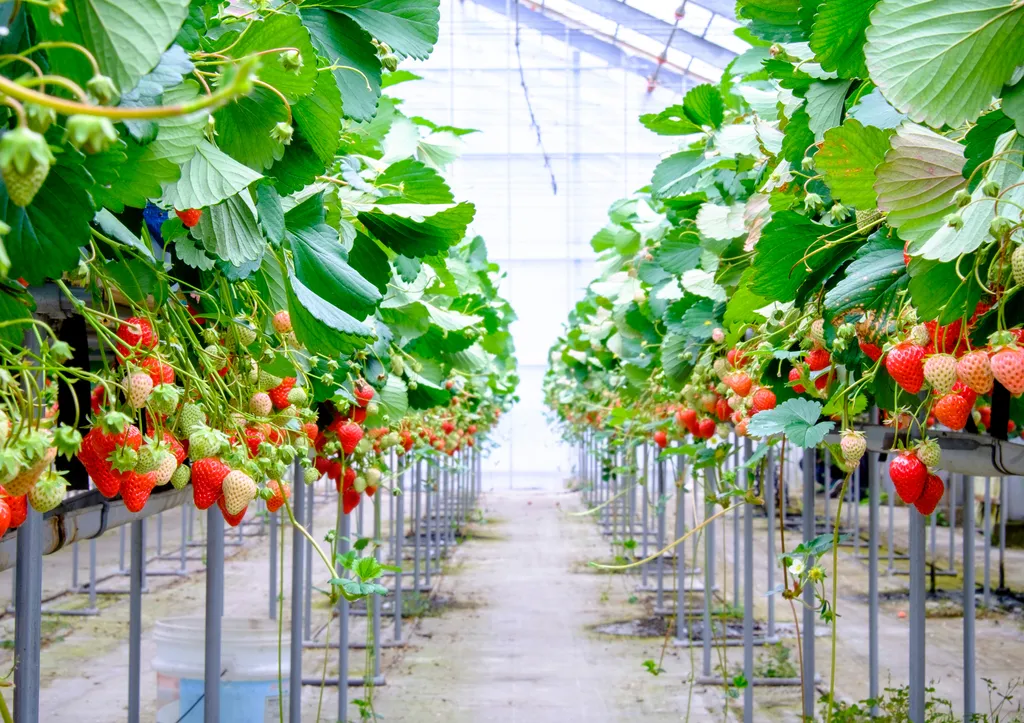
In the heart of Florida, a team of researchers is tackling a persistent challenge in strawberry production: the management of runners, or stolons, which divert plant resources and increase labor costs. Led by Md Didarul Islam from the University of Florida’s Gulf Coast Research and Education Center, the team has developed an intelligent runner detection and cutting system that could revolutionize strawberry farming.
Strawberry runners are thin, fast-growing stems that extend from the mother plant, potentially reducing yield and increasing labor demands for manual management. The team’s solution integrates deep learning and robotic actuation to automate this process, improving operational efficiency and reducing labor costs. “Our goal was to evaluate the feasibility and performance of an integrated system for automated runner management,” Islam explains. “We wanted to compare two sensing modalities—depth imaging and 3D point clouds—to optimize the cutting mechanism’s performance.”
The system uses a pre-trained YOLOv8x-seg instance segmentation model, trained on over 10,000 high-resolution field runner images. It integrates an RGB-D camera and a 4-DOF robotic arm controlled by an edge device. Lab-based experiments using greenhouse-grown potted strawberry plants demonstrated a detection precision of 67%, recall of 23%, and F1 score of 34%. While these metrics reflect challenges posed by thin and occluded runners, the system enabled successful autonomous cutting when the estimated target position was within an acceptable tolerance of ±5 mm.
The study, published in *Smart Agricultural Technology*, found that while depth imaging accelerated processing by about 7 seconds, 3D point clouds provided substantially higher accuracy in height estimation, highlighting a speed–accuracy trade-off. “This research demonstrates the feasibility of integrating deep learning, 3D perception, and robotic actuation for selective cutting tasks,” Islam notes. “It provides a framework for advancing field-deployable robotic systems for runner management in plasticulture strawberry production.”
The commercial implications of this research are significant. Automating runner management could substantially reduce labor costs and improve yield, benefiting strawberry growers worldwide. The study’s findings could also pave the way for similar applications in other crops, driving innovation in precision agriculture.
As the agriculture sector continues to embrace technological advancements, this research offers a glimpse into the future of smart farming. By integrating cutting-edge technologies, researchers are not only addressing current challenges but also shaping the future of agriculture. “This work is just the beginning,” Islam says. “We are excited about the potential for further advancements in this field.”