
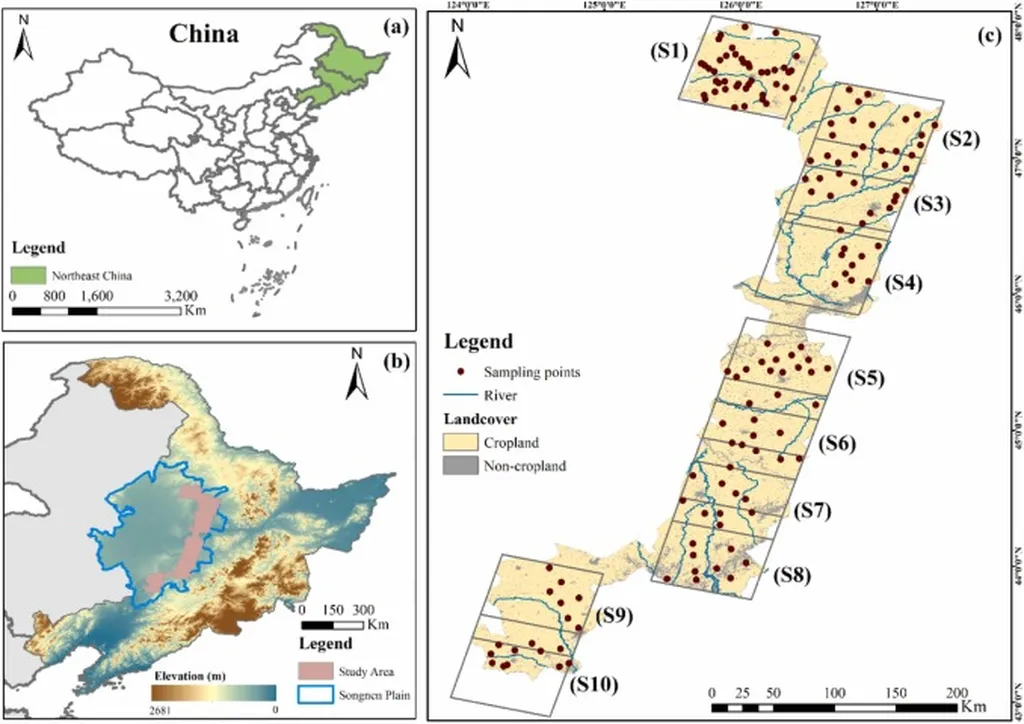
In the quest for sustainable agriculture and effective carbon management, accurate soil organic carbon (SOC) mapping has long been a critical yet challenging endeavor. A recent study published in *Scientific Reports* offers a promising breakthrough, integrating advanced machine learning techniques with satellite imagery to revolutionize SOC estimation in Northeast China’s black soil region.
The research, led by Na Chen from the College of Economics and Management at Jilin Agricultural University, addresses two persistent challenges in SOC mapping: the difficulty of obtaining true bare-soil reflectance from satellite imagery and the reliance on models that require extensive training datasets. By combining multi-temporal Sentinel-2 bare-soil composites with a transformer-based foundation model called Tabular Prior-data Fitted Network (TabPFN), the study achieves unprecedented accuracy in SOC prediction.
“Our approach leverages the strengths of both remote sensing and advanced machine learning to overcome traditional limitations,” Chen explains. “By using Sentinel-2 imagery and the TabPFN model, we can achieve high-resolution SOC mapping even with limited training data, which is a game-changer for precision agriculture and carbon accounting.”
The study compared two compositing strategies— the 50th percentile (P50) and 90th percentile (P90)—and evaluated three advanced algorithms: TabPFN, convolutional neural network (CNN), and Extreme Gradient Boosting (XGBoost). The results were striking. The TabPFN model coupled with P50 composites achieved the highest prediction accuracy, with an R² value of 0.78 and a root mean square error (RMSE) of 1.90 g kg⁻¹, outperforming CNN and XGBoost by 4–6%.
One of the standout features of TabPFN is its ability to generalize from limited samples without extensive hyperparameter tuning. This is particularly valuable in digital soil mapping, where small datasets are often the norm. “TabPFN’s design as a prior-data fitted transformer allows it to perform robustly even with small sample sizes,” Chen notes. “This addresses the ‘small data’ challenge that has long plagued the field.”
The study also employed SHapley Additive exPlanations (SHAP) analysis to interpret the model’s predictions. The findings revealed that the shortwave infrared band (B12) and precipitation had the greatest impact on model output, highlighting the joint role of soil spectral response and climate variability in SOC estimation.
The implications of this research are far-reaching for the agriculture sector. High-resolution SOC mapping enables precision agriculture, allowing farmers to optimize crop management practices, improve soil health, and enhance carbon sequestration. “This framework provides a reliable tool for high-resolution SOC mapping in heterogeneous croplands,” Chen says. “It supports precision agriculture and long-term carbon accounting initiatives, which are crucial for sustainable cropland management.”
As the agriculture industry continues to embrace digital transformation, the integration of advanced machine learning models like TabPFN with satellite imagery offers a scalable and interpretable workflow. This approach not only bridges the gap between data scarcity and model complexity but also paves the way for future developments in soil science and carbon management.
In summary, the study by Na Chen and colleagues represents a significant advancement in the field of digital soil mapping. By combining innovative machine learning techniques with satellite imagery, it offers a novel and reliable tool for high-resolution SOC mapping, supporting precision agriculture and long-term carbon accounting initiatives. As the agriculture sector continues to evolve, this research provides a foundation for future developments in sustainable cropland management and carbon sequestration monitoring.